Ch. 4 - Exponential and Logarithmic Functions
Blitzer - College Algebra 8th Edition
Blitzer8th EditionCollege AlgebraISBN: 9780136970514Not the one you use?Change textbook
Chapter 5, Problem 97

Determine whether each equation is true or false. Where possible, show work to support your conclusion. If the statement is false, make the necessary change(s) to produce a true statement. log(x + 3) - log(2x) = [log(x + 3)/log(2x)]

Verified step by step guidance
1
Recall the logarithmic property that states: \(\log a - \log b = \log \left( \frac{a}{b} \right)\), which means the difference of two logs with the same base is the log of the quotient.
Apply this property to the left side of the equation: \(\log(x + 3) - \log(2x) = \log \left( \frac{x + 3}{2x} \right)\).
Examine the right side of the equation: \(\frac{\log(x + 3)}{\log(2x)}\). This expression represents the quotient of two logarithms, which is not equivalent to the difference of the logarithms.
Since \(\log \left( \frac{x + 3}{2x} \right)\) is not equal to \(\frac{\log(x + 3)}{\log(2x)}\), the original equation is false as stated.
To make the equation true, replace the right side with \(\log \left( \frac{x + 3}{2x} \right)\), so the corrected equation is: \(\log(x + 3) - \log(2x) = \log \left( \frac{x + 3}{2x} \right)\).

Verified video answer for a similar problem:

This video solution was recommended by our tutors as helpful for the problem above.
Video duration:
1m
Was this helpful?

Key Concepts

Here are the essential concepts you must grasp in order to answer the question correctly.

Properties of Logarithms

Logarithmic properties include rules like the product, quotient, and power rules. For example, the difference of two logs with the same base, log(a) - log(b), equals log(a/b). Understanding these properties helps simplify and manipulate logarithmic expressions correctly.
Recommended video:
5:36
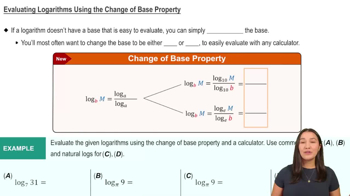
Change of Base Property

Logarithmic Equality and Expressions

An equation involving logarithms is true only if both sides represent the same value. Recognizing the difference between subtraction of logs and division of logs is crucial, as log(a) - log(b) is not the same as log(a)/log(b). This distinction is key to verifying or correcting logarithmic statements.
Recommended video:
7:30
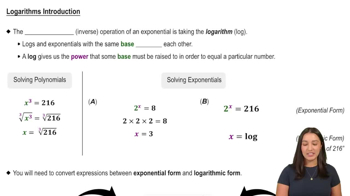
Logarithms Introduction

Domain of Logarithmic Functions

The domain of a logarithmic function includes all positive arguments since log(x) is undefined for x ≤ 0. When working with expressions like log(x + 3) and log(2x), it is essential to ensure x + 3 > 0 and 2x > 0 to maintain valid inputs and avoid extraneous solutions.
Recommended video:
5:26
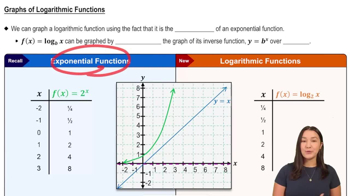
Graphs of Logarithmic Functions