Ch. 6 - Matrices and Determinants
Blitzer - College Algebra 8th Edition
Blitzer8th EditionCollege AlgebraISBN: 9780136970514Not the one you use?Change textbook
Chapter 7, Problem 41

a. Write each linear system as a matrix equation in the form AX = B. b. Solve the system using the inverse that is given for the coefficient matrix.
{wx+2y=3xy+z=4w+xy+2z=2x+y2z=4The inverse of [1120011111120112] is [0011141312120101]\(\begin{cases}\)w - x + 2y \(\quad\]\quad\) = -3 \(\quad\[\quad\) x - y + z = 4 \\-w + x - y + 2z = 2 \(\quad\]\quad\) -x + y - 2z = -4\(\end{cases}\[\text{The inverse of }\]\begin{bmatrix}\)1 & -1 & 2 & 0 \\0 & 1 & -1 & 1 \\-1 & 1 & -1 & 2 \\0 & -1 & 1 & -2\(\end{bmatrix}\[\text{ is }\]\begin{bmatrix}\)0 & 0 & -1 & -1 \\1 & 4 & 1 & 3 \\1 & 2 & 1 & 2 \\0 & -1 & 0 & -1\(\end{bmatrix}\)

Verified step by step guidance
1
Step 1: Write the system of equations in matrix form \(AX = B\), where \(A\) is the coefficient matrix, \(X\) is the column matrix of variables, and \(B\) is the constants matrix. From the system, identify \(A\), \(X\), and \(B\) as follows: \[A = \begin{bmatrix} 1 & -1 & 2 & 0 \\ 0 & 1 & -1 & 1 \\ -1 & 1 & -1 & 2 \\ 0 & -1 & 1 & -2 \end{bmatrix}, \quad X = \begin{bmatrix} w \\ x \\ y \\ z \end{bmatrix}, \quad B = \begin{bmatrix} -3 \\ 4 \\ 2 \\ -4 \end{bmatrix}\]
Step 2: Confirm that the inverse matrix \(A^{-1}\) is given as: \[A^{-1} = \begin{bmatrix} 0 & 0 & -1 & -1 \\ 1 & 4 & 1 & 3 \\ 1 & 2 & 0 & 1 \\ 0 & -1 & 0 & -2 \end{bmatrix}\]
Step 3: Use the matrix equation \(X = A^{-1}B\) to find the solution vector \(X\). This means multiplying the inverse matrix \(A^{-1}\) by the constants matrix \(B\).
Step 4: Perform the matrix multiplication by multiplying each row of \(A^{-1}\) by the column matrix \(B\) and summing the products to find each variable \(w\), \(x\), \(y\), and \(z\).
Step 5: Write the solution vector \(X\) explicitly as: \[X = \begin{bmatrix} w \\ x \\ y \\ z \end{bmatrix} = A^{-1}B\] where each element corresponds to the value of the variables in the system.

Verified video answer for a similar problem:

This video solution was recommended by our tutors as helpful for the problem above.
Video duration:
8m
Was this helpful?

Key Concepts

Here are the essential concepts you must grasp in order to answer the question correctly.

Matrix Representation of Linear Systems

A system of linear equations can be expressed as a matrix equation AX = B, where A is the coefficient matrix, X is the column matrix of variables, and B is the constants matrix. This form simplifies solving and analyzing the system using matrix operations.
Recommended video:
Guided course
4:27
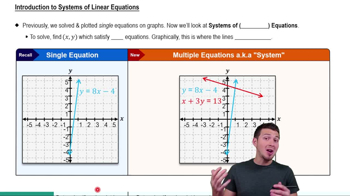
Introduction to Systems of Linear Equations

Matrix Inverse and Its Role in Solving Systems

If the coefficient matrix A is invertible, the system AX = B can be solved by multiplying both sides by A's inverse, yielding X = A⁻¹B. This method provides a direct solution when the inverse matrix is known or can be computed.
Recommended video:
Guided course
5:48
Solving Systems of Equations - Substitution

Interpreting and Using the Given Inverse Matrix

The problem provides the inverse of the coefficient matrix, which allows immediate calculation of the solution vector X by multiplying this inverse with B. Understanding how to apply the given inverse matrix is essential for efficiently solving the system.
Recommended video:
2:57
Probability of Non-Mutually Exclusive Events Example