Ch. 4 - Exponential and Logarithmic Functions
Blitzer - College Algebra 8th Edition
Blitzer8th EditionCollege AlgebraISBN: 9780136970514Not the one you use?Change textbook
Chapter 5, Problem 33

Evaluate each expression without using a calculator. log64 8

Verified step by step guidance
1
Recognize that the expression \( \log_{64} 8 \) asks for the exponent \( x \) such that \( 64^x = 8 \).
Express both 64 and 8 as powers of the same base. Since both are powers of 2, write \( 64 = 2^6 \) and \( 8 = 2^3 \).
Rewrite the equation \( 64^x = 8 \) as \( (2^6)^x = 2^3 \).
Use the power of a power property to simplify the left side: \( 2^{6x} = 2^3 \).
Since the bases are the same, set the exponents equal: \( 6x = 3 \), then solve for \( x \) by dividing both sides by 6.

Verified video answer for a similar problem:

This video solution was recommended by our tutors as helpful for the problem above.
Video duration:
1m
Was this helpful?

Key Concepts

Here are the essential concepts you must grasp in order to answer the question correctly.

Logarithm Definition

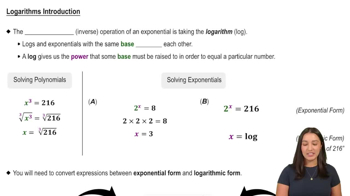
A logarithm answers the question: to what exponent must the base be raised to produce a given number? For example, log_b(a) = c means b^c = a. Understanding this definition is essential to evaluate logarithmic expressions.
Recommended video:
7:30
Logarithms Introduction

Change of Base and Prime Factorization

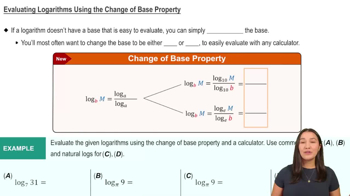
To evaluate logarithms without a calculator, express both the base and the argument as powers of the same prime number. This allows rewriting the logarithm in terms of simpler exponents, facilitating easier calculation.
Recommended video:
5:36
Change of Base Property

Properties of Logarithms

Logarithm properties, such as log_b(m^n) = n*log_b(m), help simplify expressions. Applying these rules can break down complex logarithms into manageable parts, making evaluation straightforward.
Recommended video:
5:36
Change of Base Property
Related Practice
Textbook Question

Begin by graphing f(x) = 2x. Then use transformations of this graph to graph the given function. Be sure to graph and give equations of the asymptotes. Use the graphs to determine each function's domain and range. If applicable, use a graphing utility to confirm your hand-drawn graphs. g(x) = 2.2x

755
views
Textbook Question

In Exercises 32–35, the graph of a logarithmic function is given. Select the function for each graph from the following options: f(x) = log x, g(x) = log(-x), h(x) = log(2-x), r(x)= 1+log(2-x)

1568
views
Textbook Question

Use properties of logarithms to expand each logarithmic expression as much as possible. Where possible, evaluate logarithmic expressions without using a calculator. logb(xy3z3)\(\log\)_{b}\(\left\)(\(\frac{\sqrt{x}\)y^3}{z^3}\(\right\))

794
views
Textbook Question

Begin by graphing f(x) = 2x. Then use transformations of this graph to graph the given function. Be sure to graph and give equations of the asymptotes. Use the graphs to determine each function's domain and range. If applicable, use a graphing utility to confirm your hand-drawn graphs. g(x) = −2x

823
views
Textbook Question

Solve each exponential equation in Exercises 23–48. Express the solution set in terms of natural logarithms or common logarithms. Then use a calculator to obtain a decimal approximation, correct to two decimal places, for the solution. e(1−5x)=793

724
views
Textbook Question

Solve each exponential equation in Exercises 23–48. Express the solution set in terms of natural logarithms or common logarithms. Then use a calculator to obtain a decimal approximation, correct to two decimal places, for the solution. 3e5x=1977

841
views