Ch. P - Fundamental Concepts of Algebra
Blitzer - College Algebra 8th Edition
Blitzer8th EditionCollege AlgebraISBN: 9780136970514Not the one you use?Change textbook
Chapter 1, Problem 66

Evaluate each expression in Exercises 55–66, or indicate that the root is not a real number. 1646\(\sqrt\)[6]{\(\frac{1}{64}\)}

Verified step by step guidance
1
Identify the expression to evaluate: the sixth root of \( \frac{1}{64} \), which can be written as \( \sqrt[6]{\frac{1}{64}} \).
Recall that the nth root of a number \( a \) can be expressed as \( a^{\frac{1}{n}} \). So, rewrite the expression as \( \left( \frac{1}{64} \right)^{\frac{1}{6}} \).
Express the denominator 64 as a power of a base number. Since \( 64 = 2^6 \), rewrite the expression as \( \left( \frac{1}{2^6} \right)^{\frac{1}{6}} \).
Apply the power of a power rule \( (a^m)^n = a^{m \times n} \) to simplify the expression: \( \left( 2^{-6} \right)^{\frac{1}{6}} = 2^{-6 \times \frac{1}{6}} \).
Simplify the exponent multiplication to get \( 2^{-1} \), which is the same as \( \frac{1}{2} \). This is the simplified form of the original expression.

Verified video answer for a similar problem:

This video solution was recommended by our tutors as helpful for the problem above.
Video duration:
3m
Was this helpful?

Key Concepts

Here are the essential concepts you must grasp in order to answer the question correctly.

Radical Expressions and Roots

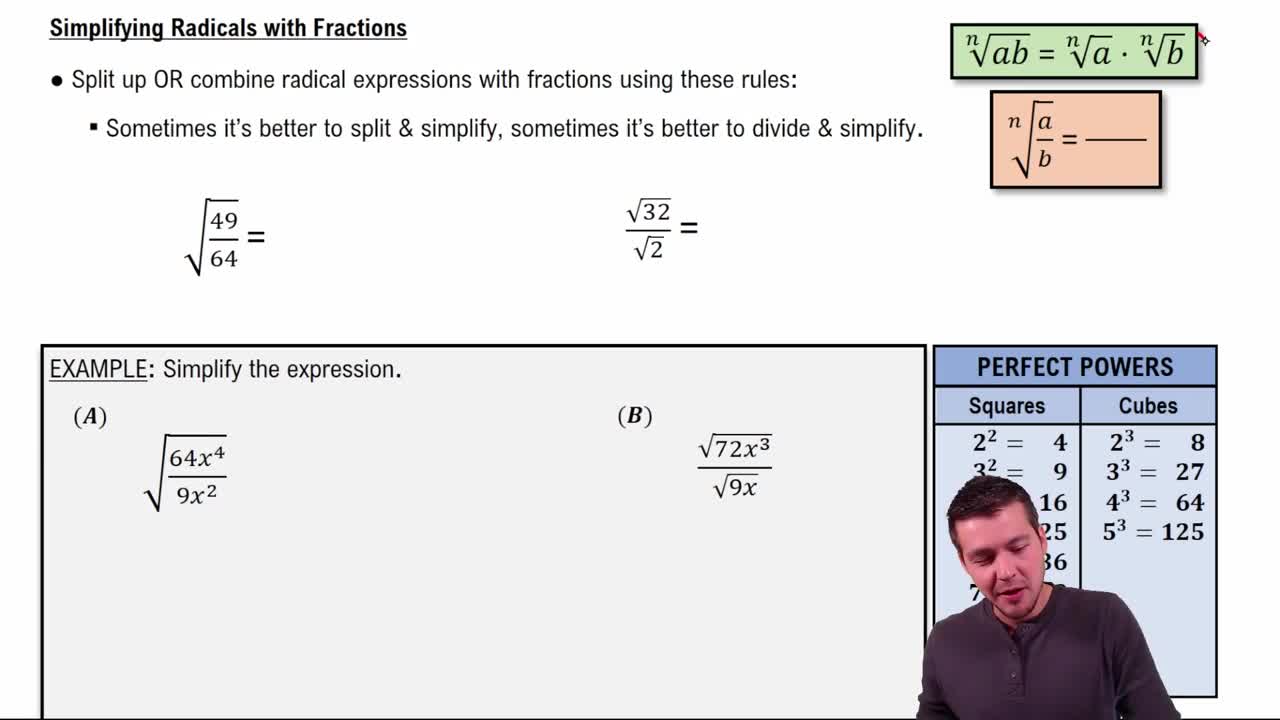
Radical expressions involve roots such as square roots, cube roots, and higher-order roots. The notation ⁿ√a represents the nth root of a number a, which is the value that, when raised to the nth power, equals a. Understanding how to interpret and simplify these roots is essential for evaluating expressions like ⁶√(1/64).
Recommended video:
Guided course
05:45
Radical Expressions with Fractions

Properties of Exponents

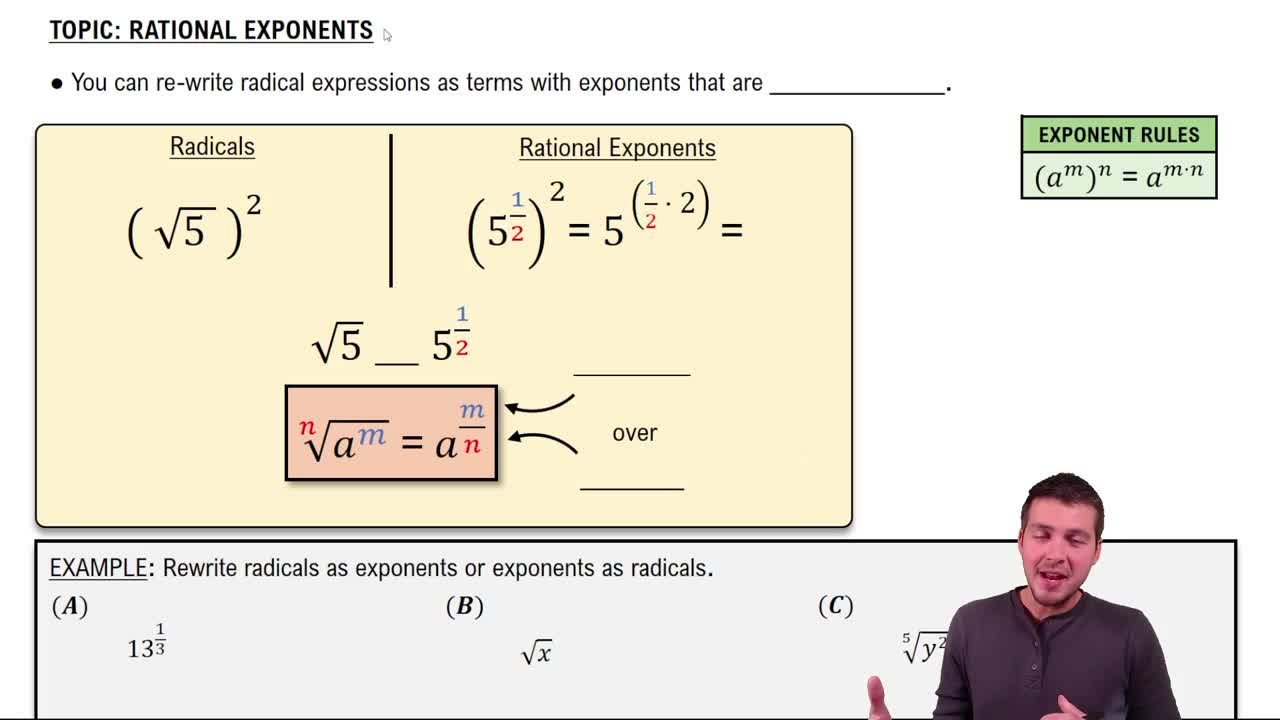
Roots can be expressed using fractional exponents, where ⁿ√a equals a^(1/n). This allows the use of exponent rules to simplify expressions. For example, ⁶√(1/64) can be rewritten as (1/64)^(1/6), facilitating easier calculation by breaking down the base and applying exponent rules.
Recommended video:
Guided course
04:06
Rational Exponents

Real vs. Non-Real Roots

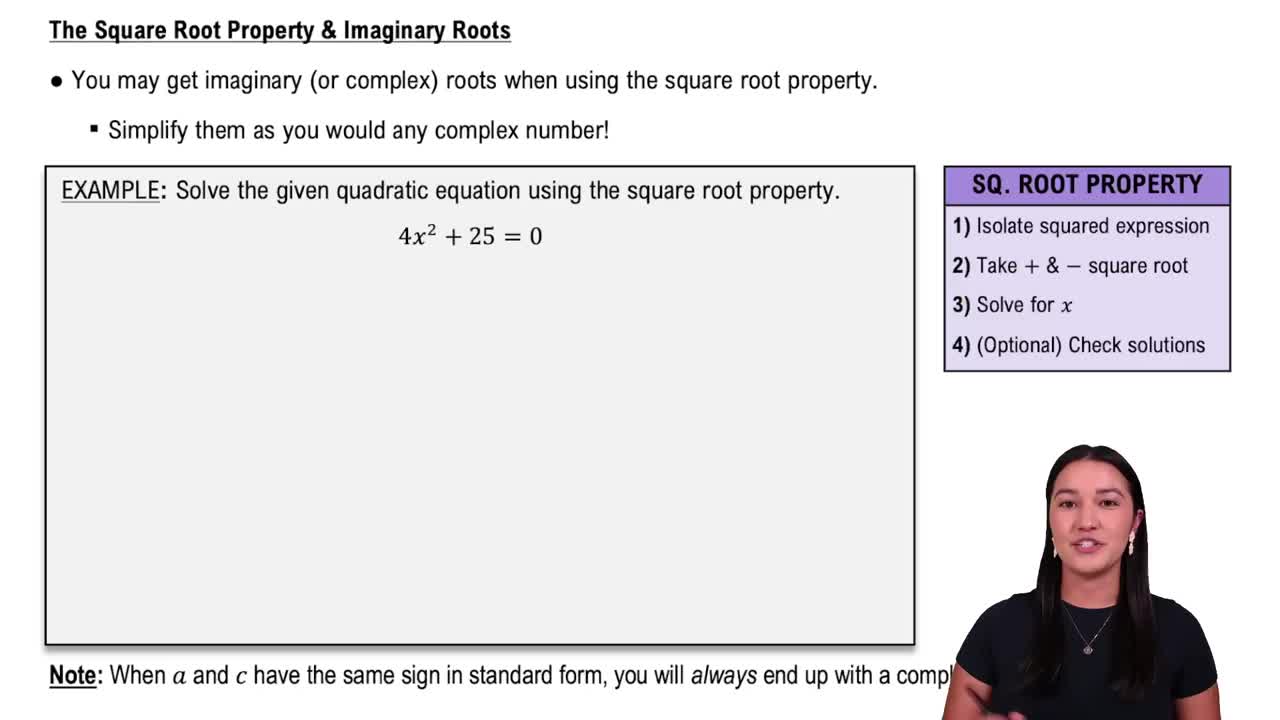
Not all roots yield real numbers; some may be complex or imaginary. For even roots, the radicand (the number inside the root) must be non-negative to have a real root. Since 1/64 is positive, its sixth root is real, but recognizing when roots are not real is important for correctly answering such questions.
Recommended video:
02:20
Imaginary Roots with the Square Root Property