Start by isolating the square root expressions on each side of the equation: \(3 - \sqrt{x} = \sqrt{2\sqrt{x} - 3}\).
To eliminate the square roots, square both sides of the equation carefully: \(\left(3 - \sqrt{x}\right)^2 = \left(\sqrt{2\sqrt{x} - 3}\right)^2\).
Expand the left side using the formula \((a - b)^2 = a^2 - 2ab + b^2\): \(9 - 6\sqrt{x} + x = 2\sqrt{x} - 3\).
Rearrange the equation to isolate the remaining square root term: \(9 + x + 3 = 2\sqrt{x} + 6\sqrt{x}\), which simplifies to \(x + 12 = 8\sqrt{x}\).
Square both sides again to remove the square root: \((x + 12)^2 = (8\sqrt{x})^2\), then expand and simplify to form a polynomial equation in terms of \(x\).
Verified video answer for a similar problem:
This video solution was recommended by our tutors as helpful for the problem above
Video duration:
8m
Play a video:
0 Comments
Key Concepts
Here are the essential concepts you must grasp in order to answer the question correctly.
Square Roots and Radicals
Square roots represent a value that, when multiplied by itself, gives the original number. Understanding how to manipulate and simplify expressions involving square roots is essential, especially when they appear nested or combined with other terms.
To solve equations with radicals, isolate the radical expression on one side and then square both sides to eliminate the square root. This process may need to be repeated if multiple radicals are present, but care must be taken to check for extraneous solutions.
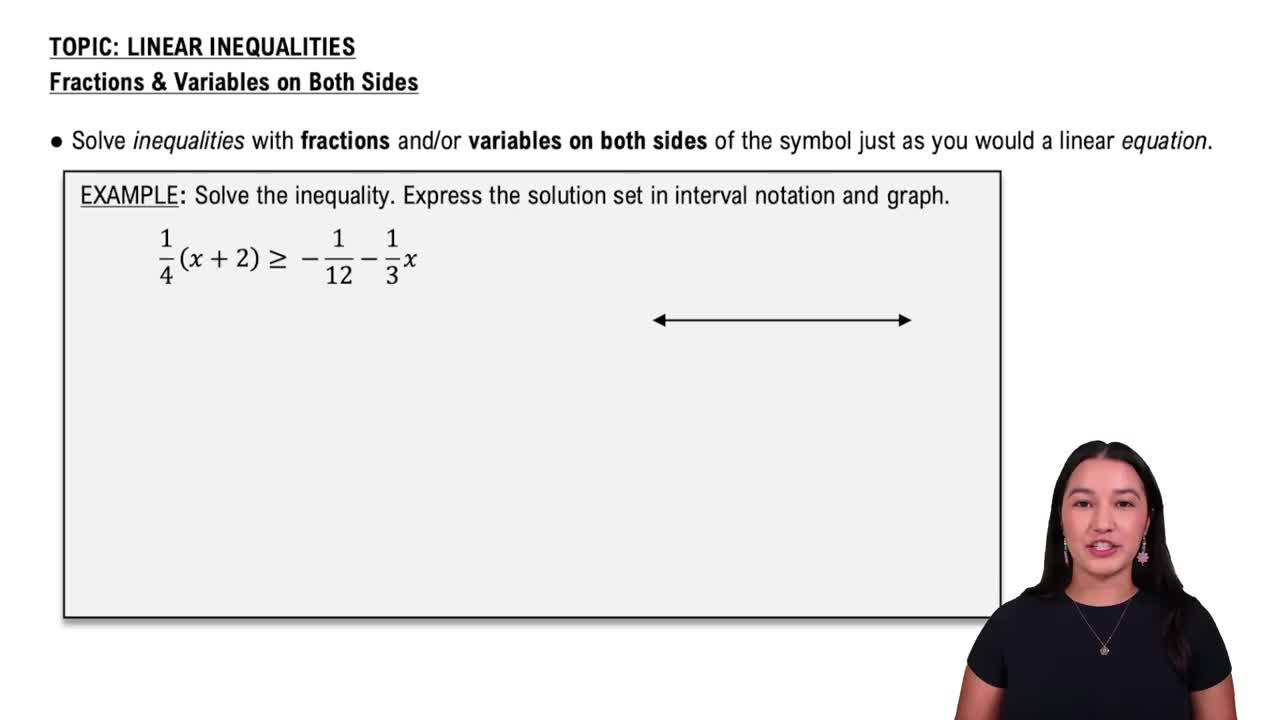
Linear Inequalities with Fractions & Variables on Both Sides
Checking for Extraneous Solutions
Squaring both sides of an equation can introduce solutions that do not satisfy the original equation. After solving, substitute the solutions back into the original equation to verify which are valid and discard any extraneous ones.

 8:05 minutes
 Verified step by step guidance
 02:20
02:20