Write a formula for the general term (the nth term) of each geometric sequence. Then use the formula for an to find a7, the seventh term of the sequence. 3, 12, 48, 192, ...
Ch. 8 - Sequences, Induction, and Probability

Chapter 9, Problem 17
Use the Binomial Theorem to expand each binomial and express the result in simplified form. (x²+2y)4
Verified step by step guidance1
Identify the binomial expression to be expanded: \((x^{2} + 2y)^4\).
Recall the Binomial Theorem formula: \(\displaystyle (a + b)^n = \sum_{k=0}^{n} \binom{n}{k} a^{n-k} b^{k}\), where \(\binom{n}{k}\) is the binomial coefficient.
Set \(a = x^{2}\), \(b = 2y\), and \(n = 4\). Write the expansion as \(\sum_{k=0}^{4} \binom{4}{k} (x^{2})^{4-k} (2y)^k\).
Calculate each term by evaluating the binomial coefficient \(\binom{4}{k}\), raising \(x^{2}\) to the power \((4-k)\), and raising \$2y\( to the power \)k\(. Remember to simplify powers: \)(x^{2})^{m} = x^{2m}\( and \)(2y)^k = 2^k y^k$.
Write out all five terms from \(k=0\) to \(k=4\), simplify each term by multiplying coefficients and combining like terms, and then sum them to express the full expanded form.

Verified video answer for a similar problem:
This video solution was recommended by our tutors as helpful for the problem above.
Video duration:
6mWas this helpful?
Key Concepts
Here are the essential concepts you must grasp in order to answer the question correctly.
Binomial Theorem
The Binomial Theorem provides a formula to expand expressions of the form (a + b)^n, where n is a non-negative integer. It uses binomial coefficients, often represented by combinations, to determine the coefficients of each term in the expansion. This theorem simplifies the process of expanding powers of binomials without direct multiplication.
Recommended video:
Guided course
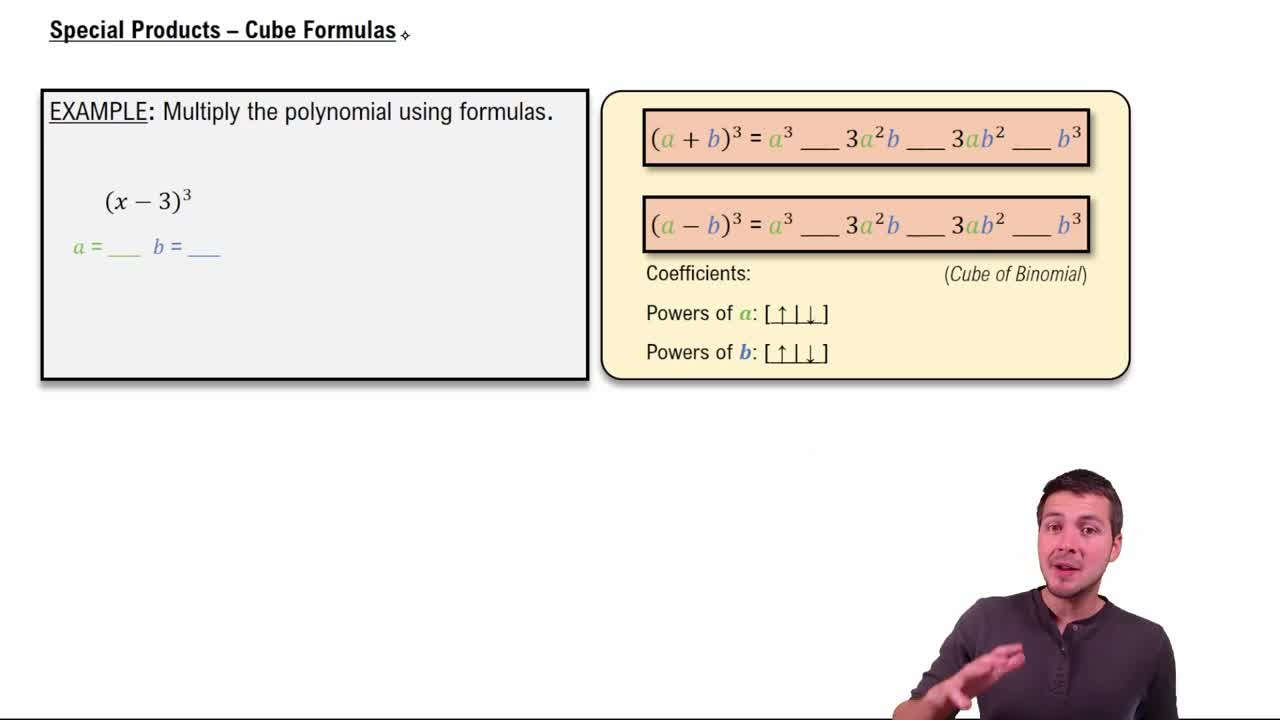
Special Products - Cube Formulas
Binomial Coefficients and Combinations
Binomial coefficients, denoted as C(n, k) or "n choose k," represent the number of ways to choose k elements from n without regard to order. These coefficients appear as the multipliers in each term of the binomial expansion and can be found using Pascal's Triangle or the formula C(n, k) = n! / (k!(n-k)!).
Recommended video:
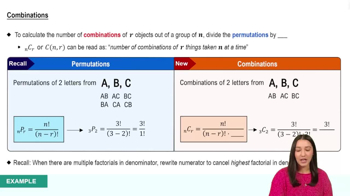
Combinations
Simplifying Algebraic Expressions
After applying the Binomial Theorem, each term in the expansion may involve powers of variables and constants. Simplifying involves combining like terms, applying exponent rules (such as (x^a)^b = x^(ab)), and reducing coefficients to express the final expanded form clearly and concisely.
Recommended video:
Guided course
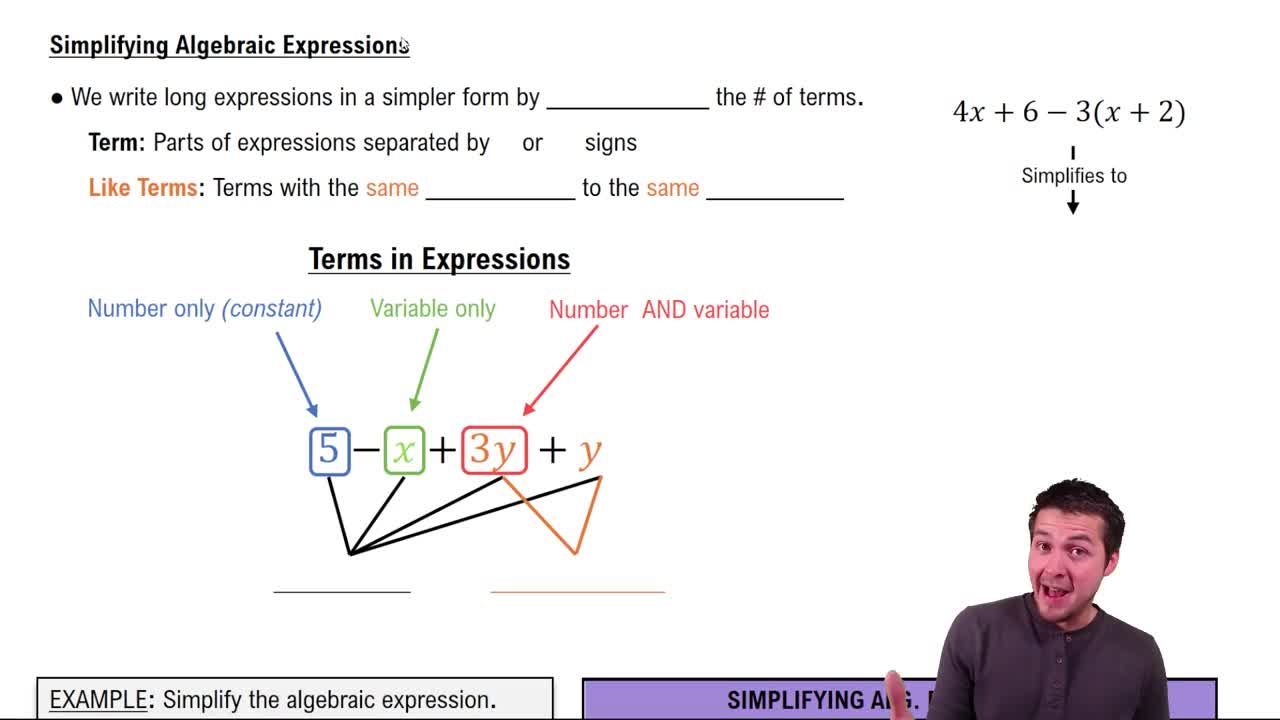
Simplifying Algebraic Expressions
Related Practice
Textbook Question
1226
views
Textbook Question
You are dealt one card from a standard 52-card deck. Find the probability of being dealt a queen.
623
views
Textbook Question
Find the indicated term of the arithmetic sequence with first term, and common difference, d. Find a50 when a1 = 7, d = 5.
932
views
Textbook Question
Use mathematical induction to prove that each statement is true for every positive integer n. 1 + 2 + 22 + ... + 2n-1 = 2n - 1
705
views
Textbook Question
The sequences in Exercises 13–18 are defined using recursion formulas. Write the first four terms of each sequence. a1=4 and an=2an-1 + 3 for n≥2
1001
views
Textbook Question
Use the Binomial Theorem to expand each binomial and express the result in simplified form. (y-3)4
644
views