In Exercises 15–18, use the Leading Coefficient Test to determine the end behavior of the graph of the given polynomial function. Then use this end behavior to match the polynomial function with its graph. [The graphs are labeled (a) through (d).] <IMAGE>

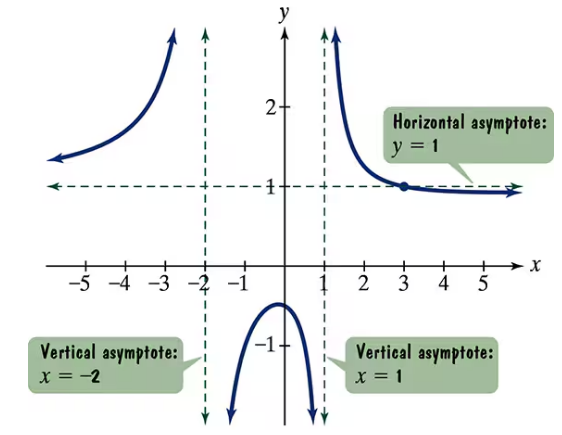
Use the graph of the rational function in the figure shown to complete each statement in Exercises 15–20.

As __
Verified step by step guidance
Verified video answer for a similar problem:
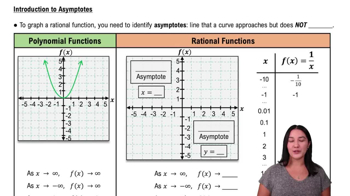
Key Concepts
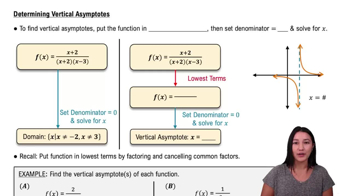
Vertical Asymptotes
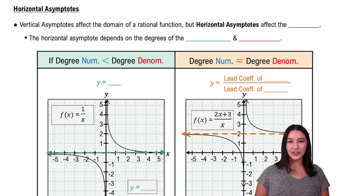
Horizontal Asymptotes
Limit Behavior Near Asymptotes
Use the vertex and intercepts to sketch the graph of each quadratic function. Give the equation of the parabola's axis of symmetry. Use the graph to determine the function's domain and range. f(x)=(x−4)2−1
In Exercises 17–24, a) List all possible rational roots. b) List all possible rational roots. c) Use the quotient from part (b) to find the remaining roots and solve the equation. x3−2x2−11x+12=0
Find the zeros for each polynomial function and give the multiplicity of each zero. State whether the graph crosses the x-axis, or touches the x-axis and turns around, at each zero.
Write an equation that expresses each relationship. Then solve the equation for y. x varies jointly as z and the sum of y and w.
Divide using synthetic division. (2x2+x−10)÷(x−2)
