Ch. 3 - Polynomial and Rational Functions
Blitzer - College Algebra 8th Edition
Blitzer8th EditionCollege AlgebraISBN: 9780136970514Not the one you use?Change textbook
Chapter 4, Problem 1

Use the Rational Zero Theorem to list all possible rational zeros for each given function. f(x)=x3+x2−4x−4

Verified step by step guidance
1
Identify the polynomial function: \(f(x) = x^{3} + x^{2} - 4x - 4\).
List the constant term and the leading coefficient: The constant term is \(-4\), and the leading coefficient is \(1\).
Find all factors of the constant term \(-4\): These are \(\pm 1, \pm 2, \pm 4\).
Find all factors of the leading coefficient \(1\): These are \(\pm 1\).
Use the Rational Zero Theorem to form all possible rational zeros by taking each factor of the constant term over each factor of the leading coefficient, resulting in \(\pm 1, \pm 2, \pm 4\).

Verified video answer for a similar problem:

This video solution was recommended by our tutors as helpful for the problem above.
Video duration:
1m
Was this helpful?

Key Concepts

Here are the essential concepts you must grasp in order to answer the question correctly.

Rational Zero Theorem

The Rational Zero Theorem provides a list of all possible rational zeros of a polynomial function. It states that any rational zero, expressed as a fraction p/q in lowest terms, must have p as a factor of the constant term and q as a factor of the leading coefficient.
Recommended video:
Guided course
02:58
Rationalizing Denominators

Factors of Integers

To apply the Rational Zero Theorem, you must find all factors of the constant term and the leading coefficient. Factors are integers that divide the number without leaving a remainder, and these factors help generate possible rational zeros by forming fractions p/q.
Recommended video:
Guided course
04:36
Factor by Grouping

Polynomial Functions and Degree

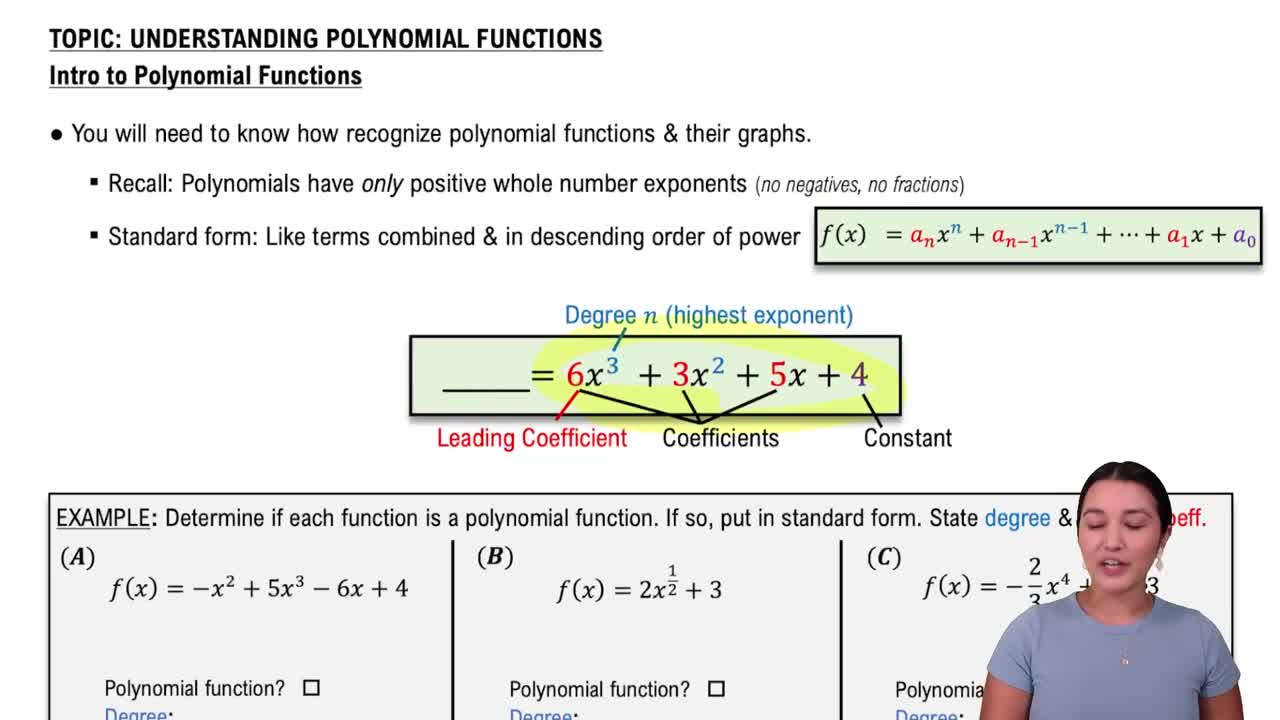
Understanding the structure of polynomial functions, including the degree and coefficients, is essential. The degree indicates the highest power of x, which affects the number of possible zeros, while coefficients determine the factors used in the Rational Zero Theorem.
Recommended video:
06:04
Introduction to Polynomial Functions