Ch. 3 - Polynomial and Rational Functions
Blitzer - College Algebra 8th Edition
Blitzer8th EditionCollege AlgebraISBN: 9780136970514Not the one you use?Change textbook
Chapter 4, Problem 27

Solve each polynomial inequality in Exercises 1–42 and graph the solution set on a real number line. Express each solution set in interval notation. 9x2−6x+1<0

Verified step by step guidance
1
Start by identifying the polynomial inequality: \$9x^2 - 6x + 1 < 0$.
Recognize that this is a quadratic inequality. To solve it, first find the roots of the corresponding quadratic equation \$9x^2 - 6x + 1 = 0\( by using the quadratic formula: \(x = \frac{-b \pm \sqrt{b^2 - 4ac}}{2a}\), where \)a=9\(, \)b=-6\(, and \)c=1$.
Calculate the discriminant \(\Delta = b^2 - 4ac\) to determine the nature of the roots. This will help you understand if the quadratic crosses the x-axis or not.
Use the roots (if any) to divide the real number line into intervals. Test a value from each interval in the original inequality \$9x^2 - 6x + 1 < 0$ to determine where the inequality holds true.
Express the solution set as an interval or union of intervals based on the test results, and then graph this solution set on the real number line.

Verified video answer for a similar problem:

This video solution was recommended by our tutors as helpful for the problem above.
Video duration:
6m
Was this helpful?

Key Concepts

Here are the essential concepts you must grasp in order to answer the question correctly.

Polynomial Inequalities

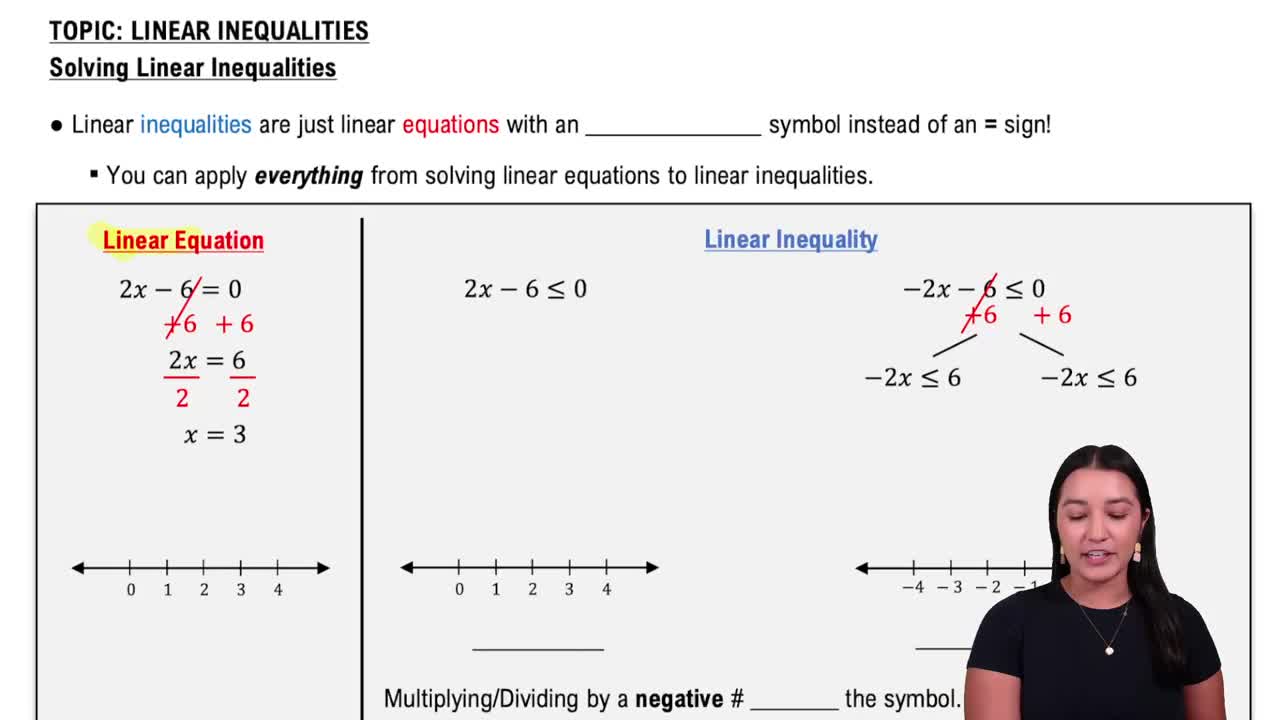
Polynomial inequalities involve expressions where a polynomial is compared to zero or another value using inequality symbols like <, >, ≤, or ≥. Solving them requires finding the values of the variable that make the inequality true, often by analyzing the sign of the polynomial over different intervals.
Recommended video:
06:07
Linear Inequalities

Factoring and Quadratic Formula

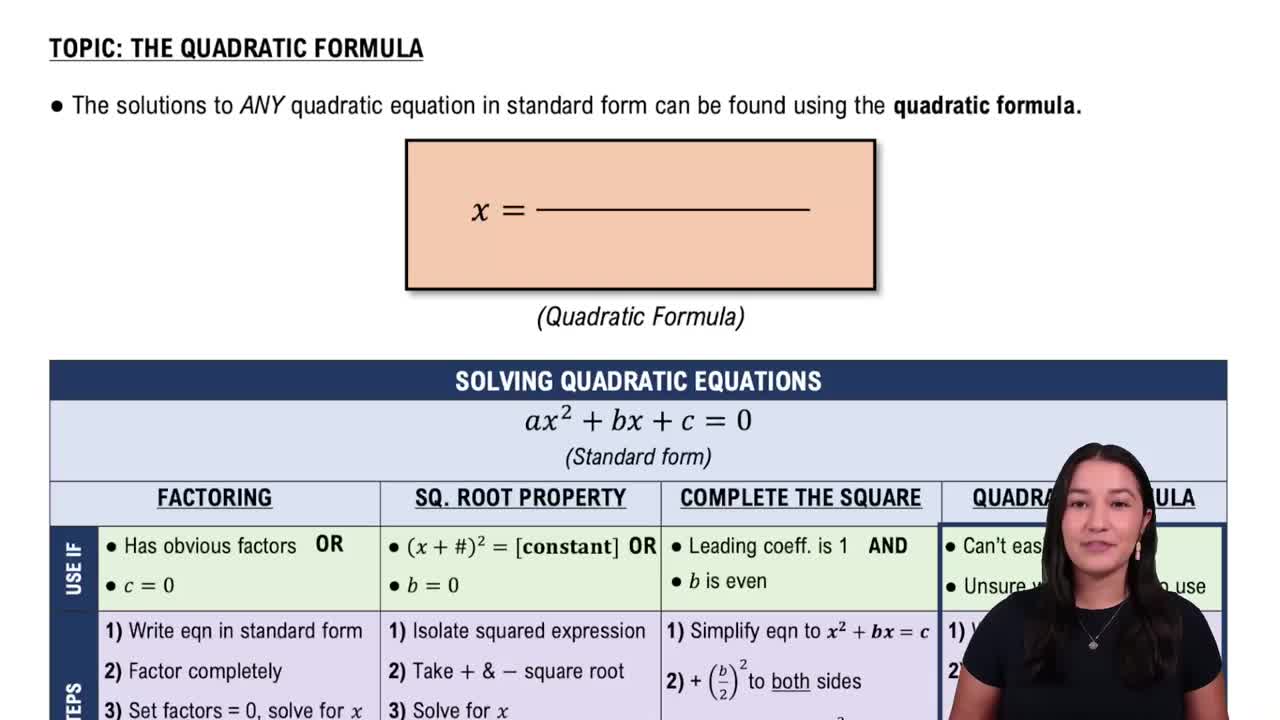
To solve polynomial inequalities, especially quadratics, you often need to find the roots by factoring or using the quadratic formula. These roots divide the number line into intervals where the polynomial's sign can be tested to determine where the inequality holds.
Recommended video:
06:36
Solving Quadratic Equations Using The Quadratic Formula

Interval Notation and Graphing on a Number Line

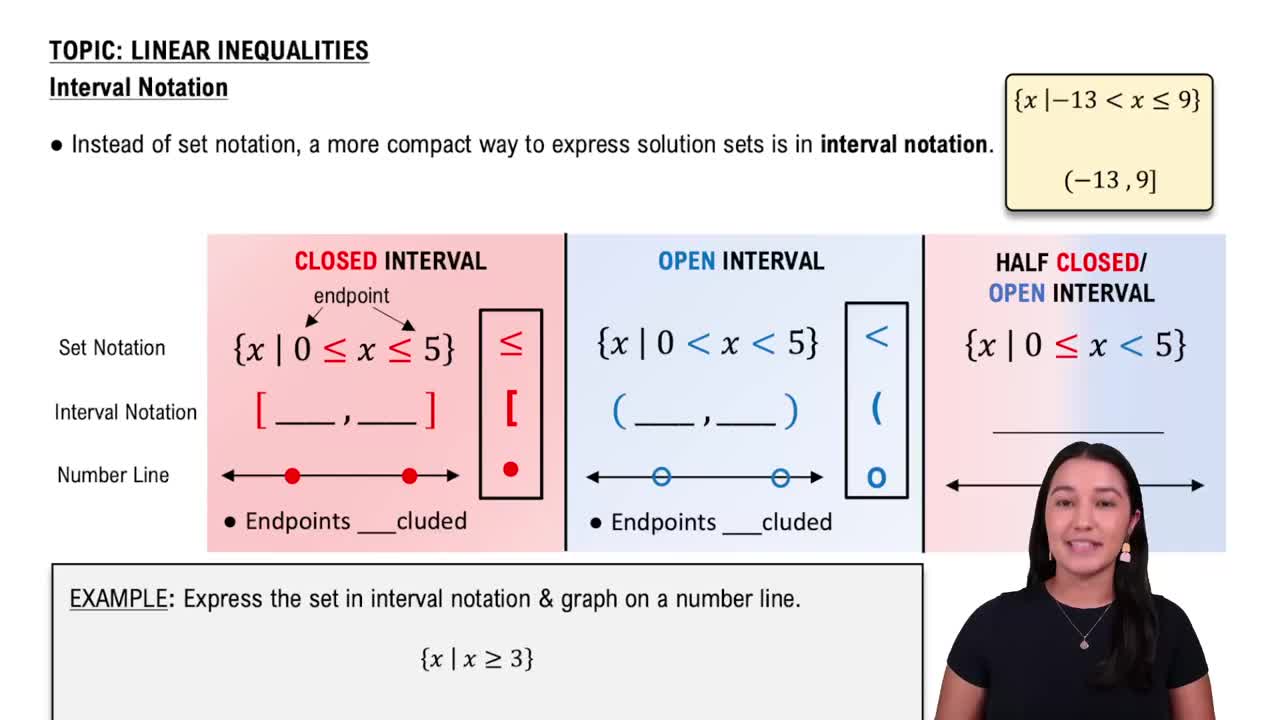
After determining the solution intervals, expressing them in interval notation provides a concise way to represent all values satisfying the inequality. Graphing these intervals on a real number line visually shows the solution set, indicating whether endpoints are included or excluded.
Recommended video:
05:18
Interval Notation