Ch. 1 - Equations and Inequalities
Blitzer - College Algebra 8th Edition
Blitzer8th EditionCollege AlgebraISBN: 9780136970514Not the one you use?Change textbook
Chapter 2, Problem 55

In Exercises 48–57, perform the indicated operations and write the result in standard form. √ (-32) - √ (-18)

Verified step by step guidance
1
Recognize that the square root of a negative number involves imaginary numbers. Recall that √(-a) = i√(a), where 'i' is the imaginary unit (i.e., i² = -1).
Rewrite each square root in terms of 'i': √(-32) = i√(32) and √(-18) = i√(18).
Simplify the square roots of the positive numbers under the radicals. For example, √(32) can be simplified as √(16 × 2) = √(16)√(2) = 4√(2). Similarly, √(18) can be simplified as √(9 × 2) = √(9)√(2) = 3√(2).
Substitute the simplified forms back into the expression: i√(32) - i√(18) becomes 4i√(2) - 3i√(2).
Combine like terms (terms with 'i√(2)') to simplify the expression further: (4i√(2) - 3i√(2)) = (4 - 3)i√(2).

Verified video answer for a similar problem:

This video solution was recommended by our tutors as helpful for the problem above.
Video duration:
4m
Was this helpful?

Key Concepts

Here are the essential concepts you must grasp in order to answer the question correctly.

Complex Numbers

Complex numbers are numbers that have a real part and an imaginary part, expressed in the form a + bi, where 'a' is the real part and 'b' is the coefficient of the imaginary unit 'i', which is defined as the square root of -1. Understanding complex numbers is essential for performing operations involving square roots of negative numbers, as they allow us to express these roots in a meaningful way.
Recommended video:
04:22
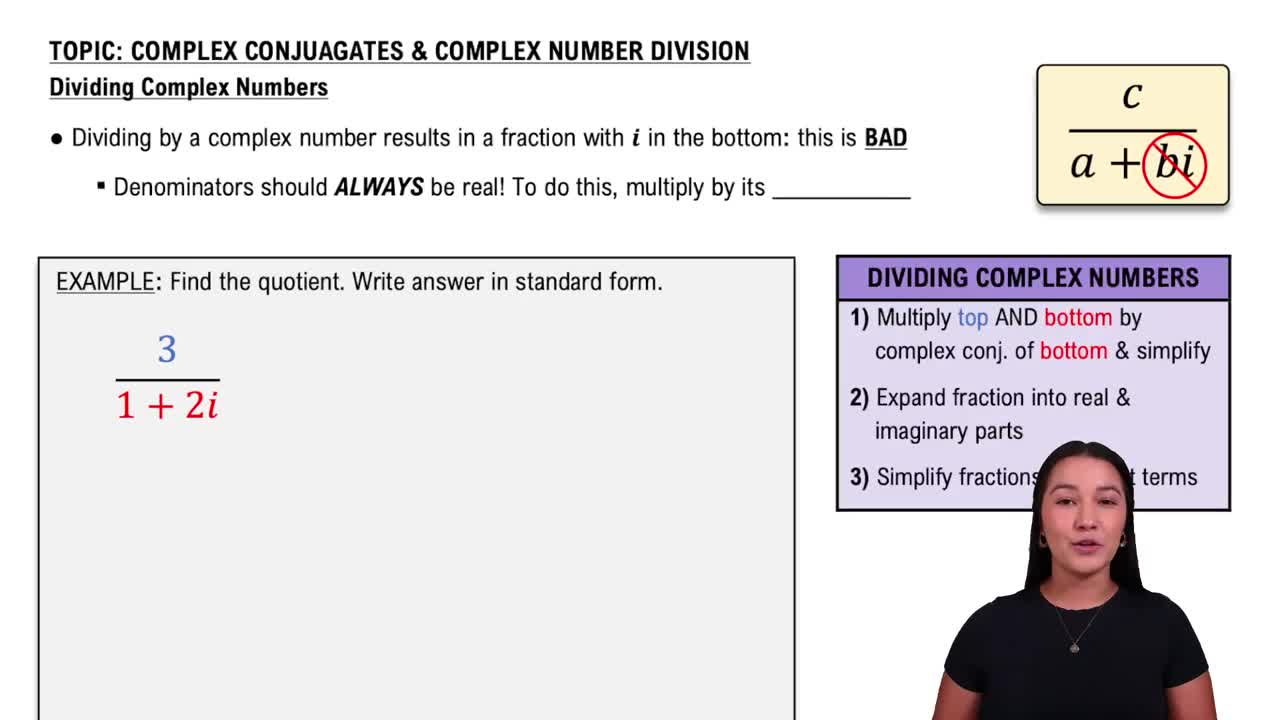
Dividing Complex Numbers

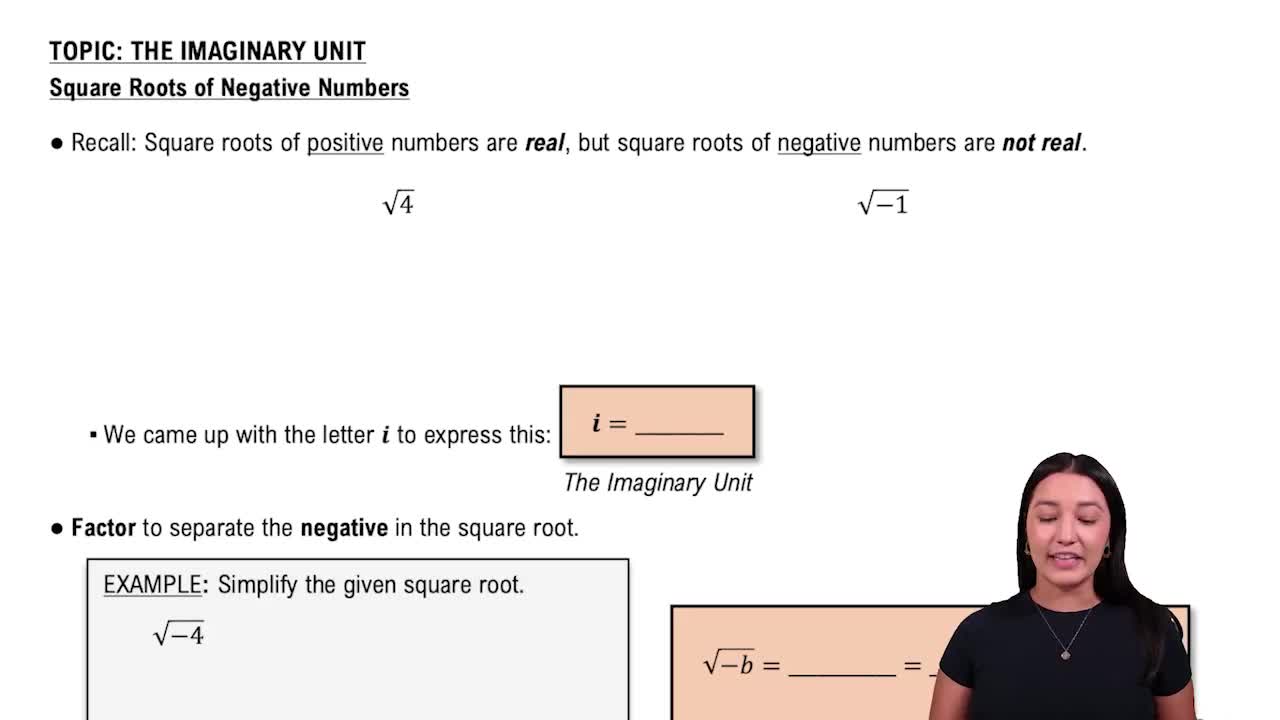
Square Roots of Negative Numbers

The square root of a negative number is not defined within the set of real numbers, but it can be expressed using imaginary numbers. For example, √(-n) can be rewritten as i√n, where 'i' is the imaginary unit. This concept is crucial for solving problems that involve square roots of negative values, as seen in the given expression.
Recommended video:
05:02
Square Roots of Negative Numbers

Standard Form of Complex Numbers

The standard form of a complex number is typically written as a + bi, where 'a' and 'b' are real numbers. When performing operations with complex numbers, such as addition or subtraction, it is important to combine like terms (real with real and imaginary with imaginary) to express the result in this standard form. This ensures clarity and consistency in mathematical communication.
Recommended video:
05:02
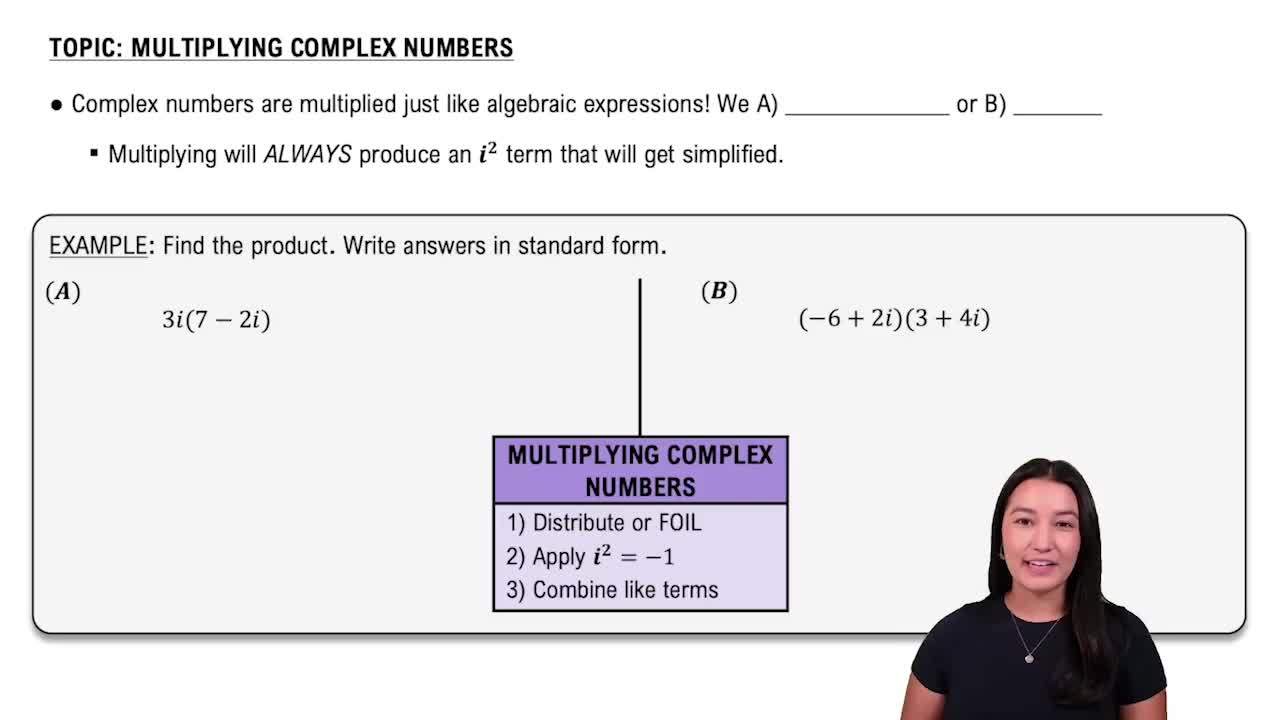
Multiplying Complex Numbers