Ch. 8 - Sequences, Induction, and Probability
Blitzer - College Algebra 8th Edition
Blitzer8th EditionCollege AlgebraISBN: 9780136970514Not the one you use?Change textbook
Chapter 9, Problem 35

Write the first three terms in each binomial expansion, expressing the result in simplified form. (x2 + 1)16

Verified step by step guidance
1
Identify the binomial expression and the exponent: here, the binomial is \((x^{2} + 1)\) and the exponent is \(16\).
Recall the Binomial Theorem formula for expansion: \(\displaystyle (a + b)^n = \sum_{k=0}^n \binom{n}{k} a^{n-k} b^k\), where \(\binom{n}{k}\) is the binomial coefficient.
Write the first three terms by substituting \(k = 0, 1, 2\) into the formula: - For \(k=0\): \(\binom{16}{0} (x^{2})^{16} (1)^0\), - For \(k=1\): \(\binom{16}{1} (x^{2})^{15} (1)^1\), - For \(k=2\): \(\binom{16}{2} (x^{2})^{14} (1)^2\).
Simplify the powers of \(x\): - \((x^{2})^{16} = x^{32}\), - \((x^{2})^{15} = x^{30}\), - \((x^{2})^{14} = x^{28}\).
Express each term fully with coefficients and powers of \(x\): - \(\binom{16}{0} x^{32}\), - \(\binom{16}{1} x^{30}\), - \(\binom{16}{2} x^{28}\), and simplify the binomial coefficients.

Verified video answer for a similar problem:

This video solution was recommended by our tutors as helpful for the problem above.
Video duration:
7m
Was this helpful?

Key Concepts

Here are the essential concepts you must grasp in order to answer the question correctly.

Binomial Theorem

The Binomial Theorem provides a formula to expand expressions of the form (a + b)^n into a sum involving terms with coefficients, powers of a, and powers of b. Each term is given by the binomial coefficient multiplied by a^(n-k) and b^k, where k ranges from 0 to n.
Recommended video:
Guided course
03:41
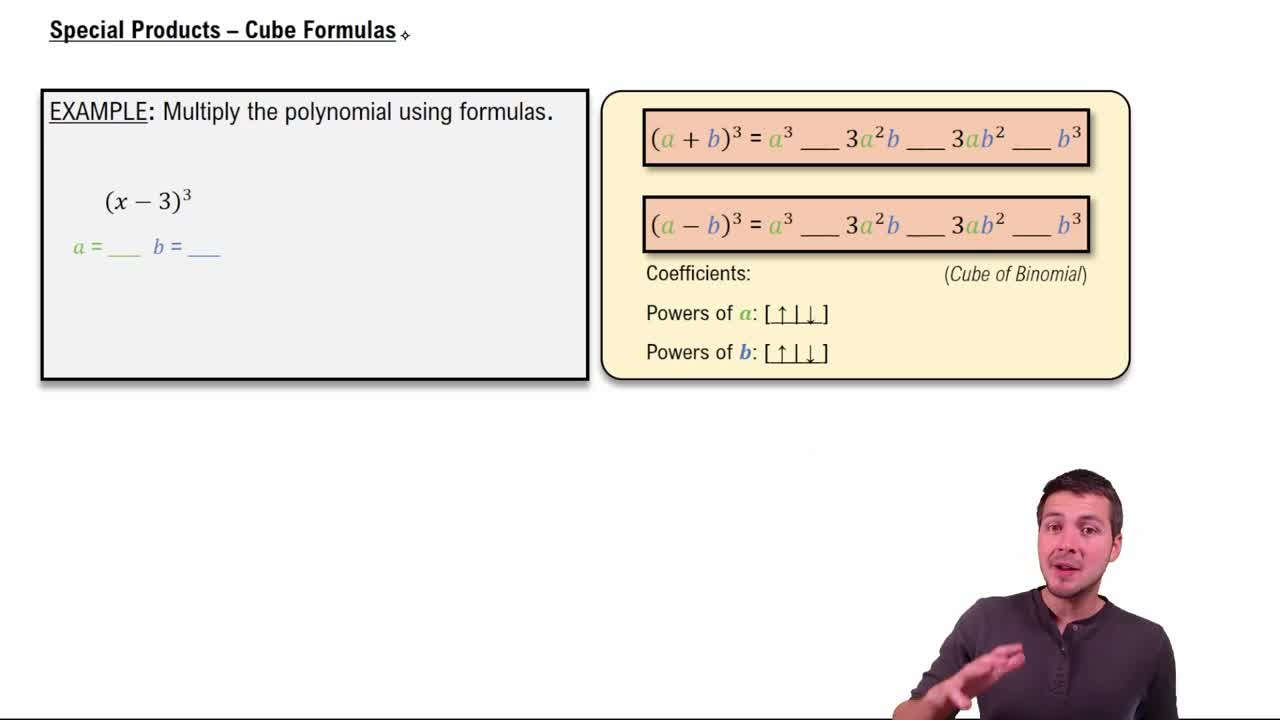
Special Products - Cube Formulas

Binomial Coefficients

Binomial coefficients, denoted as C(n, k) or "n choose k," represent the number of ways to choose k elements from n and serve as the coefficients in the binomial expansion. They can be calculated using factorials or found in Pascal's Triangle.
Recommended video:
Guided course
03:41
Special Products - Cube Formulas

Simplifying Powers and Terms

After applying the binomial theorem, each term involves powers of the binomial components. Simplifying these powers, such as (x^2)^(n-k) = x^{2(n-k)}, and combining like terms ensures the expression is in its simplest form for clarity and further use.
Recommended video:
04:10
Powers of i