Factor each polynomial. See Examples 5 and 6. 25s4-9t2
Verified step by step guidance
1
Recognize that the polynomial \$25s^4 - 9t^2\( is a difference of squares because it can be written as \)(5s^2)^2 - (3t)^2$.
Recall the difference of squares formula: \(a^2 - b^2 = (a - b)(a + b)\), where \(a = 5s^2\) and \(b = 3t\) in this case.
Apply the difference of squares formula to factor the polynomial as \((5s^2 - 3t)(5s^2 + 3t)\).
Check each factor to see if it can be factored further. Notice that \$5s^2 - 3t\( and \)5s^2 + 3t$ are not difference or sum of squares and cannot be factored further over the real numbers.
Write the final factored form as \((5s^2 - 3t)(5s^2 + 3t)\).
Verified video answer for a similar problem:
This video solution was recommended by our tutors as helpful for the problem above
Video duration:
3m
Play a video:
0 Comments
Key Concepts
Here are the essential concepts you must grasp in order to answer the question correctly.
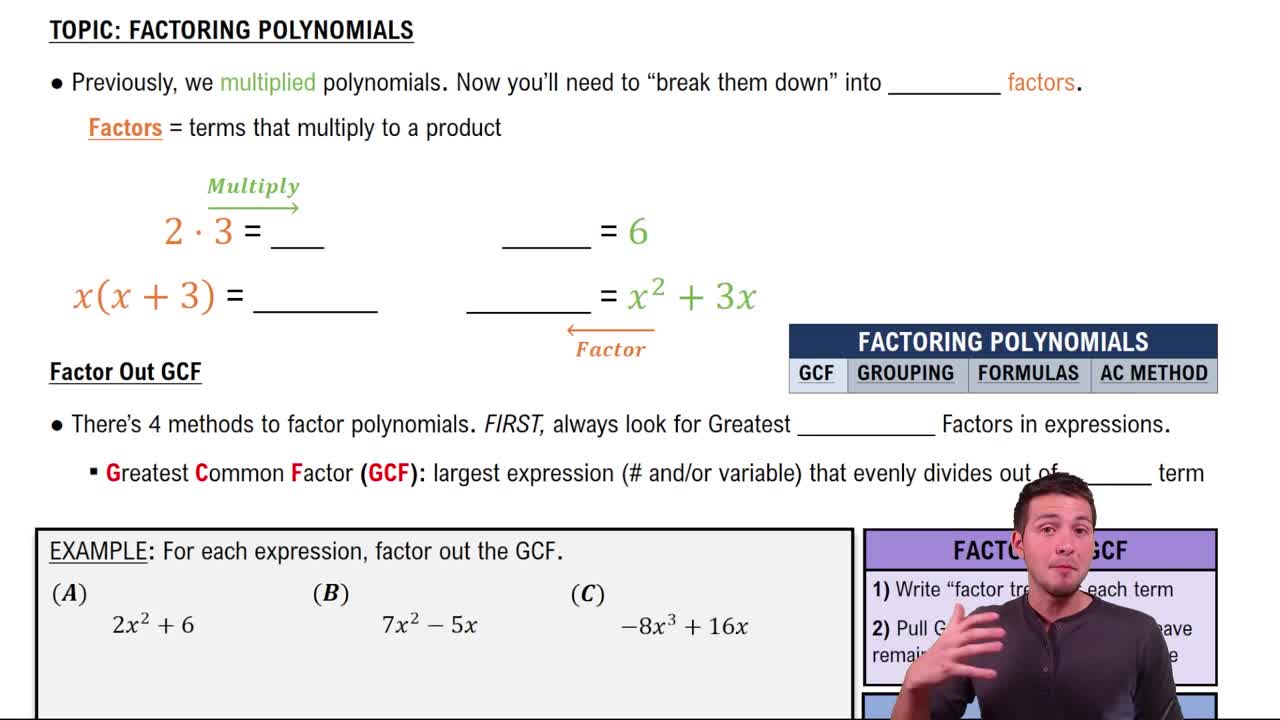
Difference of Squares
The difference of squares is a factoring technique used when an expression is in the form a² - b². It factors into (a - b)(a + b). Recognizing this pattern helps simplify polynomials like 25s⁴ - 9t² by identifying perfect squares.
Solving Quadratic Equations by Completing the Square
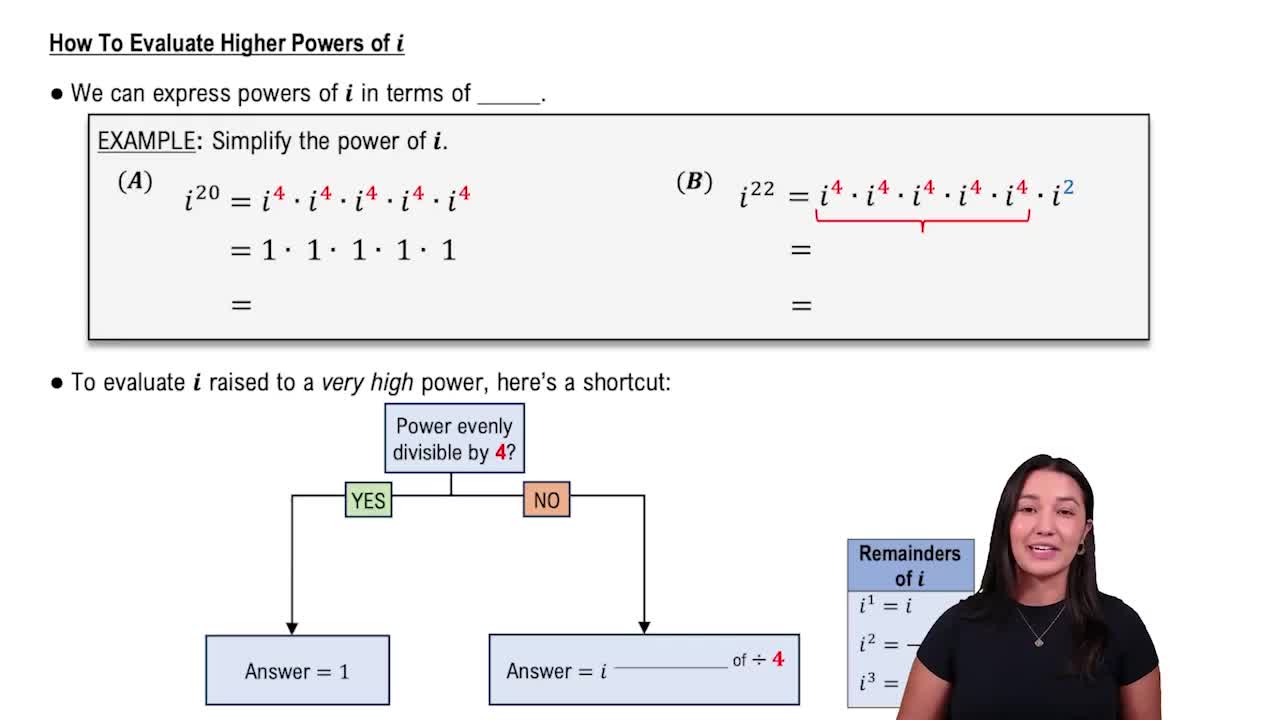
Factoring Higher Powers
When variables are raised to powers greater than 2, such as s⁴, it can be helpful to rewrite them as powers squared (e.g., s⁴ = (s²)²). This allows the use of difference of squares or other factoring methods on more complex terms.
Breaking down numerical coefficients into their prime factors helps identify perfect squares and simplifies the factoring process. For example, 25 is 5² and 9 is 3², which aids in recognizing the difference of squares structure.

 3:09 minutes
 Verified step by step guidance
 06:24
06:24