Ch. P - Fundamental Concepts of Algebra
Blitzer - College Algebra 8th Edition
Blitzer8th EditionCollege AlgebraISBN: 9780136970514Not the one you use?Change textbook
Chapter 1, Problem 43

Determine whether each statement is true or false. -13 ≤ -2

Verified step by step guidance
1
Identify the inequality given: \(-13 \leq -2\).
Recall that the symbol \(\leq\) means "less than or equal to." So the statement says "-13 is less than or equal to -2."
Compare the two numbers on the number line: -13 is to the left of -2, which means -13 is indeed less than -2.
Since -13 is less than -2, the inequality \(-13 \leq -2\) is true.
Therefore, the statement is true because the inequality holds as written.

Verified video answer for a similar problem:

This video solution was recommended by our tutors as helpful for the problem above.
Video duration:
1m
Was this helpful?

Key Concepts

Here are the essential concepts you must grasp in order to answer the question correctly.

Inequality Symbols and Their Meaning

Inequality symbols like ≤ (less than or equal to) compare two values to show their relative size. The symbol ≤ means the value on the left is either less than or exactly equal to the value on the right.
Recommended video:
06:07
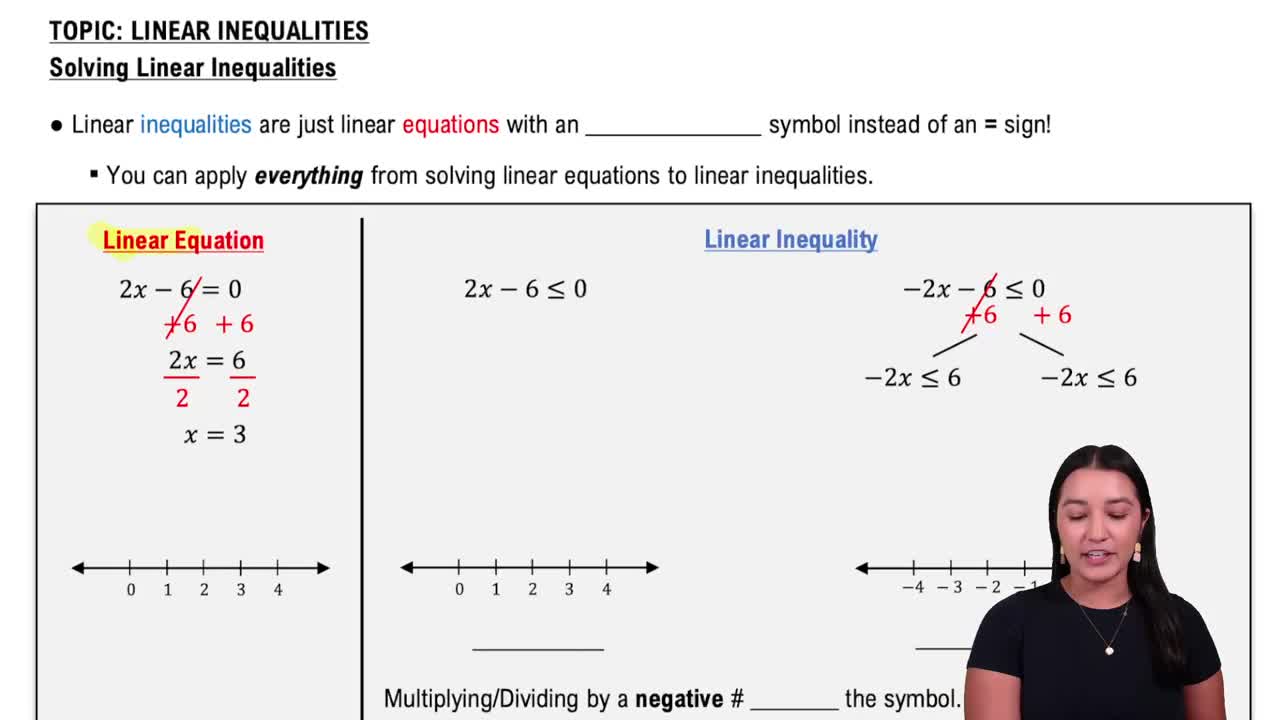
Linear Inequalities

Number Line and Ordering of Integers

Integers are ordered on a number line from left (smaller) to right (larger). Understanding that -13 is to the left of -2 helps determine that -13 is less than -2, which is essential for evaluating inequalities.
Recommended video:
Guided course
06:49
The Slope of a Line

Evaluating True or False Statements in Inequalities

To determine if an inequality is true or false, substitute the values and check if the relationship holds. For example, check if -13 ≤ -2 by comparing their positions on the number line or their numeric values.
Recommended video:
Guided course
7:02
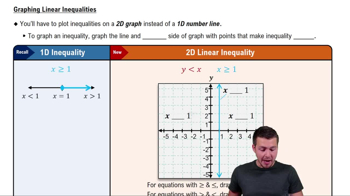
Linear Inequalities