Use the alternative method (also known as the rule of Sarrus) for evaluating a 3x3 determinant. First, rewrite the first two columns of the matrix to the right of the original matrix:
\[\begin{matrix} -3 & 4 & -5 & | & -3 & 4 \\ 5 & -2 & 0 & | & 5 & -2 \\ 8 & -1 & 3 & | & 8 & -1 \end{matrix}\]
Calculate the sum of the products of the diagonals going from top-left to bottom-right:
\[(-3) \times (-2) \times 3 + 4 \times 0 \times 8 + (-5) \times 5 \times (-1)\]
Calculate the sum of the products of the diagonals going from bottom-left to top-right:
\[8 \times (-2) \times (-5) + (-1) \times 0 \times (-3) + 3 \times 5 \times 4\]
Find the determinant by subtracting the second sum from the first sum:
\[\text{Determinant} = \left[(-3)(-2)(3) + 4(0)(8) + (-5)(5)(-1)\right] - \left[8(-2)(-5) + (-1)(0)(-3) + 3(5)(4)\right]\]
Verified video answer for a similar problem:
This video solution was recommended by our tutors as helpful for the problem above
Video duration:
3m
Play a video:
0 Comments
Key Concepts
Here are the essential concepts you must grasp in order to answer the question correctly.
Third-Order Determinants
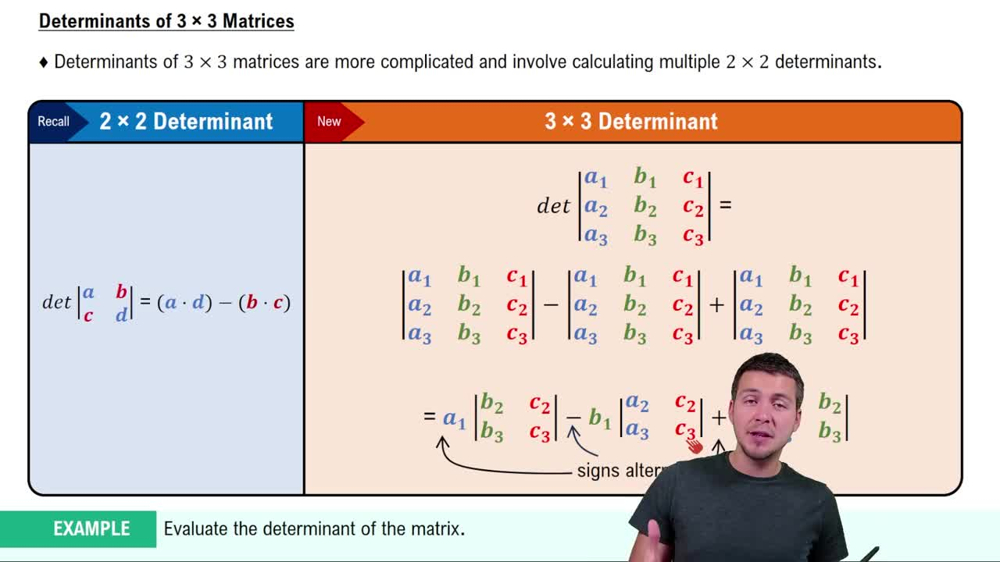
A third-order determinant is a scalar value calculated from a 3x3 matrix. It helps determine properties like matrix invertibility and solutions to systems of equations. The determinant is computed using specific methods such as expansion by minors or the alternative method.
The alternative method, often called the diagonal or Sarrus' rule, is a shortcut for calculating 3x3 determinants. It involves summing the products of diagonals from left to right and subtracting the products of diagonals from right to left, simplifying the calculation process.
Properties of Determinants in Systems of Equations
Determinants are used to analyze systems of linear equations; a nonzero determinant indicates a unique solution. Understanding how to evaluate determinants helps in solving systems using Cramer's rule and assessing matrix invertibility.

 3:14 minutes
 Verified step by step guidance
 7:25
7:25