Ch. 4 - Exponential and Logarithmic Functions
Blitzer - College Algebra 8th Edition
Blitzer8th EditionCollege AlgebraISBN: 9780136970514Not the one you use?Change textbook
Chapter 5, Problem 39

Solve each exponential equation in Exercises 23–48. Express the solution set in terms of natural logarithms or common logarithms. Then use a calculator to obtain a decimal approximation, correct to two decimal places, for the solution. 70.3x=813

Verified step by step guidance
1
Start with the given exponential equation: \(7^{0.3x} = 813\).
To solve for \(x\), take the natural logarithm (or common logarithm) of both sides to utilize the property that \(\ln(a^b) = b \ln(a)\): \(\ln(7^{0.3x}) = \ln(813)\).
Apply the logarithm power rule to bring down the exponent: \(0.3x \cdot \ln(7) = \ln(813)\).
Isolate \(x\) by dividing both sides by \(0.3 \ln(7)\): \(x = \frac{\ln(813)}{0.3 \cdot \ln(7)}\).
Use a calculator to find the decimal values of the logarithms and compute the quotient to get the approximate value of \(x\) rounded to two decimal places.

Verified video answer for a similar problem:

This video solution was recommended by our tutors as helpful for the problem above.
Video duration:
3m
Was this helpful?

Key Concepts

Here are the essential concepts you must grasp in order to answer the question correctly.

Exponential Equations

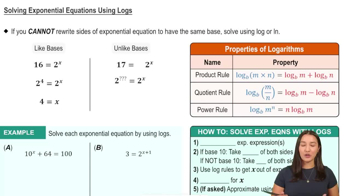
An exponential equation is one in which the variable appears in the exponent. Solving such equations often involves rewriting the equation to isolate the exponential expression and then applying logarithms to both sides to solve for the variable.
Recommended video:
5:47
Solving Exponential Equations Using Logs

Logarithms and Their Properties

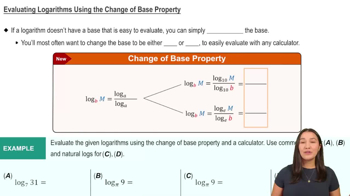
Logarithms are the inverse operations of exponentials. They allow us to solve equations where the variable is an exponent by converting the exponential form into a logarithmic form. Common logarithms (base 10) and natural logarithms (base e) are frequently used.
Recommended video:
5:36
Change of Base Property

Using Calculators for Approximation

After expressing the solution in logarithmic form, calculators are used to find decimal approximations. This step involves evaluating logarithmic expressions and rounding the result to the desired decimal places, ensuring practical and usable answers.
Recommended video:
5:47
Solving Exponential Equations Using Logs