Exercises 57–59 will help you prepare for the material covered in the next section. Subtract:
Ch. 5 - Systems of Equations and Inequalities

Chapter 6, Problem 58
Find the length and width of a rectangle whose perimeter is 40 feet and whose area is 96 square feet.
Verified step by step guidance1
Let the length of the rectangle be \(L\) feet and the width be \(W\) feet. We are given two conditions: the perimeter and the area.
Write the equation for the perimeter of a rectangle: \$2L + 2W = 40\(. Simplify this to \)L + W = 20$.
Write the equation for the area of a rectangle: \(L \times W = 96\).
From the perimeter equation, express one variable in terms of the other, for example, \(L = 20 - W\).
Substitute \(L = 20 - W\) into the area equation to get \((20 - W) \times W = 96\). This will give a quadratic equation in terms of \(W\) that you can solve.

Verified video answer for a similar problem:
This video solution was recommended by our tutors as helpful for the problem above.
Video duration:
4mWas this helpful?
Key Concepts
Here are the essential concepts you must grasp in order to answer the question correctly.
Perimeter of a Rectangle
The perimeter of a rectangle is the total distance around it, calculated as P = 2(length + width). This formula helps relate the length and width when the perimeter is known, providing one equation to solve for the dimensions.
Area of a Rectangle
The area of a rectangle is the amount of space inside it, found by multiplying length by width (A = length × width). Knowing the area gives a second equation that, combined with the perimeter, allows solving for both dimensions.
Recommended video:
Guided course
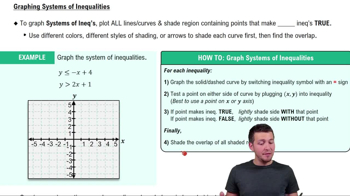
Systems of Inequalities
Solving Systems of Equations
To find the length and width, you set up two equations from the perimeter and area formulas and solve them simultaneously. Techniques include substitution or elimination, which help find the values of length and width that satisfy both conditions.
Recommended video:
Guided course
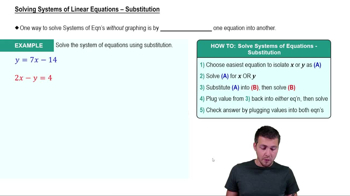
Solving Systems of Equations - Substitution
Related Practice
Textbook Question
630
views
Textbook Question
In Exercises 57–59, graph the region determined by the constraints. Then find the maximum value of the given objective function, subject to the constraints. This is a piecewise function. Refer to the textbook.
627
views
Textbook Question
Graph the solution set of each system of inequalities or indicate that the system has no solution.
375
views
Textbook Question
In Exercises 57–59, graph the region determined by the constraints. Then find the maximum value of the given objective function, subject to the constraints. This is a piecewise function. Refer to the textbook.
581
views
Textbook Question
Find the length and width of a rectangle whose perimeter is 36 feet and whose area is 77 square feet.
597
views
Textbook Question
Exercises 57–59 will help you prepare for the material covered in the next section. Add: (5x−3)/(x2+1) + 2x/(x2+1)2.
675
views