Ch. 2 - Functions and Graphs
Blitzer - College Algebra 8th Edition
Blitzer8th EditionCollege AlgebraISBN: 9780136970514Not the one you use?Change textbook
Chapter 3, Problem 69

In Exercises 67–69, begin by graphing the absolute value function, f(x) = |x|. Then use transformations of this graph to graph the given function. r(x) = (1/2) |x + 2|

Verified step by step guidance
1
Start with the basic absolute value function \(f(x) = |x|\), which is graphed as a V-shaped graph with its vertex at the origin (0,0).
Identify the transformation inside the absolute value: \(x + 2\). This represents a horizontal shift of the graph. Since it is \(x + 2\), shift the graph 2 units to the left.
Next, look at the coefficient outside the absolute value, which is \(\frac{1}{2}\). This is a vertical compression by a factor of \(\frac{1}{2}\), meaning the graph will be 'flatter' compared to the original \(f(x) = |x|\) graph.
Apply the horizontal shift first: move the vertex from (0,0) to (-2,0).
Then apply the vertical compression: multiply all the y-values of the shifted graph by \(\frac{1}{2}\). This will give you the graph of \(r(x) = \frac{1}{2} |x + 2|\).

Verified video answer for a similar problem:

This video solution was recommended by our tutors as helpful for the problem above.
Video duration:
5m
Was this helpful?

Key Concepts

Here are the essential concepts you must grasp in order to answer the question correctly.

Absolute Value Function

The absolute value function, f(x) = |x|, outputs the distance of x from zero on the number line, always producing non-negative values. Its graph is a V-shaped figure with the vertex at the origin (0,0), where the function changes direction. Understanding this basic shape is essential for applying transformations.
Recommended video:
4:56
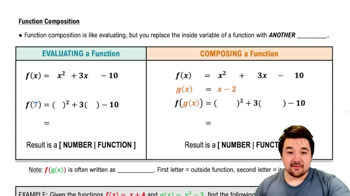
Function Composition

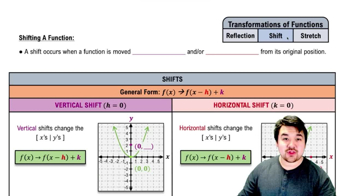
Horizontal Shifts

A horizontal shift moves the graph left or right without changing its shape. For r(x) = (1/2)|x + 2|, the '+2' inside the absolute value shifts the graph 2 units to the left. This means the vertex of the graph moves from (0,0) to (-2,0).
Recommended video:
5:34
Shifts of Functions

Vertical Scaling

Vertical scaling changes the steepness of the graph by multiplying the function by a constant. In r(x) = (1/2)|x + 2|, the factor 1/2 compresses the graph vertically, making it less steep than the original absolute value function. This affects the slope of the lines forming the V shape.
Recommended video:
5:30
Foci and Vertices of an Ellipse