Ch. 5 - Systems of Equations and Inequalities
Blitzer - College Algebra 8th Edition
Blitzer8th EditionCollege AlgebraISBN: 9780136970514Not the one you use?Change textbook
Chapter 6, Problem 45

Perform each long division and write the partial fraction decomposition of the remainder term. (x4-x2+2)/(x3-x2)

Verified step by step guidance
1
Identify the dividend and divisor for the long division: dividend is \(x^{4} - x^{2} + 2\) and divisor is \(x^{3} - x^{2}\).
Set up the long division by dividing the leading term of the dividend, \(x^{4}\), by the leading term of the divisor, \(x^{3}\), to find the first term of the quotient.
Multiply the entire divisor \(x^{3} - x^{2}\) by the term found in the previous step and subtract this product from the dividend to find the new remainder.
Repeat the division process with the new remainder: divide its leading term by \(x^{3}\), multiply the divisor by this term, and subtract again until the degree of the remainder is less than the degree of the divisor.
Express the original rational expression as the quotient plus the remainder over the original divisor, then write the partial fraction decomposition of the remainder term by factoring the divisor and breaking the fraction into simpler terms.

Verified video answer for a similar problem:

This video solution was recommended by our tutors as helpful for the problem above.
Video duration:
10m
Was this helpful?

Key Concepts

Here are the essential concepts you must grasp in order to answer the question correctly.

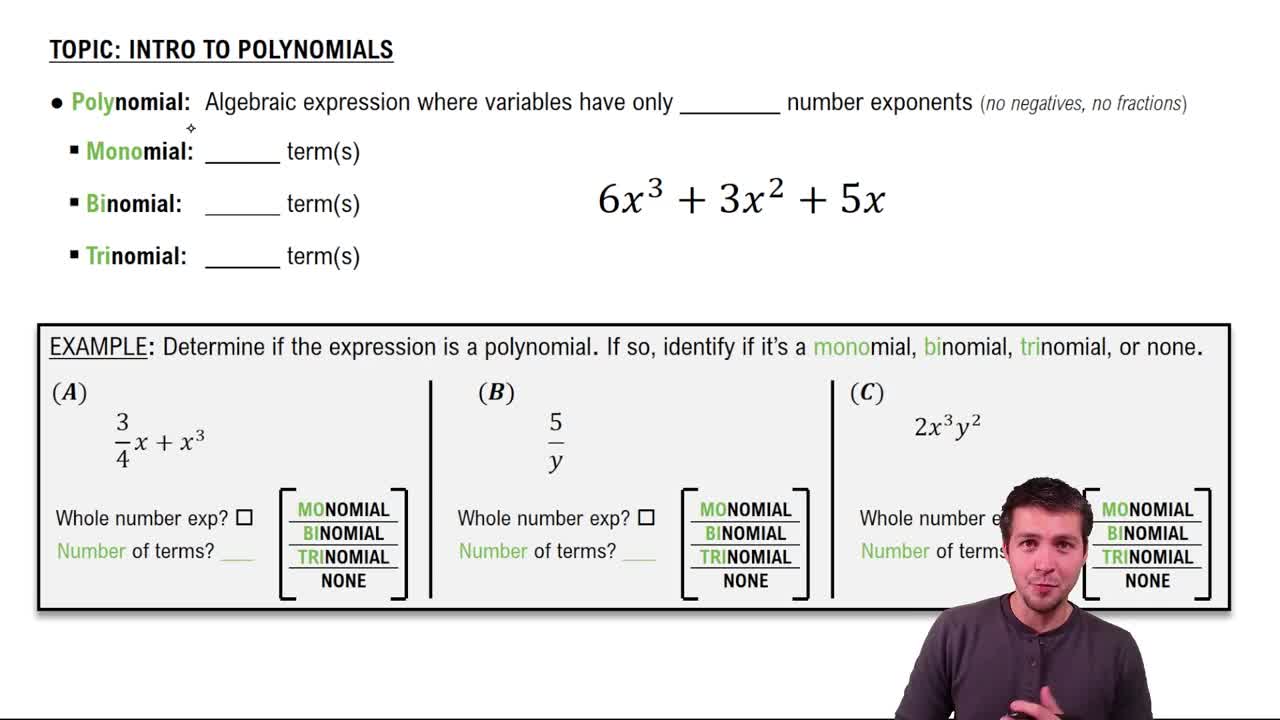
Polynomial Long Division

Polynomial long division is a method used to divide a polynomial by another polynomial of lower or equal degree. It involves dividing the leading terms, multiplying, subtracting, and bringing down the next term repeatedly until the remainder has a lower degree than the divisor. This process helps simplify complex rational expressions.
Recommended video:
Guided course
05:13
Introduction to Polynomials

Partial Fraction Decomposition

Partial fraction decomposition breaks a rational expression into a sum of simpler fractions with denominators that are factors of the original denominator. This technique is useful for integration and solving equations. After division, the remainder term is expressed as partial fractions to simplify further operations.
Recommended video:
4:07
Decomposition of Functions

Factoring Polynomials

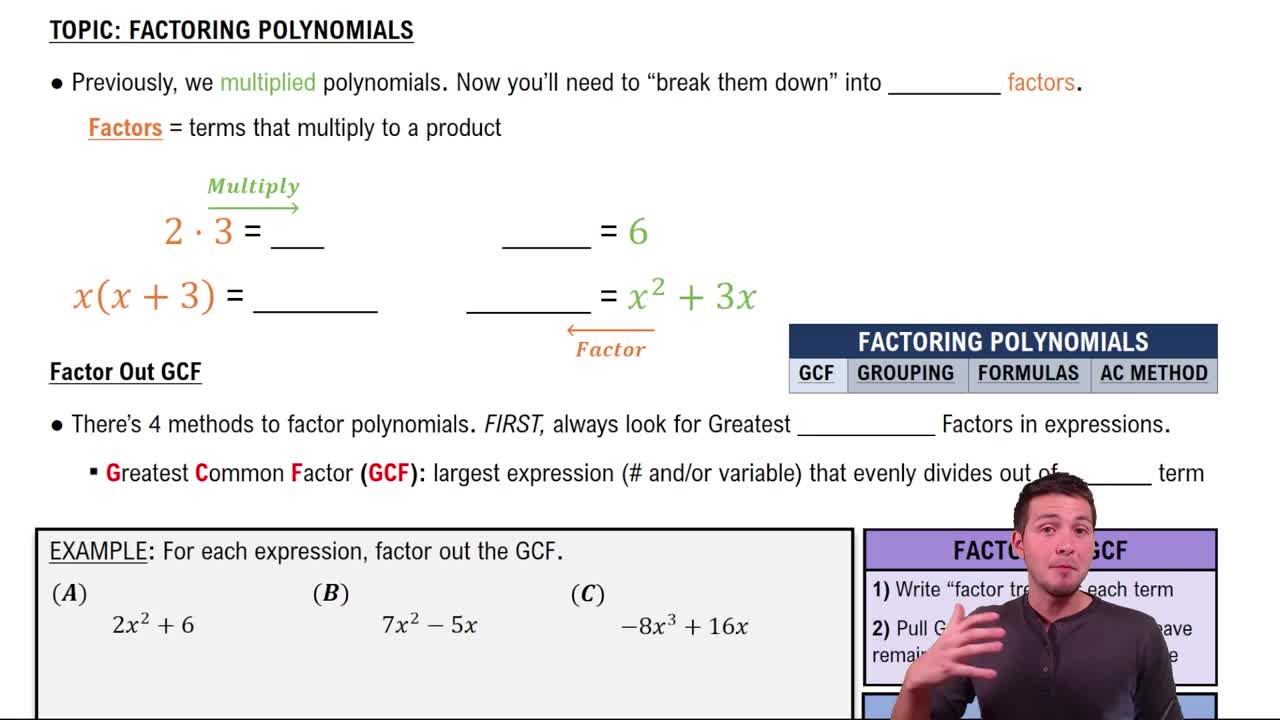
Factoring polynomials involves expressing a polynomial as a product of its factors, which can be linear or quadratic. Recognizing and factoring the denominator is essential for partial fraction decomposition, as it determines the form of the simpler fractions into which the expression is broken down.
Recommended video:
Guided course
07:30
Introduction to Factoring Polynomials