Identify the complex fraction: the numerator is \(m - \frac{1}{m^{2} - 4}\) and the denominator is \(\frac{1}{m + 2}\).
Recognize that \(m^{2} - 4\) is a difference of squares and factor it as \((m - 2)(m + 2)\).
Rewrite the numerator as \(m - \frac{1}{(m - 2)(m + 2)}\) to have a common denominator for the terms in the numerator.
Express \(m\) as \(\frac{m(m - 2)(m + 2)}{(m - 2)(m + 2)}\) so that both terms in the numerator share the denominator \((m - 2)(m + 2)\), then combine them into a single fraction.
Divide the resulting numerator fraction by the denominator \(\frac{1}{m + 2}\) by multiplying the numerator fraction by the reciprocal of the denominator, which is \((m + 2)\).
Verified video answer for a similar problem:
This video solution was recommended by our tutors as helpful for the problem above
Video duration:
5m
Play a video:
0 Comments
Key Concepts
Here are the essential concepts you must grasp in order to answer the question correctly.
Complex Fractions
A complex fraction is a fraction where the numerator, denominator, or both contain fractions themselves. Simplifying involves rewriting the expression as a single fraction by finding common denominators or multiplying by the reciprocal of the denominator.
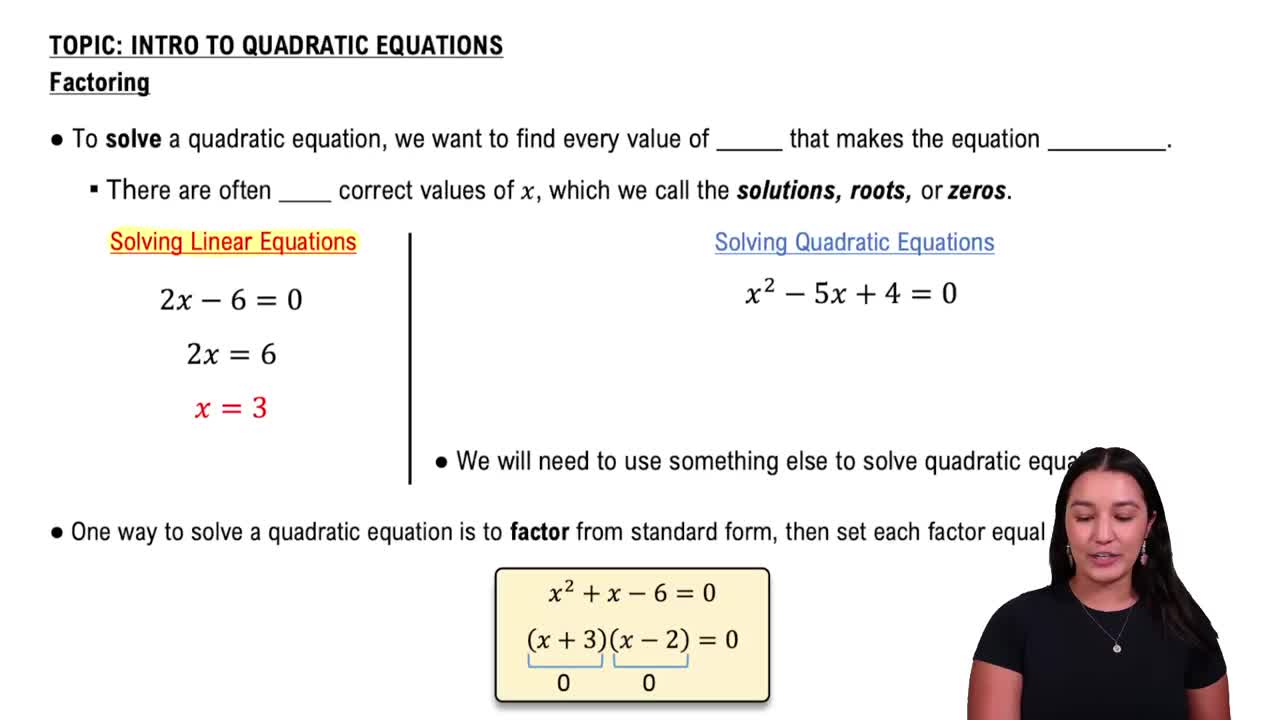
Factoring involves expressing a quadratic expression as a product of simpler binomials. For example, m^2 - 4 is a difference of squares and factors into (m - 2)(m + 2), which helps simplify fractions by canceling common factors.
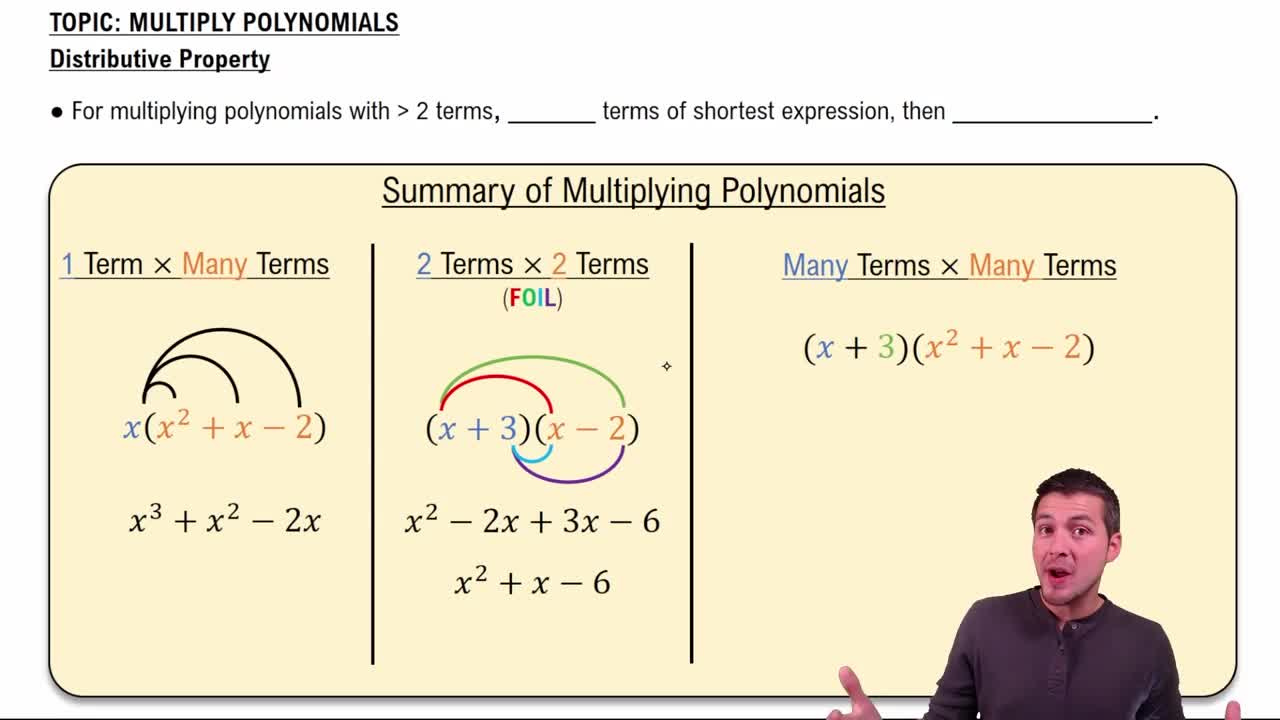
To divide by a fraction, multiply by its reciprocal. In this problem, dividing by 1/(m + 2) is equivalent to multiplying by (m + 2), which simplifies the complex fraction into a simpler algebraic expression.

 5:27 minutes
 Verified step by step guidance
 05:33
05:33