Ch. 1 - Equations and Inequalities
Blitzer - College Algebra 8th Edition
Blitzer8th EditionCollege AlgebraISBN: 9780136970514Not the one you use?Change textbook
Chapter 2, Problem 67a

Solve each equation in Exercises 65–74 using the quadratic formula. x2 + 5x + 3 = 0

Verified step by step guidance
1
Identify the coefficients in the quadratic equation. The general form of a quadratic equation is ax^2 + bx + c = 0. Here, a = 1, b = 5, and c = 3.
Recall the quadratic formula: x = -b ± b2 - 4ac2a. This formula is used to solve any quadratic equation.
Substitute the values of a, b, and c into the quadratic formula. Replace a with 1, b with 5, and c with 3: x = -5 ± 52 - 4(1)(3)2(1).
Simplify the discriminant (the part under the square root): 52 - 4(1)(3). Calculate 52 (which is 25) and subtract 4(1)(3) (which is 12).
Write the simplified quadratic formula with the discriminant value substituted. If the discriminant is positive, proceed to calculate the two possible solutions for x using the ± symbol. If the discriminant is zero, there will be one solution. If the discriminant is negative, the solutions will involve imaginary numbers.

Verified video answer for a similar problem:

This video solution was recommended by our tutors as helpful for the problem above.
Video duration:
5m
Was this helpful?

Key Concepts

Here are the essential concepts you must grasp in order to answer the question correctly.

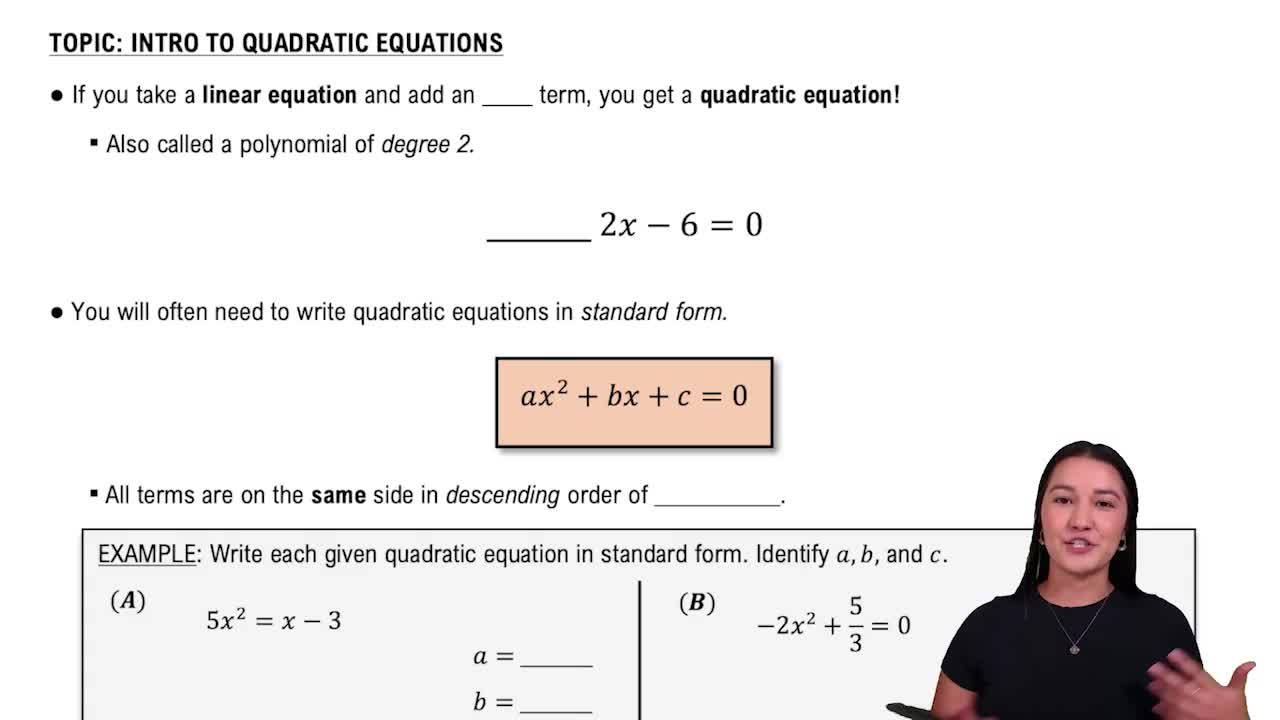
Quadratic Equation

A quadratic equation is a polynomial equation of the form ax^2 + bx + c = 0, where a, b, and c are constants, and a ≠ 0. The solutions to this equation can be found using various methods, including factoring, completing the square, or applying the quadratic formula.
Recommended video:
05:35
Introduction to Quadratic Equations

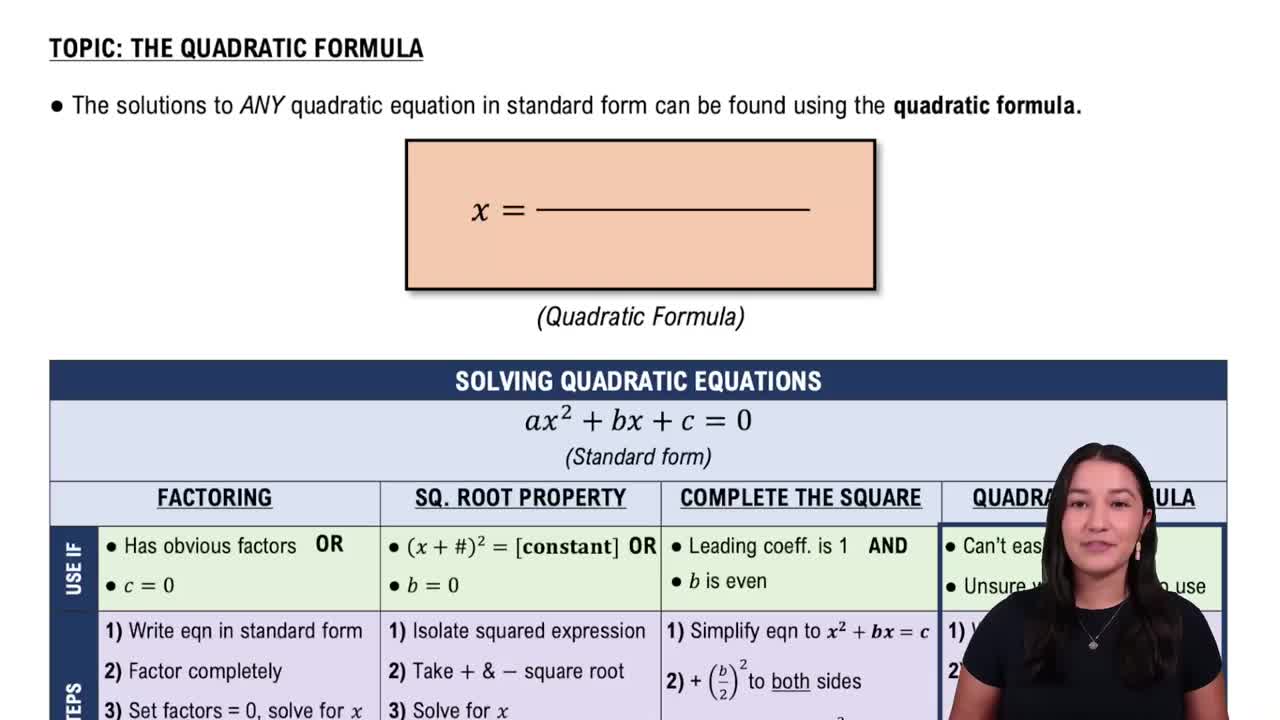
Quadratic Formula

The quadratic formula is a mathematical formula used to find the roots of a quadratic equation. It is expressed as x = (-b ± √(b² - 4ac)) / (2a), where a, b, and c are the coefficients from the quadratic equation. This formula provides a systematic way to calculate the solutions, even when the equation cannot be easily factored.
Recommended video:
06:36
Solving Quadratic Equations Using The Quadratic Formula

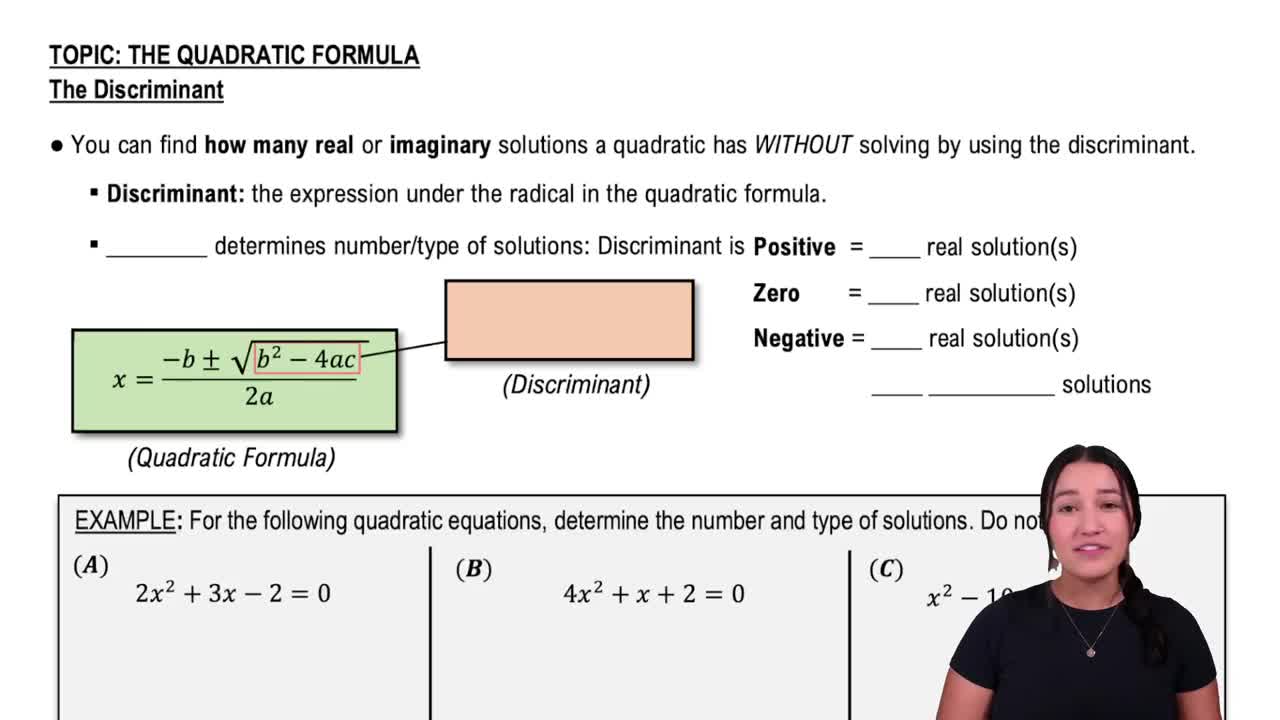
Discriminant

The discriminant is the part of the quadratic formula under the square root, given by b² - 4ac. It determines the nature of the roots of the quadratic equation: if the discriminant is positive, there are two distinct real roots; if it is zero, there is one real root (a repeated root); and if it is negative, there are two complex roots. Understanding the discriminant helps in predicting the type of solutions without solving the equation.
Recommended video:
04:11
The Discriminant