Ch. 1 - Equations and Inequalities
Blitzer - College Algebra 8th Edition
Blitzer8th EditionCollege AlgebraISBN: 9780136970514Not the one you use?Change textbook
Chapter 2, Problem 71

Evaluate x2 - 2x + 2 for x = 1 + i.

Verified step by step guidance
1
Substitute the given value of x = 1 + i into the expression x^2 - 2x + 2. This means replacing every occurrence of x in the expression with (1 + i).
Expand the term (1 + i)^2 using the formula (a + b)^2 = a^2 + 2ab + b^2. Here, a = 1 and b = i, so (1 + i)^2 = 1^2 + 2(1)(i) + i^2.
Simplify the result of (1 + i)^2. Recall that i^2 = -1, so the expression becomes 1 + 2i - 1, which simplifies further to 2i.
Substitute the simplified value of (1 + i)^2 = 2i back into the original expression. The expression now becomes 2i - 2(1 + i) + 2.
Distribute and simplify the remaining terms. Expand -2(1 + i) to get -2 - 2i, then combine all real and imaginary terms to simplify the final result.

Verified video answer for a similar problem:

This video solution was recommended by our tutors as helpful for the problem above.
Video duration:
3m
Was this helpful?

Key Concepts

Here are the essential concepts you must grasp in order to answer the question correctly.

Complex Numbers

Complex numbers are numbers that have a real part and an imaginary part, expressed in the form a + bi, where a is the real part, b is the imaginary part, and i is the imaginary unit defined as the square root of -1. Understanding complex numbers is essential for evaluating expressions that include them, as they extend the number system beyond real numbers.
Recommended video:
04:22
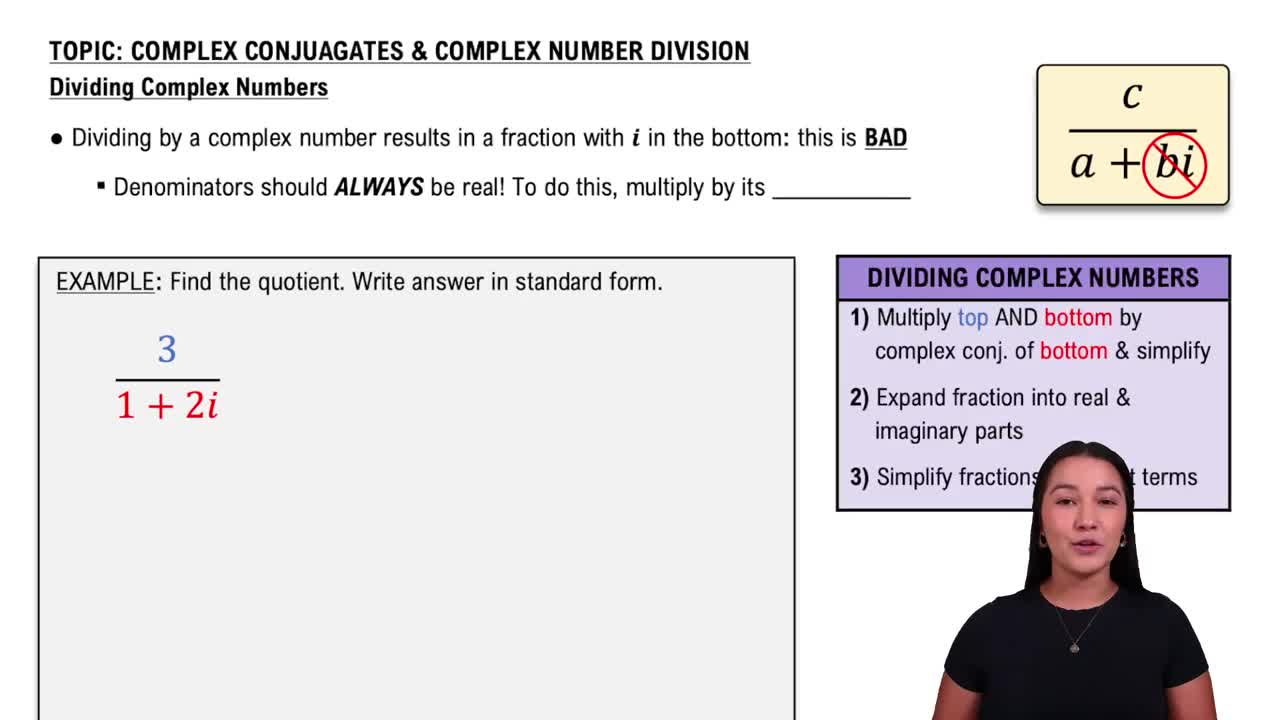
Dividing Complex Numbers

Polynomial Evaluation

Polynomial evaluation involves substituting a specific value into a polynomial expression to compute its value. In this case, we substitute x = 1 + i into the polynomial x^2 - 2x + 2, which requires performing operations like addition, multiplication, and squaring complex numbers.
Recommended video:
Guided course
05:13
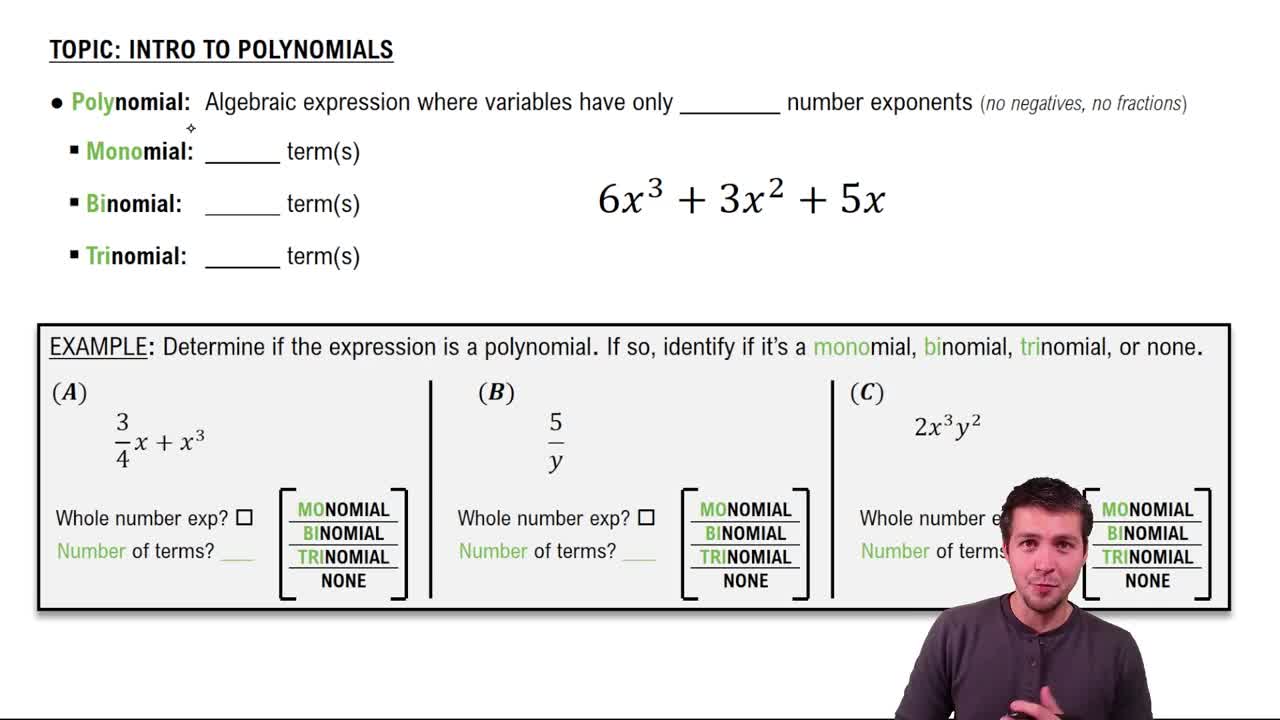
Introduction to Polynomials

Quadratic Functions

Quadratic functions are polynomial functions of degree two, typically expressed in the form ax^2 + bx + c. They can have various properties, such as roots, vertex, and direction of opening, which are important for understanding their behavior. Evaluating a quadratic function at a complex number involves understanding how these properties apply in the complex plane.
Recommended video:
06:36
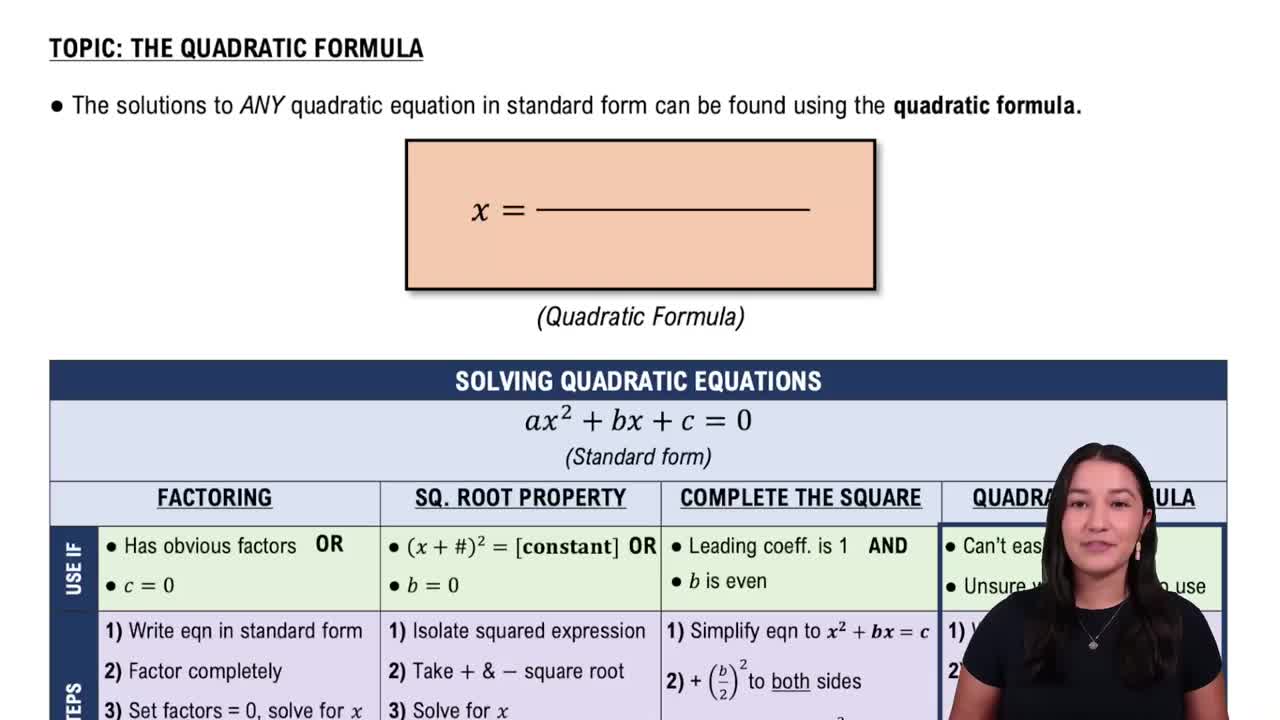
Solving Quadratic Equations Using The Quadratic Formula