Ch. P - Fundamental Concepts of Algebra
Blitzer - College Algebra 8th Edition
Blitzer8th EditionCollege AlgebraISBN: 9780136970514Not the one you use?Change textbook
Chapter 1, Problem 57

Rewrite each expression without absolute value bars. -3/|-3|

Verified step by step guidance
1
Identify the absolute value expression in the problem: \(\left| -3 \right|\).
Recall that the absolute value of a number is its distance from zero on the number line, which is always non-negative. So, \(\left| -3 \right| = 3\).
Rewrite the original expression \(\frac{-3}{\left| -3 \right|}\) by substituting the absolute value with its value: \(\frac{-3}{3}\).
Simplify the fraction \(\frac{-3}{3}\) by dividing numerator and denominator.
Express the simplified result without absolute value bars.

Verified video answer for a similar problem:

This video solution was recommended by our tutors as helpful for the problem above.
Video duration:
1m
Was this helpful?

Key Concepts

Here are the essential concepts you must grasp in order to answer the question correctly.

Absolute Value

The absolute value of a number is its distance from zero on the number line, always expressed as a non-negative value. For example, |−3| equals 3 because −3 is three units away from zero.
Recommended video:
7:12
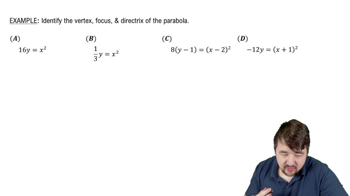
Parabolas as Conic Sections Example 1

Simplifying Expressions with Absolute Values

To rewrite expressions without absolute value bars, first evaluate the absolute value portion, then simplify the expression accordingly. This often involves replacing the absolute value with its positive equivalent.
Recommended video:
Guided course
05:07
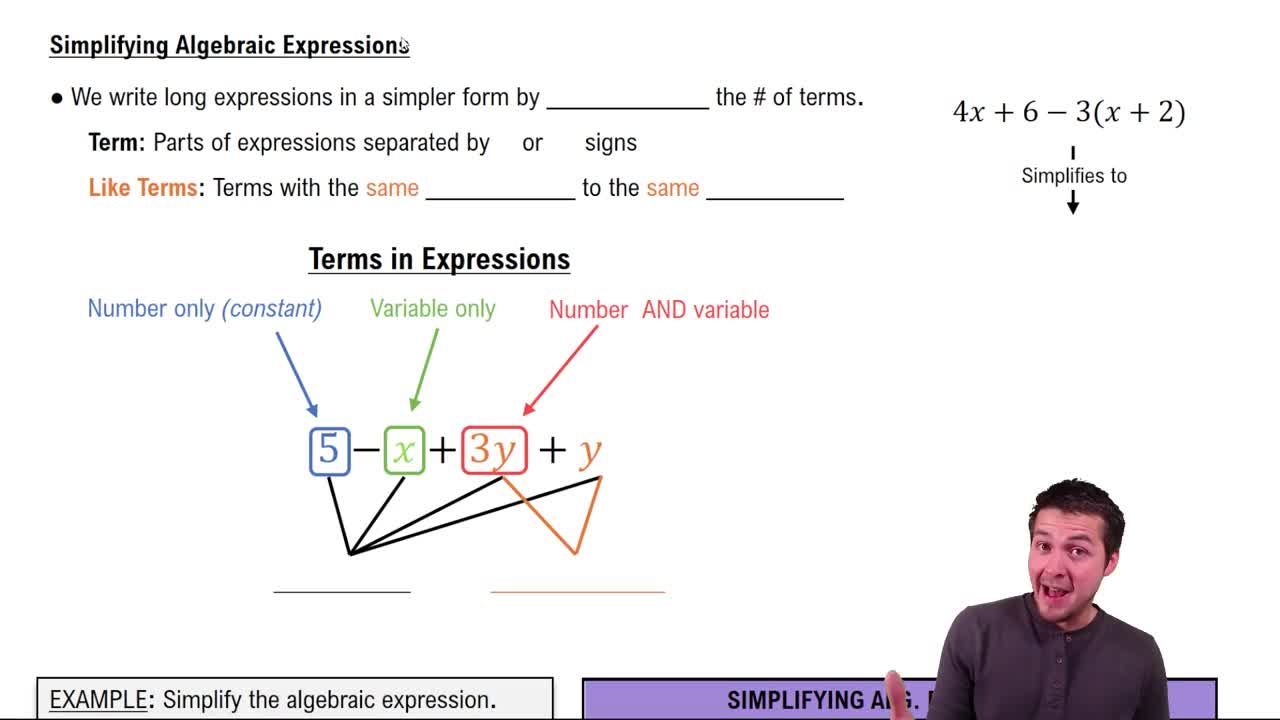
Simplifying Algebraic Expressions

Division of Rational Numbers

Dividing rational numbers involves dividing the numerator by the denominator, considering their signs. When dividing by an absolute value, the denominator is always positive, which affects the sign of the result.
Recommended video:
4:47
The Number e