Ch. 1 - Equations and Inequalities
Blitzer - College Algebra 8th Edition
Blitzer8th EditionCollege AlgebraISBN: 9780136970514Not the one you use?Change textbook
Chapter 2, Problem 35

Exercises 27–40 contain linear equations with constants in denominators. Solve each equation. (x + 3)/6 = 3/8 + (x - 5)/4

Verified step by step guidance
1
Identify the given equation: \(\frac{(x + 3)}{6} = \frac{3}{8} + \frac{(x - 5)}{4}\).
Find the least common denominator (LCD) of all denominators (6, 8, and 4). The LCD is 24.
Multiply every term on both sides of the equation by 24 to eliminate the denominators: \(24 \times \frac{(x + 3)}{6} = 24 \times \frac{3}{8} + 24 \times \frac{(x - 5)}{4}\).
Simplify each term after multiplication: \(4(x + 3) = 3 \times 3 + 6(x - 5)\).
Distribute and combine like terms to form a linear equation without fractions, then solve for \(x\) by isolating the variable on one side.

Verified video answer for a similar problem:

This video solution was recommended by our tutors as helpful for the problem above.
Video duration:
4m
Was this helpful?

Key Concepts

Here are the essential concepts you must grasp in order to answer the question correctly.

Solving Linear Equations

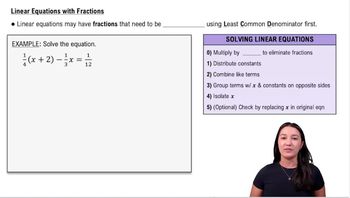
A linear equation is an algebraic equation in which each term is either a constant or the product of a constant and a single variable. Solving such equations involves isolating the variable on one side to find its value. This often requires performing inverse operations like addition, subtraction, multiplication, or division.
Recommended video:
04:02
Solving Linear Equations with Fractions

Clearing Fractions by Finding a Common Denominator

When an equation contains fractions, multiplying both sides by the least common denominator (LCD) eliminates the denominators, simplifying the equation. This step helps avoid dealing with fractions directly and makes solving the equation more straightforward.
Recommended video:
Guided course
02:58
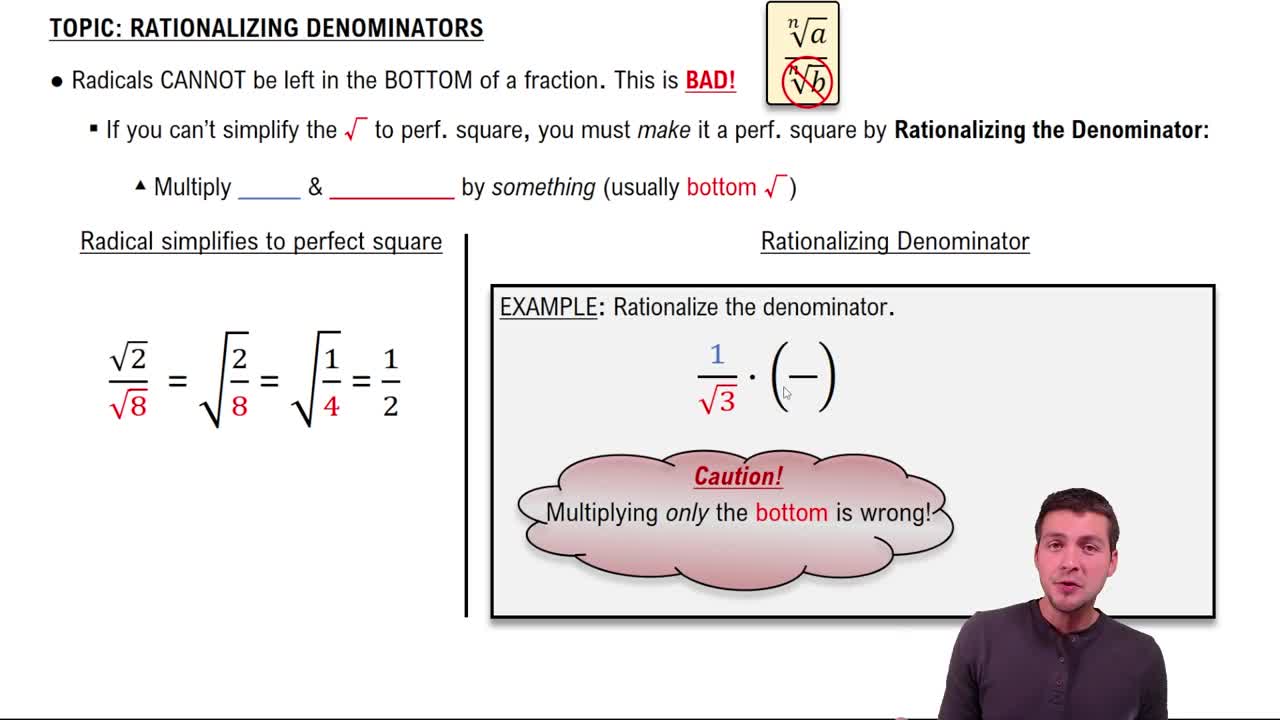
Rationalizing Denominators

Properties of Equality

Properties of equality, such as the addition, subtraction, multiplication, and division properties, allow you to perform the same operation on both sides of an equation without changing its solution. These properties are essential for manipulating and simplifying equations to isolate the variable.
Recommended video:
5:36
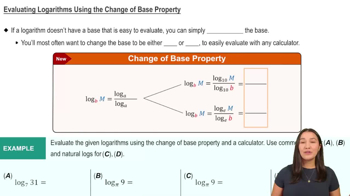
Change of Base Property