Understand the parent function: The function ƒ(x) = |x| represents the absolute value of x, which forms a V-shaped graph opening upwards with its vertex at the origin (0,0).
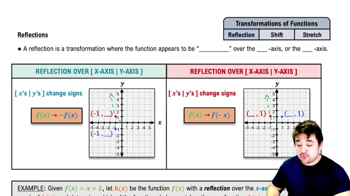
Identify the transformation: The given function is ƒ(x) = -|x|, which means the absolute value function is multiplied by -1. This reflects the graph of |x| across the x-axis.
Determine the vertex: Since there are no horizontal or vertical shifts, the vertex remains at the origin (0,0).
Plot key points: Choose values of x such as -2, -1, 0, 1, and 2. Calculate ƒ(x) = -|x| for each to get points like (-2, -2), (-1, -1), (0, 0), (1, -1), and (2, -2).
Draw the graph: Connect the plotted points with straight lines forming an upside-down V shape, opening downward, with the vertex at the origin.
Verified video answer for a similar problem:
This video solution was recommended by our tutors as helpful for the problem above
Video duration:
2m
Play a video:
0 Comments
Key Concepts
Here are the essential concepts you must grasp in order to answer the question correctly.
Absolute Value Function
The absolute value function, denoted |x|, outputs the distance of x from zero on the number line, always yielding a non-negative result. Its graph is a V-shaped curve with the vertex at the origin (0,0), opening upwards.
Multiplying a function by -1 reflects its graph across the x-axis. For ƒ(x) = -|x|, the standard V-shape of |x| is flipped upside down, creating an inverted V that opens downward.
The absolute value function can be expressed as a piecewise function: |x| = x if x ≥ 0, and -x if x < 0. Understanding this helps in plotting points accurately and visualizing how the negative sign affects each piece.

 2:11 minutes
 Verified step by step guidance
 4:56
4:56