Ch. 7 - Conic Sections
Blitzer - College Algebra 8th Edition
Blitzer8th EditionCollege AlgebraISBN: 9780136970514Not the one you use?Change textbook
Chapter 8, Problem 49

Identify each equation without completing the square. y2 - 4x + 2y + 21 = 0

Verified step by step guidance
1
Rewrite the given equation to group the terms involving \( y \) together and isolate the \( x \) terms: \( y^2 + 2y - 4x + 21 = 0 \).
Move the \( x \) terms and constant to the other side to focus on the \( y \) terms: \( y^2 + 2y = 4x - 21 \).
Recognize that the equation is quadratic in \( y \) and linear in \( x \), which suggests it might represent a parabola that opens horizontally.
Recall the standard form of a parabola that opens left or right is \( (y - k)^2 = 4p(x - h) \), where \( (h, k) \) is the vertex.
Based on the structure and terms, identify the conic as a parabola without completing the square.

Verified video answer for a similar problem:

This video solution was recommended by our tutors as helpful for the problem above.
Video duration:
4m
Was this helpful?

Key Concepts

Here are the essential concepts you must grasp in order to answer the question correctly.

Identifying Conic Sections

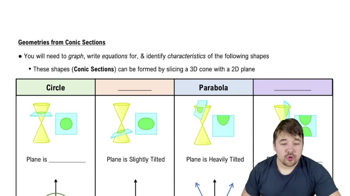
Conic sections are curves obtained by intersecting a plane with a cone, including circles, ellipses, parabolas, and hyperbolas. Each conic has a standard form equation involving x and y variables. Recognizing the type of conic from its general equation is essential before further manipulation.
Recommended video:
3:08
Geometries from Conic Sections

General Form of Conic Equations

The general form of a conic equation is Ax^2 + Bxy + Cy^2 + Dx + Ey + F = 0. By analyzing the coefficients, especially those of x^2 and y^2, one can determine the conic type. For example, if only one variable is squared, the conic is a parabola.
Recommended video:
3:08
Geometries from Conic Sections

Completing the Square (Conceptual Understanding)

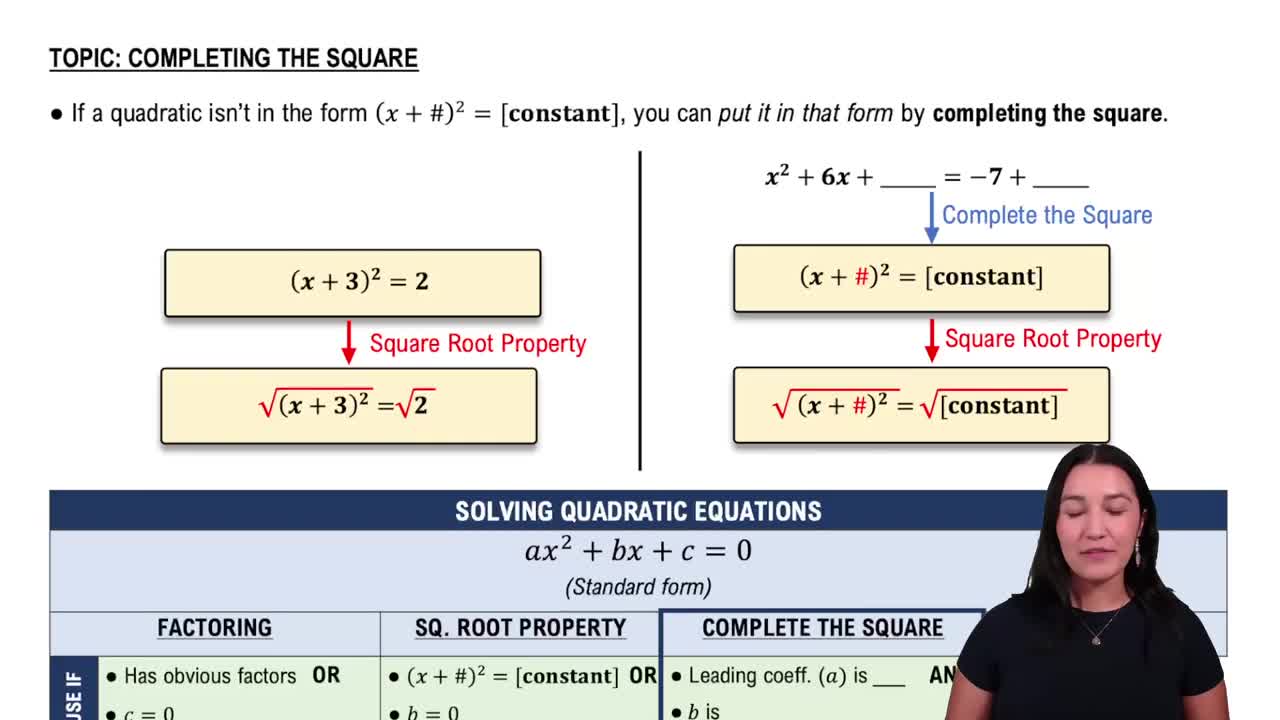
Completing the square is a method to rewrite quadratic expressions in a form that reveals the conic's center and shape. Although the question asks to identify the conic without completing the square, understanding this process helps in recognizing the conic type from the equation's structure.
Recommended video:
06:24
Solving Quadratic Equations by Completing the Square