Ch. P - Fundamental Concepts of Algebra
Blitzer - College Algebra 8th Edition
Blitzer8th EditionCollege AlgebraISBN: 9780136970514Not the one you use?Change textbook
Chapter 1, Problem 12

Evaluate each expression in Exercises 1–12, or indicate that the root is not a real number. (17)2\(\sqrt{(-17)^2}\)

Verified step by step guidance
1
Identify the expression inside the square root: \(\sqrt{(-17)^2}\).
Recall that squaring a number means multiplying it by itself, so \((-17)^2 = (-17) \times (-17)\).
Calculate \((-17) \times (-17)\), which results in a positive number because a negative times a negative is positive.
Rewrite the expression as \(\sqrt{\text{positive number}}\).
Since the square root of a positive number is a real number, simplify \(\sqrt{(-17)^2}\) to the absolute value of \(-17\), which is \(17\).

Verified video answer for a similar problem:

This video solution was recommended by our tutors as helpful for the problem above.
Video duration:
1m
Was this helpful?

Key Concepts

Here are the essential concepts you must grasp in order to answer the question correctly.

Square Root and Its Properties

The square root of a number is a value that, when multiplied by itself, gives the original number. For non-negative numbers, the square root is real and non-negative. Understanding how to simplify square roots, especially with squared terms, is essential for evaluating expressions like √(−17)^2.
Recommended video:
02:20
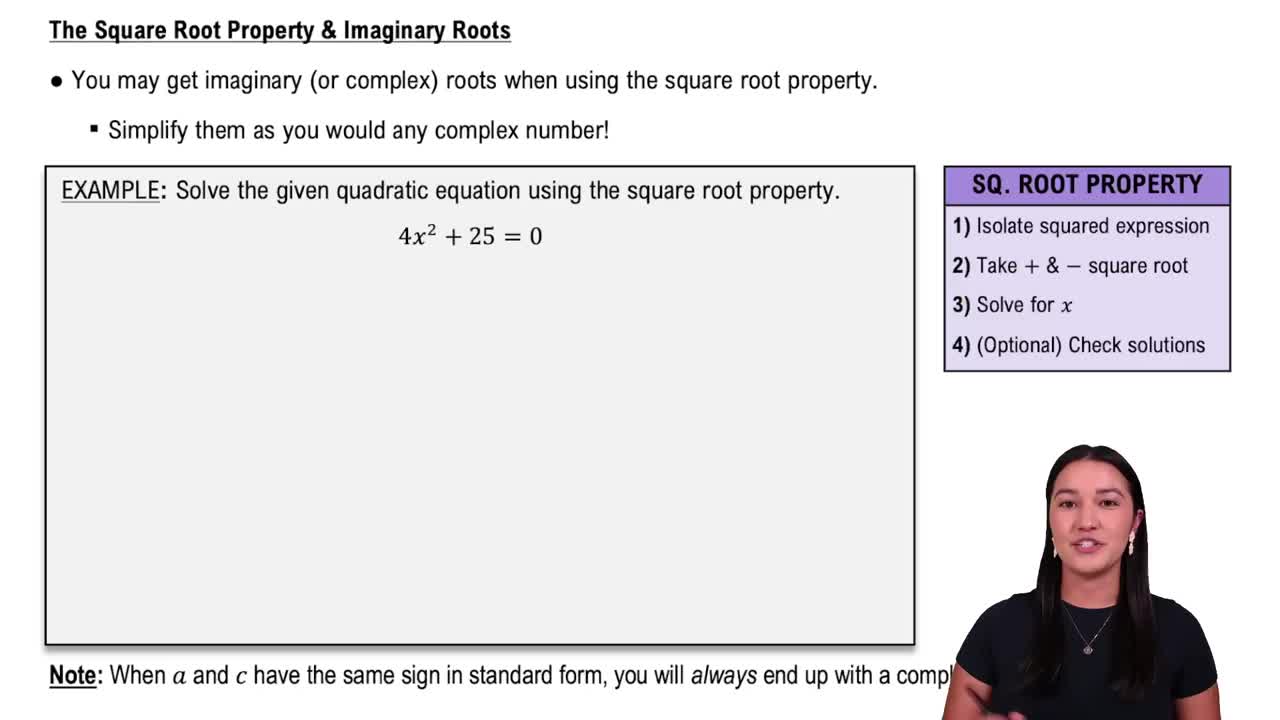
Imaginary Roots with the Square Root Property

Order of Operations

The order of operations dictates the sequence in which parts of a mathematical expression are evaluated. Parentheses and exponents are handled before roots. In the expression √(−17)^2, the exponent applies to −17 first, then the square root is taken, which affects the final result.
Recommended video:
Guided course
8:38
Performing Row Operations on Matrices

Real Numbers and Imaginary Numbers

Real numbers include all rational and irrational numbers, while imaginary numbers involve the square root of negative values. Recognizing when an expression results in a real number or when it involves imaginary numbers helps determine if the root is real or not, as asked in the question.
Recommended video:
03:31
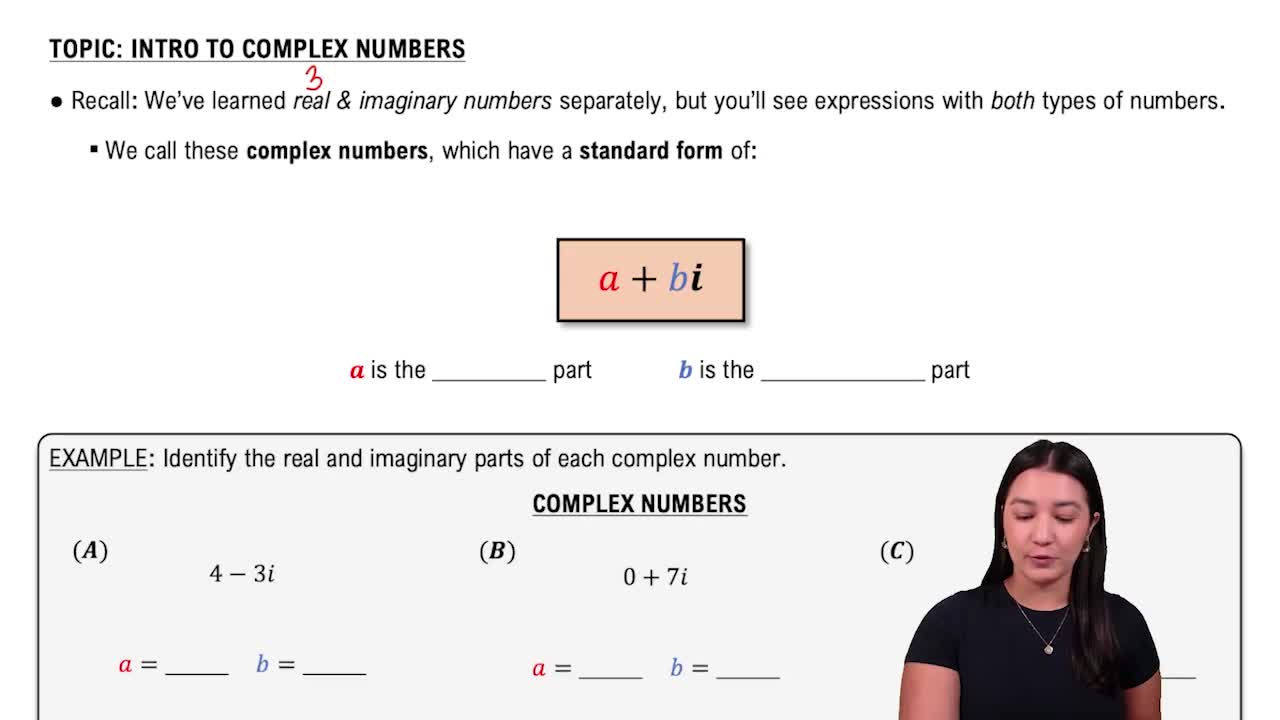
Introduction to Complex Numbers