Ch. P - Fundamental Concepts of Algebra
Blitzer - College Algebra 8th Edition
Blitzer8th EditionCollege AlgebraISBN: 9780136970514Not the one you use?Change textbook
Chapter 1, Problem 63

Evaluate each expression in Exercises 55–66, or indicate that the root is not a real number. ⁵√(−3)5

Verified step by step guidance
1
Recognize that the given expression involves a fifth root: ⁵√((-3)^5). This means we are looking for the number that, when raised to the fifth power, equals (-3)^5.
Simplify the expression inside the root. The base is -3, and it is raised to the power of 5. Using the rule of exponents, calculate (-3)^5. Note that raising a negative number to an odd power results in a negative number.
Now, the expression becomes ⁵√(-243), since (-3)^5 equals -243.
Determine whether the fifth root of -243 is a real number. Recall that the nth root of a negative number is real if n is odd. Since 5 is odd, the fifth root of -243 is a real number.
Conclude that the fifth root of -243 is the number that, when raised to the fifth power, equals -243. This number is -3, as (-3)^5 = -243.

Verified video answer for a similar problem:

This video solution was recommended by our tutors as helpful for the problem above.
Video duration:
1m
Was this helpful?

Key Concepts

Here are the essential concepts you must grasp in order to answer the question correctly.

Radical Expressions

Radical expressions involve roots, such as square roots or cube roots. The notation ⁵√(x) represents the fifth root of x, which is the number that, when raised to the power of 5, equals x. Understanding how to manipulate and evaluate these expressions is crucial for solving problems involving roots.
Recommended video:
Guided course
05:45
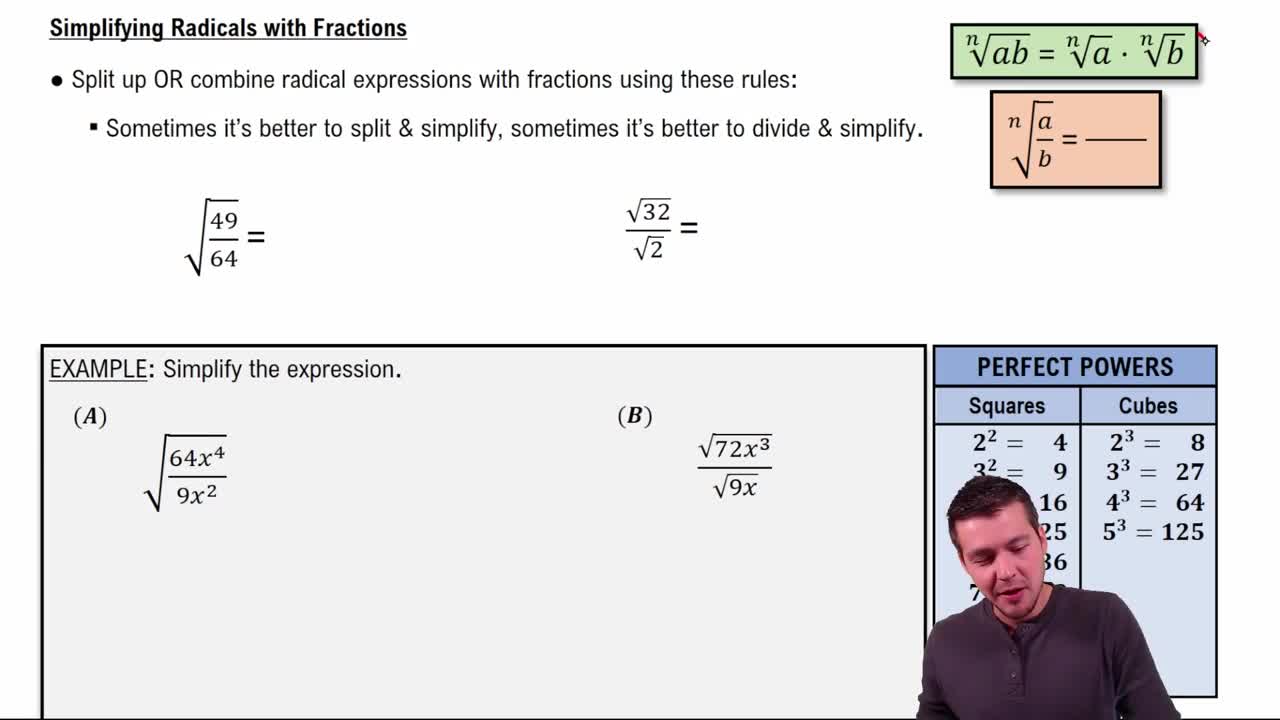
Radical Expressions with Fractions

Odd and Even Roots

The distinction between odd and even roots is essential in algebra. Odd roots, like the fifth root, can be taken of negative numbers and will yield a real number. In contrast, even roots, such as square roots, cannot be taken of negative numbers without resulting in complex numbers. This concept is key to determining the nature of the roots in expressions.
Recommended video:
02:20
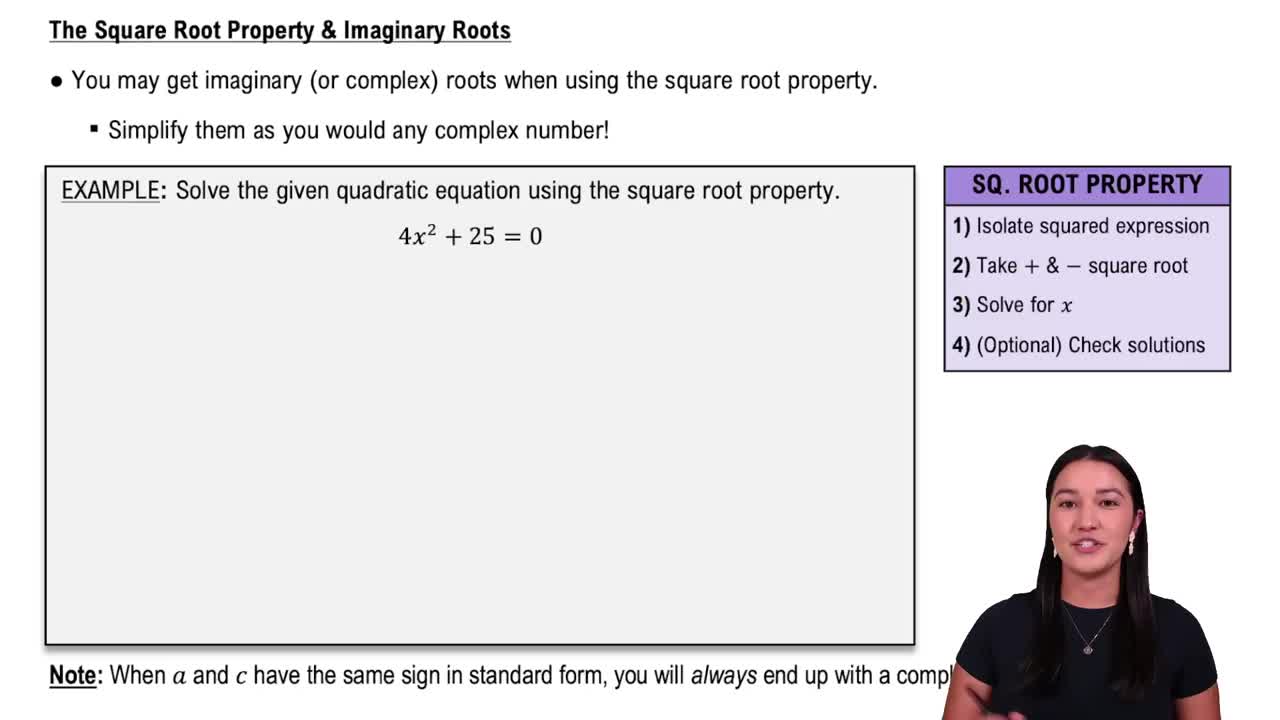
Imaginary Roots with the Square Root Property

Exponents and Powers

Exponents indicate how many times a number, known as the base, is multiplied by itself. In the expression (−3)^5, the base is −3, and the exponent is 5, meaning −3 is multiplied by itself five times. Understanding how to evaluate powers is fundamental for simplifying expressions and solving equations in algebra.
Recommended video:
04:10
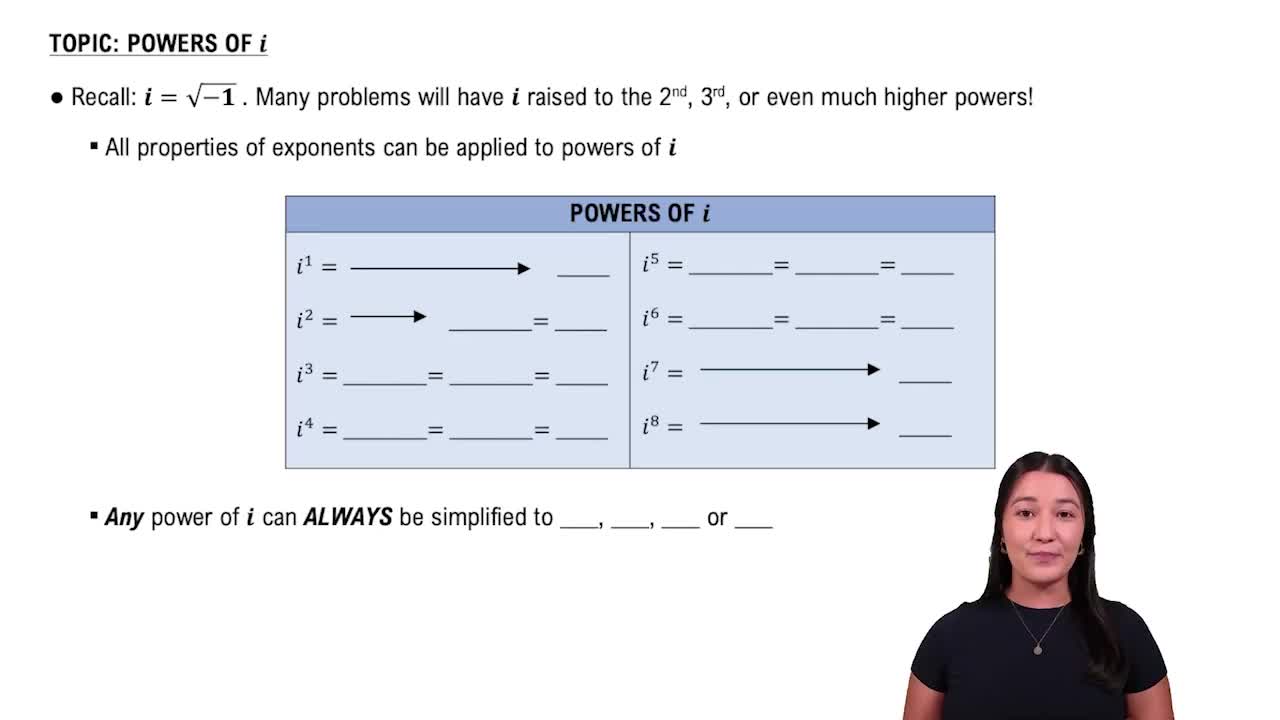
Powers of i