Ch. 3 - Polynomial and Rational Functions
Blitzer - College Algebra 8th Edition
Blitzer8th EditionCollege AlgebraISBN: 9780136970514Not the one you use?Change textbook
Chapter 4, Problem 48

Solve each rational inequality in Exercises 43–60 and graph the solution set on a real number line. Express each solution set in interval notation. (−x−3)/(x+2)≤0

Verified step by step guidance
1
Identify the rational inequality: \(\frac{-x - 3}{x + 2} \leq 0\).
Find the critical points by setting the numerator and denominator equal to zero separately: solve \(-x - 3 = 0\) and \(x + 2 = 0\).
Determine the critical points: from \(-x - 3 = 0\), solve for \(x\); from \(x + 2 = 0\), solve for \(x\). These points divide the number line into intervals.
Test each interval by choosing a test value from each interval and substituting it into the inequality \(\frac{-x - 3}{x + 2} \leq 0\) to check if the inequality holds.
Based on the test results, write the solution set in interval notation, remembering to exclude any points where the denominator is zero and include points where the expression equals zero if the inequality is non-strict (\(\leq\)).

Verified video answer for a similar problem:

This video solution was recommended by our tutors as helpful for the problem above.
Video duration:
6m
Was this helpful?

Key Concepts

Here are the essential concepts you must grasp in order to answer the question correctly.

Rational Inequalities

Rational inequalities involve expressions where one polynomial is divided by another, and the inequality compares this ratio to zero or another value. Solving them requires finding where the rational expression is positive, negative, or zero by analyzing the signs of numerator and denominator.
Recommended video:
Guided course
3:21
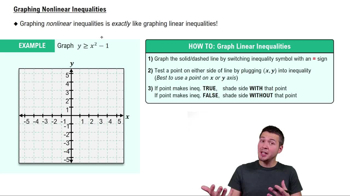
Nonlinear Inequalities

Critical Points and Sign Analysis

Critical points occur where the numerator or denominator equals zero, dividing the number line into intervals. By testing values in each interval, you determine the sign of the rational expression, which helps identify where the inequality holds true.
Recommended video:
Guided course
05:46
Point-Slope Form

Interval Notation and Graphing Solutions

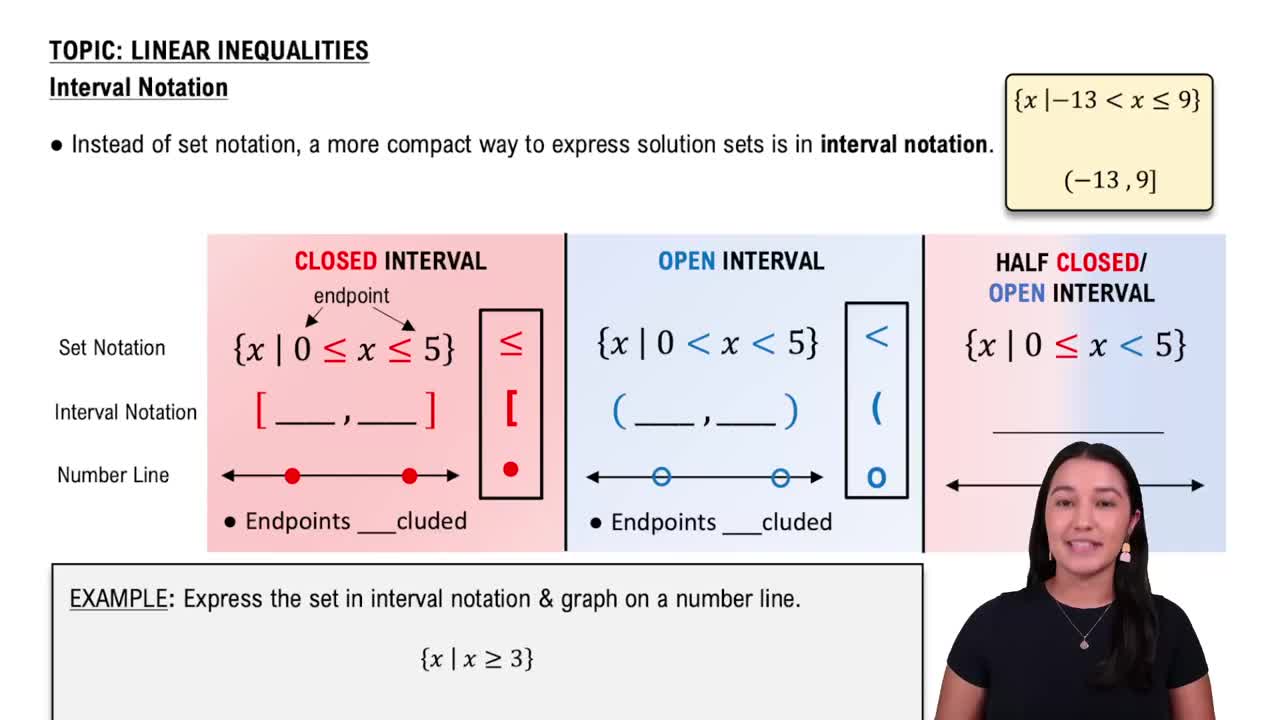
After determining the solution intervals, express them using interval notation to clearly show the range of values satisfying the inequality. Graphing on a number line visually represents these intervals, indicating included or excluded points based on inequality symbols.
Recommended video:
05:18
Interval Notation