Evaluate or simplify each expression without using a calculator. log 107
Verified step by step guidance
1
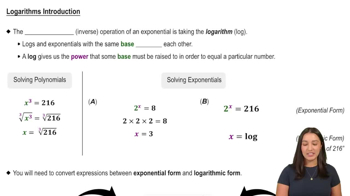
Recall the definition of logarithms: \(\log_b(a)\) asks the question, "To what power must the base \(b\) be raised to get \(a\)?"
In this problem, the base of the logarithm is 10, and the argument is \$10^7\(, so we are looking for the exponent \)x\( such that \)10^x = 10^7$.
Since the bases on both sides of the equation are the same (base 10), the exponents must be equal. Therefore, \(x = 7\).
Thus, \(\log 10^{7} = 7\) because the logarithm of a power of 10 with base 10 is simply the exponent.
This simplification uses the logarithmic identity: \(\log_b(b^k) = k\) for any positive base \(b \neq 1\) and any real number \(k\).
Verified video answer for a similar problem:
This video solution was recommended by our tutors as helpful for the problem above
Video duration:
1m
Play a video:
0 Comments
Key Concepts
Here are the essential concepts you must grasp in order to answer the question correctly.
Definition of Logarithms
A logarithm answers the question: to what exponent must the base be raised to produce a given number? For example, log_b(a) = c means b^c = a. Understanding this definition is essential for evaluating logarithmic expressions.
The logarithm of a number raised to an exponent can be simplified using the rule log_b(a^n) = n * log_b(a). This property allows you to bring the exponent in front as a multiplier, simplifying calculations without a calculator.
Common logarithms have base 10, written as log or log_10. Since log_10(10) = 1, powers of 10 simplify easily: log_10(10^n) = n. Recognizing this helps quickly evaluate expressions like log 10^7.