The equations in Exercises 79–90 combine the types of equations we have discussed in this section. Solve each equation. Then state whether the equation is an identity, a conditional equation, or an inconsistent equation. 2/x + 1/2 = 3/4
Ch. 1 - Equations and Inequalities

Chapter 2, Problem 85
In Exercises 59–94, solve each absolute value inequality. 3 ≤ |2x - 1|
Verified step by step guidance1
Recall that the absolute value inequality \(3 \leq |2x - 1|\) means the expression inside the absolute value, \$2x - 1$, is at least 3 units away from 0 on the number line.
Rewrite the inequality \(3 \leq |2x - 1|\) as two separate inequalities to remove the absolute value: \(2x - 1 \leq -3\) or \(2x - 1 \geq 3\).
Solve the first inequality \(2x - 1 \leq -3\) by adding 1 to both sides: \(2x \leq -2\), then divide both sides by 2 to get \(x \leq -1\).
Solve the second inequality \(2x - 1 \geq 3\) by adding 1 to both sides: \(2x \geq 4\), then divide both sides by 2 to get \(x \geq 2\).
Combine the two solution sets to express the final answer: \(x \leq -1\) or \(x \geq 2\).

Verified video answer for a similar problem:
This video solution was recommended by our tutors as helpful for the problem above.
Video duration:
4mWas this helpful?
Key Concepts
Here are the essential concepts you must grasp in order to answer the question correctly.
Absolute Value Definition
The absolute value of a number represents its distance from zero on the number line, always as a non-negative value. For an expression |A|, it equals A if A ≥ 0, and -A if A < 0. Understanding this helps in rewriting absolute value inequalities into equivalent compound inequalities.
Recommended video:
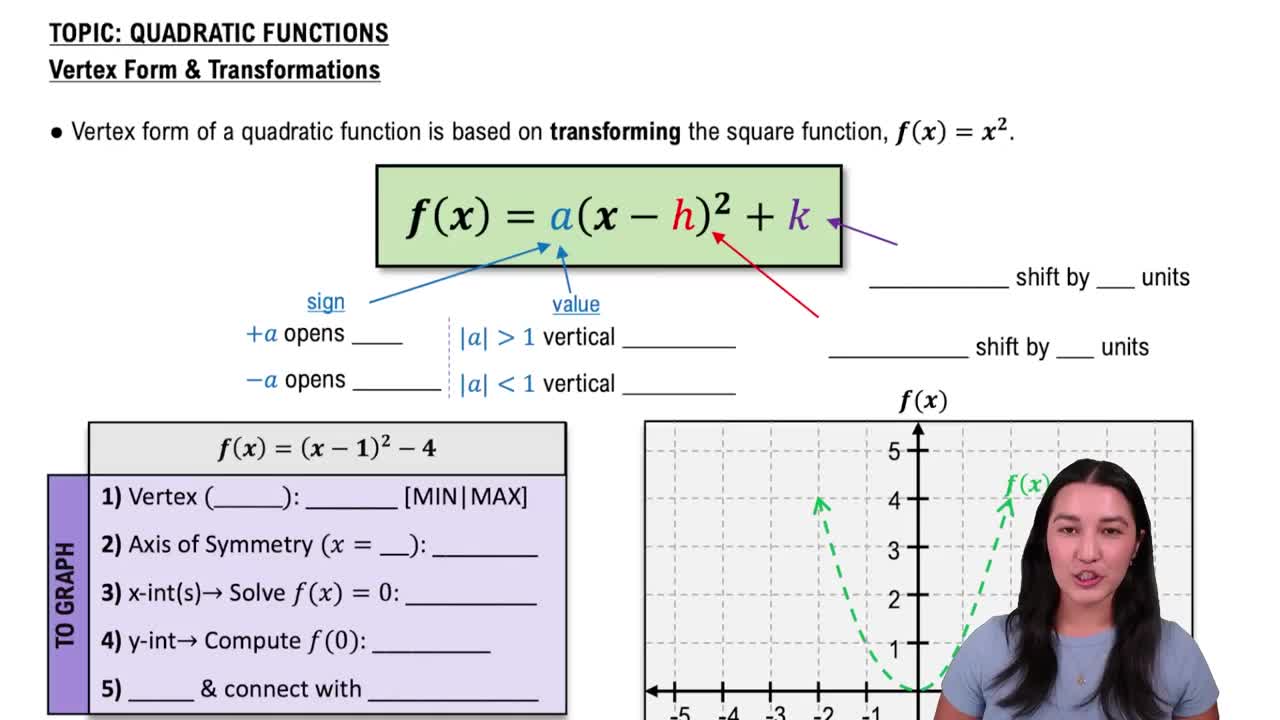
Vertex Form
Solving Absolute Value Inequalities
To solve inequalities involving absolute values, such as |A| ≥ k, where k ≥ 0, split the inequality into two cases: A ≥ k or A ≤ -k. This approach transforms the absolute value inequality into two linear inequalities that can be solved separately.
Recommended video:
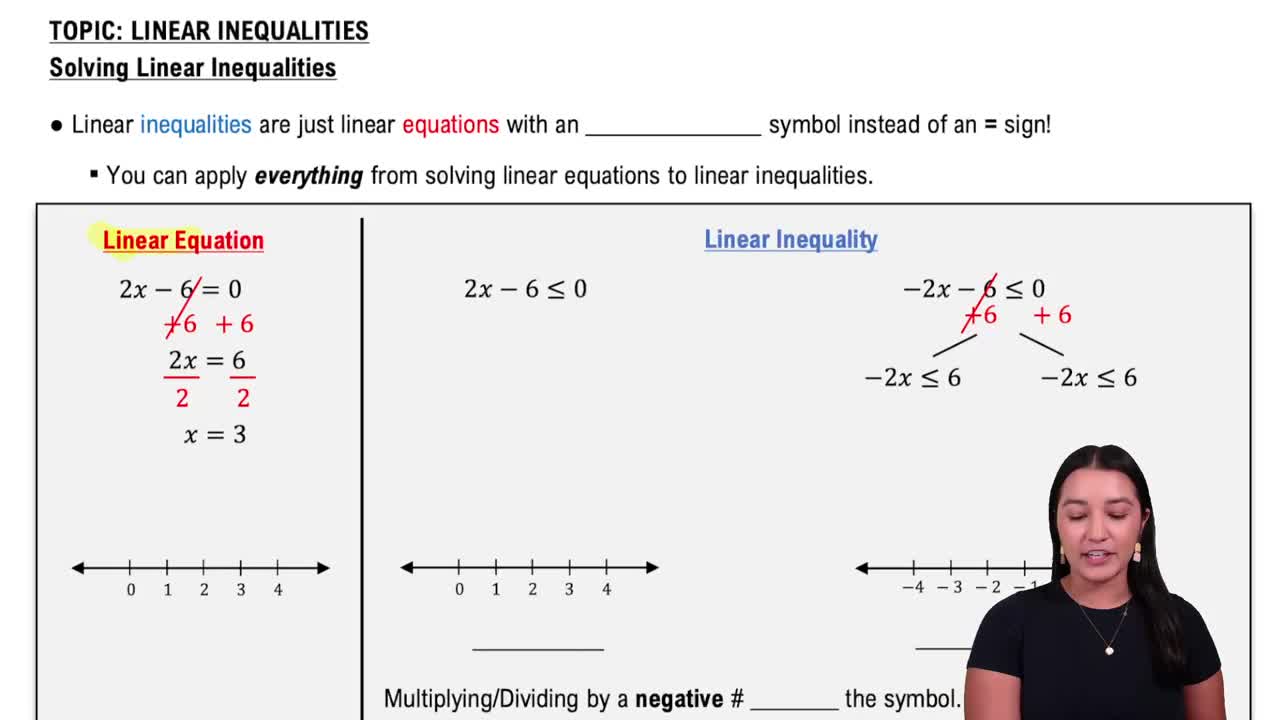
Linear Inequalities
Compound Inequalities and Solution Sets
After splitting the absolute value inequality, the solution is the union of the solution sets of the two inequalities. Understanding how to combine these sets correctly is essential to express the final answer, often in interval notation, representing all values satisfying the original inequality.
Recommended video:
Linear Inequalities
Related Practice
Textbook Question
767
views
Textbook Question
Solve each absolute value inequality. - 4|1 - x| < - 16
791
views
Textbook Question
Solve each equation in Exercises 83–108 by the method of your choice.
969
views
Textbook Question
Solve each polynomial equation in Exercises 86–87. 2x^4 = 50 x^2
576
views
Textbook Question
The rule for rewriting an absolute value equation without absolute value bars can be extended to equations with two sets of absolute value bars: If u and v represent algebraic expressions, then |u| = |v| is equivalent to u = v or u = - v. Use this to solve the equations in Exercises 77–84.
642
views
Textbook Question
In Exercises 85–90, find the x-intercepts of the graph of each equation. Then use the x-intercepts to match the equation with its graph. [The graphs are labeled (a) through (f).]
a)b)c)d)e)f)
637
views
