Identify the conic represented by the equation without completing the square. y^2 + 4x + 2y - 15 = 0
Verified step by step guidance
1
Rewrite the given equation in a more standard form by grouping terms involving the same variable: \( y^2 + 2y + 4x - 15 = 0 \).
Identify the highest degree of each variable. Notice that \( y^2 \) is the highest degree term, and there is no \( x^2 \) term. This suggests the equation might represent a parabola.
Recall the general form of a parabola: \( Ax^2 + Bxy + Cy^2 + Dx + Ey + F = 0 \). For a parabola, either \( A = 0 \) or \( C = 0 \). In this case, \( C = 1 \) (coefficient of \( y^2 \)) and \( A = 0 \) (no \( x^2 \) term), confirming it is a parabola.
The presence of the linear \( x \) term (\( 4x \)) and the linear \( y \) term (\( 2y \)) indicates that the parabola is not centered at the origin and may need further manipulation to find its vertex.
Conclude that the given equation represents a parabola. To fully analyze its properties (e.g., vertex, focus, etc.), you would complete the square, but this step is not required for this problem.
Verified video answer for a similar problem:
This video solution was recommended by our tutors as helpful for the problem above
Video duration:
2m
Play a video:
0 Comments
Key Concepts
Here are the essential concepts you must grasp in order to answer the question correctly.
Conic Sections
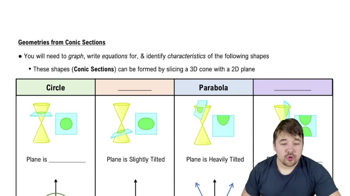
Conic sections are the curves obtained by intersecting a plane with a double-napped cone. The four primary types of conic sections are circles, ellipses, parabolas, and hyperbolas. Each type has a distinct equation and geometric properties, which can be identified by analyzing the coefficients of the variables in the equation.
Conic sections can be expressed in standard forms, which help identify their type. For example, the standard form of a parabola is y = ax^2 + bx + c, while that of a circle is (x-h)² + (y-k)² = r². By rearranging the given equation into a recognizable standard form, one can determine the specific conic represented.
The discriminant of a conic section, given by the formula D = B² - 4AC from the general equation Ax² + Bxy + Cy² + Dx + Ey + F = 0, helps classify the conic. If D < 0, it represents an ellipse; if D = 0, a parabola; and if D > 0, a hyperbola. This classification is crucial for identifying the type of conic without completing the square.

 2:53 minutes
 Verified step by step guidance
 3:08
3:08