Ch. 5 - Systems of Equations and Inequalities
Blitzer - College Algebra 8th Edition
Blitzer8th EditionCollege AlgebraISBN: 9780136970514Not the one you use?Change textbook
Chapter 6, Problem 20

In Exercises 9–42, write the partial fraction decomposition of each rational expression. (2x2 -18x -12)/x³- 4x

Verified step by step guidance
1
First, factor the denominator x3-4x. Notice that x is a common factor, so factor it out: x(x2-4). Then recognize that x2-4 is a difference of squares, which factors as (x-2)(x+2). So the fully factored denominator is x(x-2)(x+2).
Next, set up the partial fraction decomposition. Since the denominator factors into three distinct linear factors, the decomposition will be of the form: \(\frac{2x^{2}\) - 18x - 12}{x(x-2)(x+2)} = \(\frac{A}{x}\) + \(\frac{B}{x-2}\) + \(\frac{C}{x+2}\), where A, B, and C are constants to be determined.
Multiply both sides of the equation by the common denominator x(x-2)(x+2) to clear the fractions. This gives: 2x^{2} - 18x - 12 = A(x-2)(x+2) + B x (x+2) + C x (x-2).
Expand the right-hand side by multiplying out each term: A(x^{2} - 4) + B x (x+2) + C x (x-2). Then further expand to get: A x^{2} - 4A + B x^{2} + 2 B x + C x^{2} - 2 C x.
Group like terms on the right-hand side: (A + B + C) x^{2} + (2 B - 2 C) x - 4 A. Now, equate the coefficients of corresponding powers of x from both sides to form a system of equations: 2 = A + B + C (coefficient of x^{2}), -18 = 2 B - 2 C (coefficient of x), and -12 = -4 A (constant term). These equations can be solved to find the values of A, B, and C.

Verified video answer for a similar problem:

This video solution was recommended by our tutors as helpful for the problem above.
Video duration:
16m
Was this helpful?

Key Concepts

Here are the essential concepts you must grasp in order to answer the question correctly.

Rational Expressions

A rational expression is a fraction where both the numerator and denominator are polynomials. Understanding how to manipulate these expressions, including factoring and simplifying, is essential before performing partial fraction decomposition.
Recommended video:
Guided course
02:58
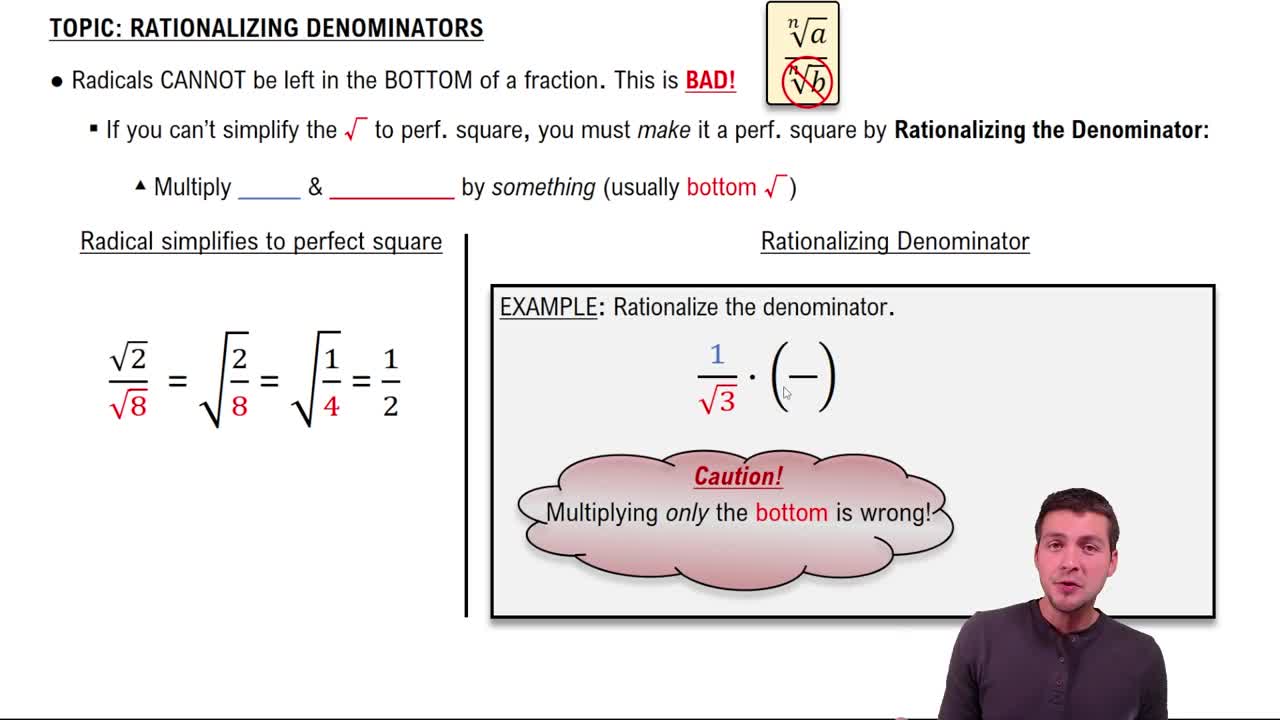
Rationalizing Denominators

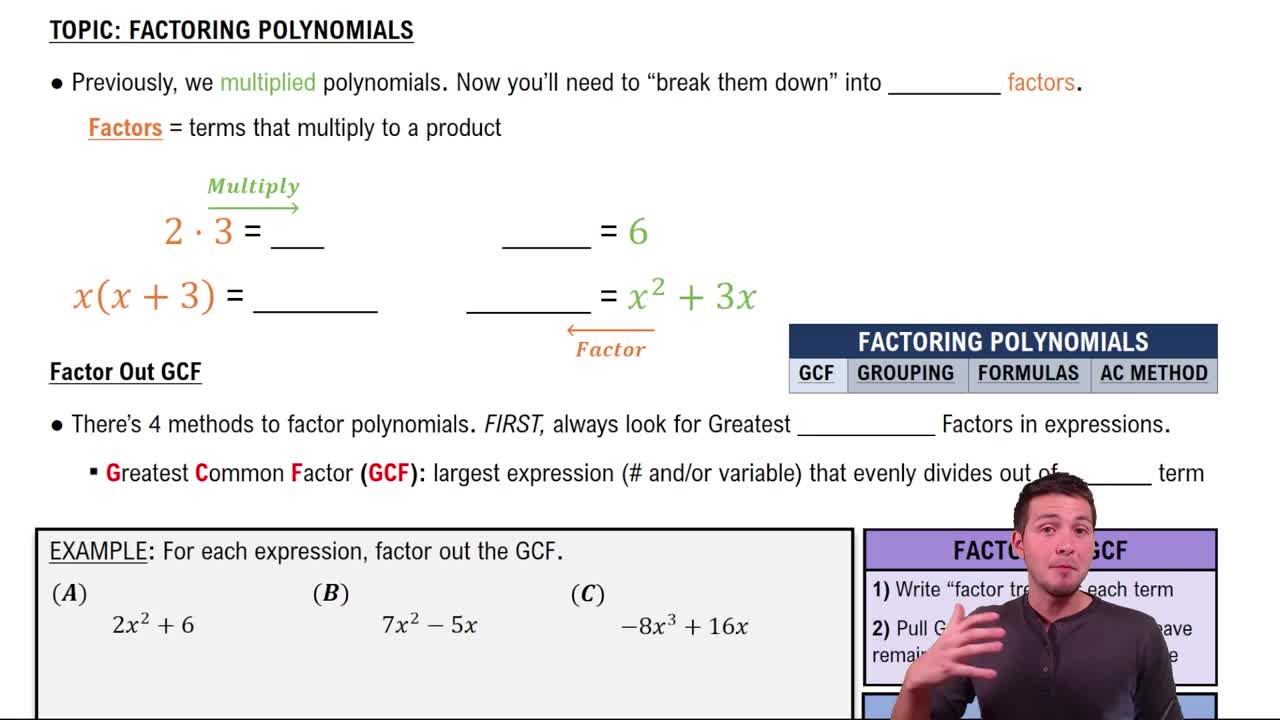
Factoring Polynomials

Factoring involves rewriting a polynomial as a product of its factors. For partial fraction decomposition, factoring the denominator completely into linear or irreducible quadratic factors is crucial to set up the correct form of the decomposition.
Recommended video:
Guided course
07:30
Introduction to Factoring Polynomials

Partial Fraction Decomposition

Partial fraction decomposition breaks a complex rational expression into a sum of simpler fractions with simpler denominators. This technique is useful for integration and solving equations, and requires setting up unknown coefficients for each factor in the denominator.
Recommended video:
4:07
Decomposition of Functions