Solve each equation using the zero-factor property. 36x2 + 60x + 25 = 0
Verified step by step guidance
1
Recognize that the equation \$36x^2 + 60x + 25 = 0\( is a quadratic equation and check if it can be factored into the form \)(ax + b)(cx + d) = 0$.
Look for two numbers that multiply to \(36 \times 25 = 900\) and add up to \(60\), which will help in factoring the middle term.
Rewrite the middle term \$60x$ as the sum of two terms using the numbers found in the previous step, then group the terms to factor by grouping.
Factor out the greatest common factor from each group to express the quadratic as a product of two binomials, i.e., \((mx + n)(px + q) = 0\).
Apply the zero-factor property by setting each factor equal to zero: \(mx + n = 0\) and \(px + q = 0\), then solve each linear equation for \(x\).
Verified video answer for a similar problem:
This video solution was recommended by our tutors as helpful for the problem above
Video duration:
1m
Play a video:
0 Comments
Key Concepts
Here are the essential concepts you must grasp in order to answer the question correctly.
Zero-Factor Property
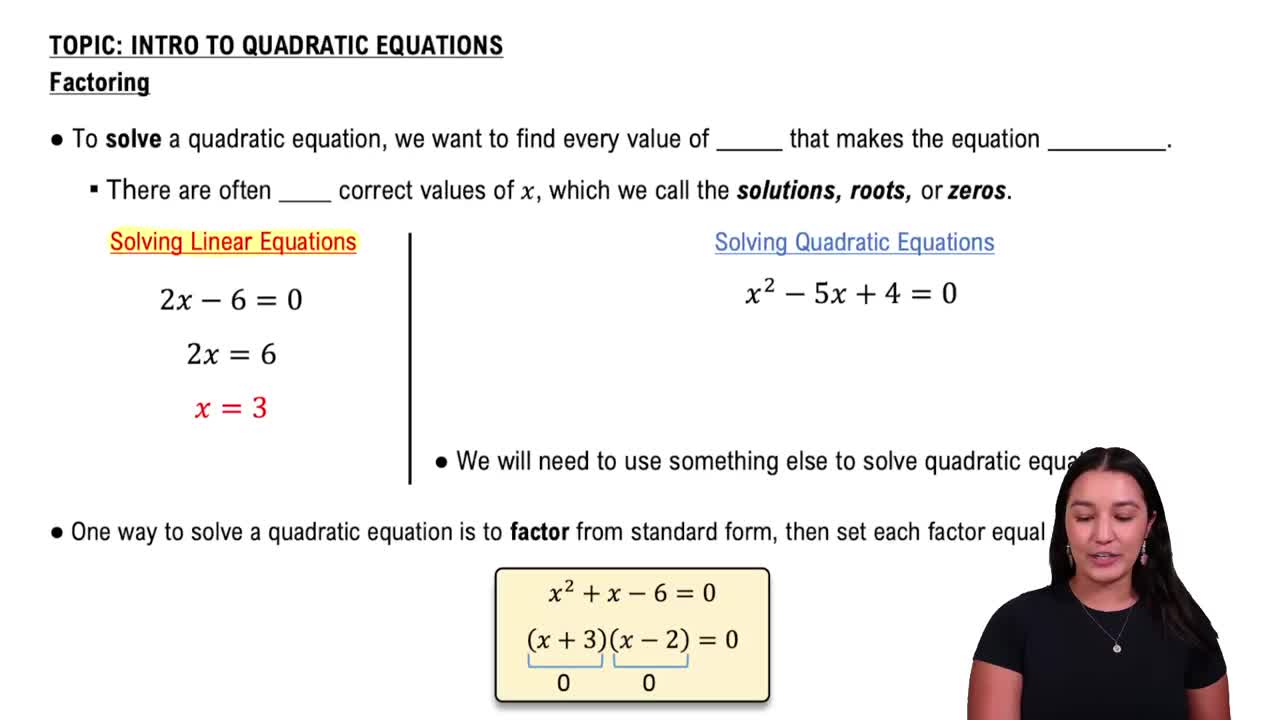
The zero-factor property states that if the product of two factors equals zero, then at least one of the factors must be zero. This property is essential for solving polynomial equations by factoring, as it allows us to set each factor equal to zero and solve for the variable.
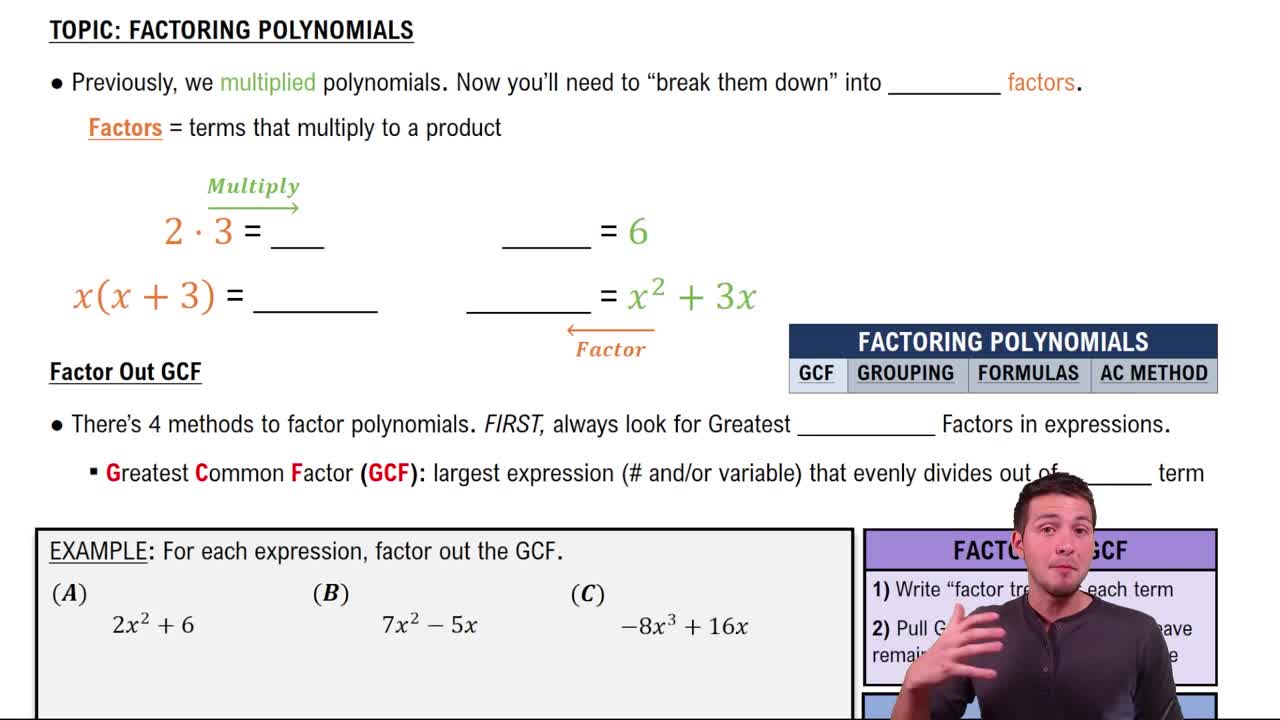
Factoring quadratic expressions involves rewriting a quadratic equation in the form ax^2 + bx + c as a product of two binomials. This step is crucial before applying the zero-factor property, as it breaks down the equation into simpler parts that can be individually set to zero.
Solving quadratic equations means finding the values of the variable that satisfy the equation. After factoring and applying the zero-factor property, each resulting linear equation is solved to find the roots or solutions of the original quadratic.

 1:38 minutes
 Verified step by step guidance
 07:30
07:30