Use the Fundamental Counting Principle to solve Exercises 29–40. A popular brand of pen is available in three colors (red, green, or blue) and four writing tips (bold, medium, fine, or micro). How many different choices of pens do you have with this brand?
Ch. 8 - Sequences, Induction, and Probability

Chapter 9, Problem 31
Write the first three terms in each binomial expansion, expressing the result in simplified form. (x+2)8
Verified step by step guidance1
Recall the Binomial Theorem, which states that for any positive integer \(n\), the expansion of \((a + b)^n\) is given by:
\[ (a + b)^n = \sum_{k=0}^n \binom{n}{k} a^{n-k} b^k \]
where \(\binom{n}{k}\) is the binomial coefficient calculated as \(\frac{n!}{k!(n-k)!}\).
Identify the values of \(a\), \(b\), and \(n\) in the expression \((x + 2)^8\). Here, \(a = x\), \(b = 2\), and \(n = 8\).
Write the first three terms of the expansion by substituting \(k = 0, 1, 2\) into the binomial formula:
- For \(k=0\):
\[ \binom{8}{0} x^{8-0} 2^0 = \binom{8}{0} x^8 \cdot 1 \]
- For \(k=1\):
\[ \binom{8}{1} x^{8-1} 2^1 = \binom{8}{1} x^7 \cdot 2 \]
- For \(k=2\):
\[ \binom{8}{2} x^{8-2} 2^2 = \binom{8}{2} x^6 \cdot 4 \]
Calculate the binomial coefficients \(\binom{8}{0}\), \(\binom{8}{1}\), and \(\binom{8}{2}\) using the formula \(\binom{n}{k} = \frac{n!}{k!(n-k)!}\) or Pascal's Triangle.
Multiply the coefficients by the powers of \(x\) and \(2\), then simplify each term to write the first three terms of the expansion in simplified form.

Verified video answer for a similar problem:
This video solution was recommended by our tutors as helpful for the problem above.
Video duration:
7mWas this helpful?
Key Concepts
Here are the essential concepts you must grasp in order to answer the question correctly.
Binomial Theorem
The Binomial Theorem provides a formula to expand expressions of the form (a + b)^n. It states that the expansion is the sum of terms involving binomial coefficients multiplied by powers of a and b. This theorem allows us to find any term in the expansion without fully multiplying the expression.
Recommended video:
Guided course
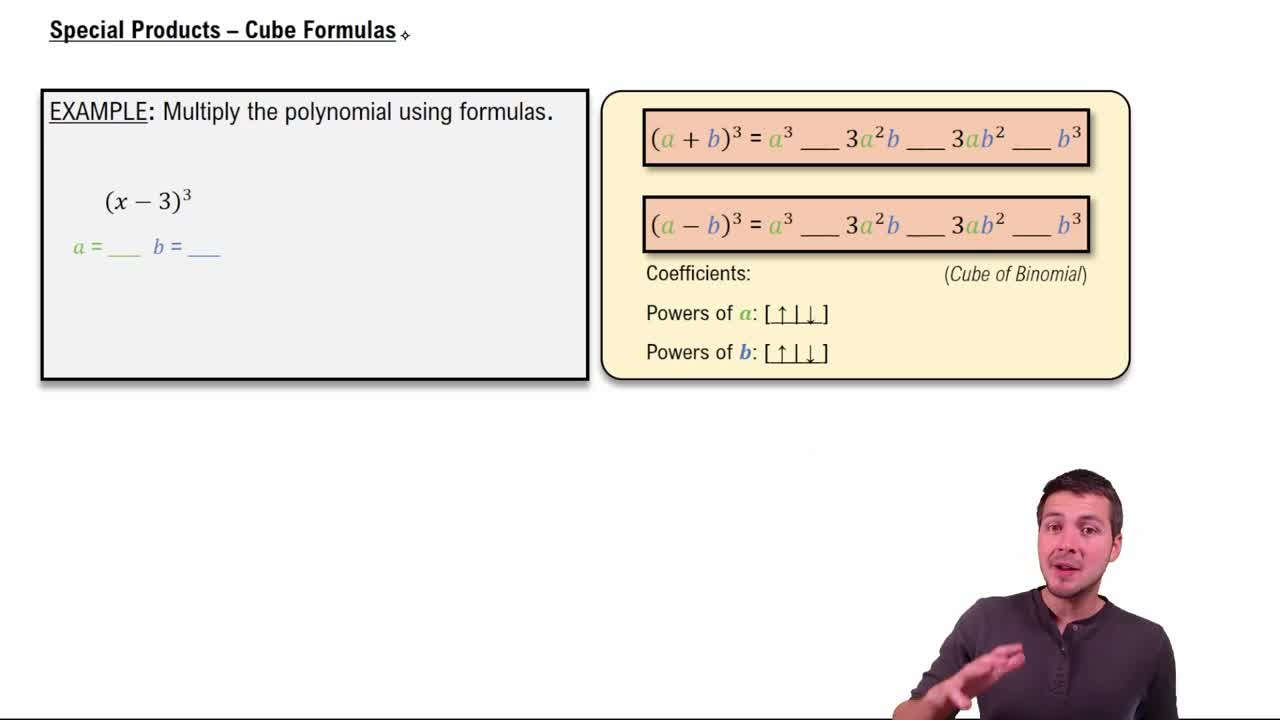
Special Products - Cube Formulas
Binomial Coefficients
Binomial coefficients, denoted as C(n, k) or "n choose k," represent the number of ways to choose k elements from n. They appear as coefficients in the binomial expansion and can be calculated using factorials or Pascal's Triangle. These coefficients determine the weight of each term in the expansion.
Recommended video:
Guided course
Special Products - Cube Formulas
Simplifying Powers and Terms
After applying the binomial theorem, each term involves powers of the variables and constants. Simplifying these powers and multiplying constants correctly is essential to express the terms in their simplest form. This step ensures the final expansion is clear and easy to interpret.
Recommended video:
Powers of i
Related Practice
Textbook Question
643
views
Textbook Question
Use mathematical induction to prove that each statement is true for every positive integer n. n + 2 > n
681
views
Textbook Question
Write a formula for the general term (the nth term) of each arithmetic sequence. Do not use a recursion formula. Then use the formula for an to find a20, the 20th term of the sequence. an = an-1 +3, a1 = 4
843
views
Textbook Question
Write a formula for the general term (the nth term) of each arithmetic sequence. Do not use a recursion formula. Then use the formula for an to find a20, the 20th term of the sequence. a1=-20, d = -4
975
views
Textbook Question
Find the indicated sum. Use the formula for the sum of the first n terms of a geometric sequence.
826
views
Textbook Question
Use the Binomial Theorem to expand each binomial and express the result in simplified form. (2a + b)6
687
views
