In Exercises 81–88, a. Find the slant asymptote of the graph of each rational function and b. Follow the seven-step strategy and use the slant asymptote to graph each rational function. f(x)=(x2+x−6)/(x−3)
Ch. 3 - Polynomial and Rational Functions

Chapter 4, Problem 86
Solve each inequality in Exercises 86–91 using a graphing utility. x2 + 3x - 10 > 0
Verified step by step guidance1
Rewrite the inequality to understand the expression clearly: \(x^{2} + 3x - 10 > 0\).
Find the roots of the quadratic equation \(x^{2} + 3x - 10 = 0\) by using the quadratic formula: \(x = \frac{-b \pm \sqrt{b^{2} - 4ac}}{2a}\), where \(a=1\), \(b=3\), and \(c=-10\).
Calculate the discriminant \(\Delta = b^{2} - 4ac\) to determine the nature of the roots.
Use the roots found to divide the number line into intervals. Test a value from each interval in the inequality \(x^{2} + 3x - 10 > 0\) to determine where the inequality holds true.
Express the solution set as intervals where the quadratic expression is greater than zero, based on the test results from the intervals.

Verified video answer for a similar problem:
This video solution was recommended by our tutors as helpful for the problem above.
Video duration:
1mWas this helpful?
Key Concepts
Here are the essential concepts you must grasp in order to answer the question correctly.
Quadratic Inequalities
A quadratic inequality involves a quadratic expression set greater than or less than a value, often zero. Solving it means finding the range of x-values where the inequality holds true. This typically requires identifying where the quadratic expression is positive or negative.
Recommended video:
Guided course
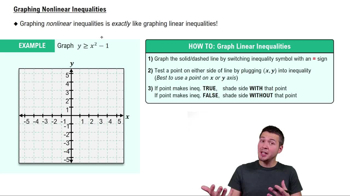
Nonlinear Inequalities
Graphing Quadratic Functions
Graphing a quadratic function y = ax² + bx + c helps visualize its shape (a parabola) and identify where it lies above or below the x-axis. The points where the graph crosses the x-axis (roots) divide the number line into intervals to test for the inequality.
Recommended video:
Graphs of Logarithmic Functions
Using a Graphing Utility
A graphing utility is a tool or calculator that plots functions quickly and accurately. It helps find the roots of the quadratic and shows where the graph is above or below the x-axis, making it easier to determine the solution set for the inequality.
Recommended video:
Graphing Rational Functions Using Transformations
Related Practice
Textbook Question
629
views
Textbook Question
Exercises 82–84 will help you prepare for the material covered in the next section. Let f(x)=an(x4−3x2−4). If f(3)=−150, determine the value of a_n.
370
views
Textbook Question
Solve each inequality in Exercises 86–91 using a graphing utility. 2x2 + 5x - 3 ≤ 0
577
views
Textbook Question
In Exercises 81–88, a. Find the slant asymptote of the graph of each rational function and b. Follow the seven-step strategy and use the slant asymptote to graph each rational function. f(x)=(x3+1)/(x2+2x)
601
views
Textbook Question
In Exercises 81–88, a. Find the slant asymptote of the graph of each rational function and b. Follow the seven-step strategy and use the slant asymptote to graph each rational function. f(x)=(x2+1)/x
604
views
Textbook Question
Solve each inequality in Exercises 86–91 using a graphing utility. x3 + x2 - 4x - 4 > 0
548
views