Ch. P - Fundamental Concepts of Algebra
Blitzer - College Algebra 8th Edition
Blitzer8th EditionCollege AlgebraISBN: 9780136970514Not the one you use?Change textbook
Chapter 1, Problem 114

In Exercises 107–114, simplify each exponential expression. Assume that variables represent nonzero real numbers. (2^−1x^−3y^−1)^−2(2x^−6y^4)^−2(9x^3y^−3)^0/(2x^−4y^−6)^2

Verified step by step guidance
1
Step 1: Simplify each term in the numerator and denominator separately. Start with the first term \((2^{-1}x^{-3}y^{-1})^{-2}\). Apply the power rule \((a^m)^n = a^{m \cdot n}\) to distribute the \(-2\) exponent to each base: \(2^{(-1)(-2)}x^{(-3)(-2)}y^{(-1)(-2)} = 2^2x^6y^2\).
Step 2: Simplify the second term \((2x^{-6}y^4)^{-2}\). Again, apply the power rule \((a^m)^n = a^{m \cdot n}\): \(2^{1 \cdot -2}x^{-6 \cdot -2}y^{4 \cdot -2} = 2^{-2}x^{12}y^{-8}\).
Step 3: Simplify the third term \((9x^3y^{-3})^0\). Any expression raised to the power of 0 is equal to 1, so \((9x^3y^{-3})^0 = 1\).
Step 4: Simplify the denominator \((2x^{-4}y^{-6})^2\). Apply the power rule \((a^m)^n = a^{m \cdot n}\): \(2^{1 \cdot 2}x^{-4 \cdot 2}y^{-6 \cdot 2} = 2^2x^{-8}y^{-12}\).
Step 5: Combine all the simplified terms into a single expression. The numerator becomes \(2^2x^6y^2 \cdot 2^{-2}x^{12}y^{-8} \cdot 1\), and the denominator is \(2^2x^{-8}y^{-12}\). Use the product rule \(a^m \cdot a^n = a^{m+n}\) to combine like bases in the numerator, and then simplify the fraction by subtracting exponents for like bases \(a^m / a^n = a^{m-n}\).

Verified video answer for a similar problem:

This video solution was recommended by our tutors as helpful for the problem above.
Video duration:
8m
Was this helpful?

Key Concepts

Here are the essential concepts you must grasp in order to answer the question correctly.

Exponential Rules

Exponential rules are fundamental properties that govern the manipulation of expressions involving exponents. Key rules include the product of powers (a^m * a^n = a^(m+n)), the power of a power ( (a^m)^n = a^(m*n)), and the power of a product ( (ab)^n = a^n * b^n). Understanding these rules is essential for simplifying complex exponential expressions.
Recommended video:
Guided course
6:54
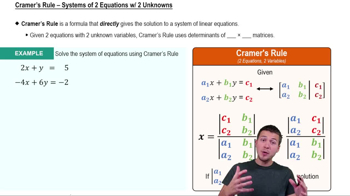
Cramer's Rule - 2 Equations with 2 Unknowns

Negative Exponents

Negative exponents indicate the reciprocal of the base raised to the opposite positive exponent. For example, a^(-n) = 1/(a^n). This concept is crucial when simplifying expressions, as it allows for the transformation of negative exponents into a more manageable form, facilitating further simplification.
Recommended video:
Guided course
6:37
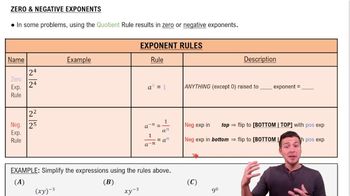
Zero and Negative Rules

Zero Exponent Rule

The zero exponent rule states that any nonzero number raised to the power of zero equals one, expressed as a^0 = 1. This rule is important in simplifying expressions, particularly when dealing with terms that may have a zero exponent, as it can significantly reduce the complexity of the expression.
Recommended video:
Guided course
7:39
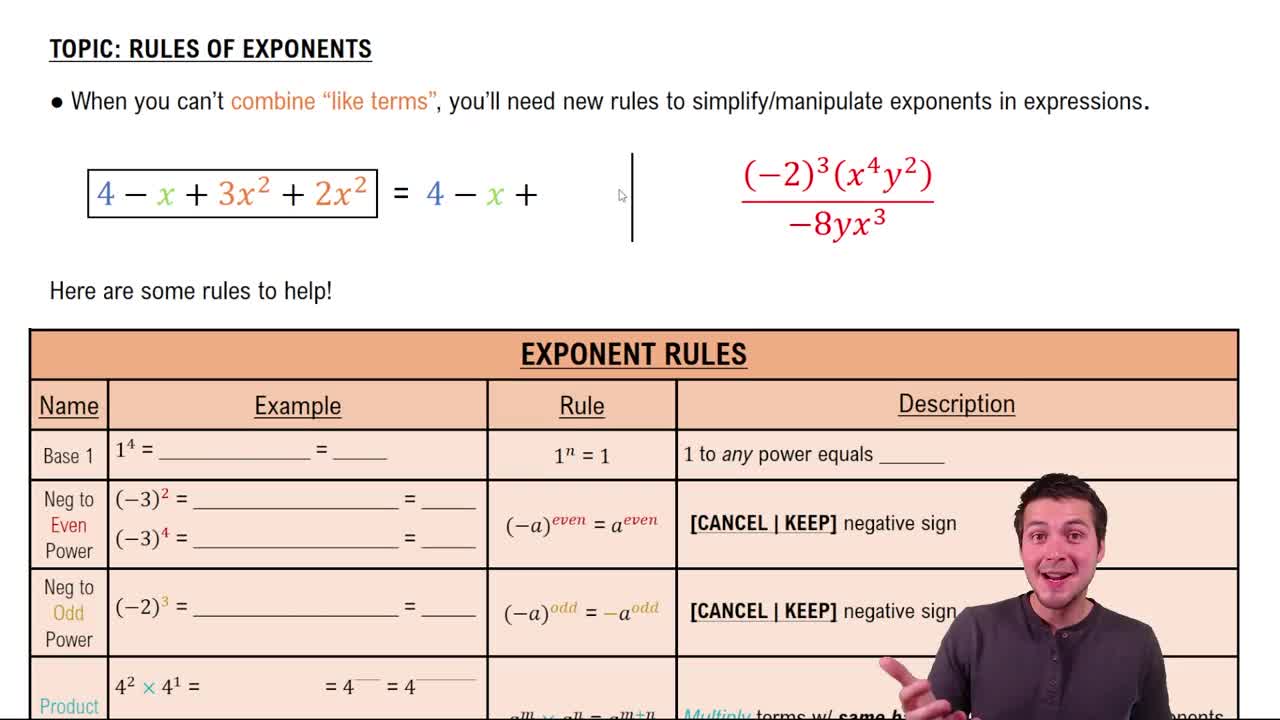
Introduction to Exponent Rules