Ch. 5 - Systems of Equations and Inequalities
Blitzer - College Algebra 8th Edition
Blitzer8th EditionCollege AlgebraISBN: 9780136970514Not the one you use?Change textbook
Chapter 6, Problem 79

Solve the systems in Exercises 79–80.
{logy x=3logy (4x)=5\(\left\)\{\(\begin{array}{l}\]\log\)_{y}\(\text{ x=3}\)\\ \(\log\)_{y}\(\text{ (4x)=5}\[\end{array}\]\right\).

Verified step by step guidance
1
Start by writing down the given system of logarithmic equations: logyx = 3 and logy(4x) = 5.
Recall the definition of logarithms: logab = c means a^c = b. Use this to rewrite each logarithmic equation in exponential form.
Rewrite the first equation: y^3 = x. Rewrite the second equation: y^5 = 4x.
Substitute the expression for x from the first equation into the second equation: replace x in y^5 = 4x with y^3, resulting in y^5 = 4y^3.
Solve the resulting equation for y by dividing both sides by y^3 (assuming y eq 0), which gives y^{5-3} = 4 or y^2 = 4. Then find the possible values of y.

Verified video answer for a similar problem:

This video solution was recommended by our tutors as helpful for the problem above.
Video duration:
5m
Was this helpful?

Key Concepts

Here are the essential concepts you must grasp in order to answer the question correctly.

Logarithmic Functions and Their Properties

A logarithm log_b(a) answers the question: to what power must the base b be raised to get a? Understanding properties like log_b(xy) = log_b(x) + log_b(y) and log_b(x^k) = k log_b(x) is essential for manipulating and solving logarithmic equations.
Recommended video:
5:26
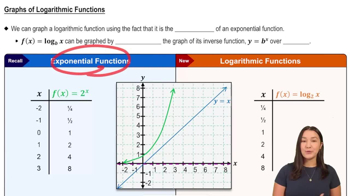
Graphs of Logarithmic Functions

Change of Base and Variable Identification

In equations involving logs with unknown bases or arguments, recognizing how to express variables and rewrite equations using properties or substitutions helps isolate variables. Here, identifying y as the base and expressing x in terms of y is key to solving the system.
Recommended video:
5:36
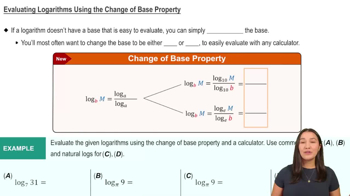
Change of Base Property

Solving Systems of Equations

A system of equations involves finding values that satisfy all equations simultaneously. Techniques include substitution or elimination. For logarithmic systems, converting logs to exponential form often simplifies the process and reveals relationships between variables.
Recommended video:
Guided course
5:48
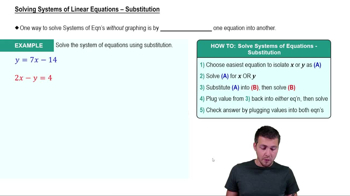
Solving Systems of Equations - Substitution