Ch. P - Fundamental Concepts of Algebra
Blitzer - College Algebra 8th Edition
Blitzer8th EditionCollege AlgebraISBN: 9780136970514Not the one you use?Change textbook
Chapter 1, Problem 58

Simplify each exponential expression in Exercises 23–64. 10x4y930x12y3\(\frac{10x^4 y^9}{30x^{12}\) y^{-3}}

Verified step by step guidance
1
Start by writing the expression clearly: \(\frac{10x^{4} y^{9}}{30x^{12} y^{-3}}\).
Simplify the coefficients (numerical parts) by dividing 10 by 30, which gives \(\frac{10}{30}\).
Apply the quotient rule for exponents to the variables with the same base: for \(x\), subtract the exponents in the denominator from those in the numerator: \(x^{4 - 12}\); for \(y\), do the same: \(y^{9 - (-3)}\).
Rewrite the expression with the simplified coefficients and the new exponents: \(\frac{10}{30} x^{4 - 12} y^{9 - (-3)}\).
Simplify the numerical fraction and the exponents to get the final simplified expression.

Verified video answer for a similar problem:

This video solution was recommended by our tutors as helpful for the problem above.
Video duration:
2m
Was this helpful?

Key Concepts

Here are the essential concepts you must grasp in order to answer the question correctly.

Laws of Exponents

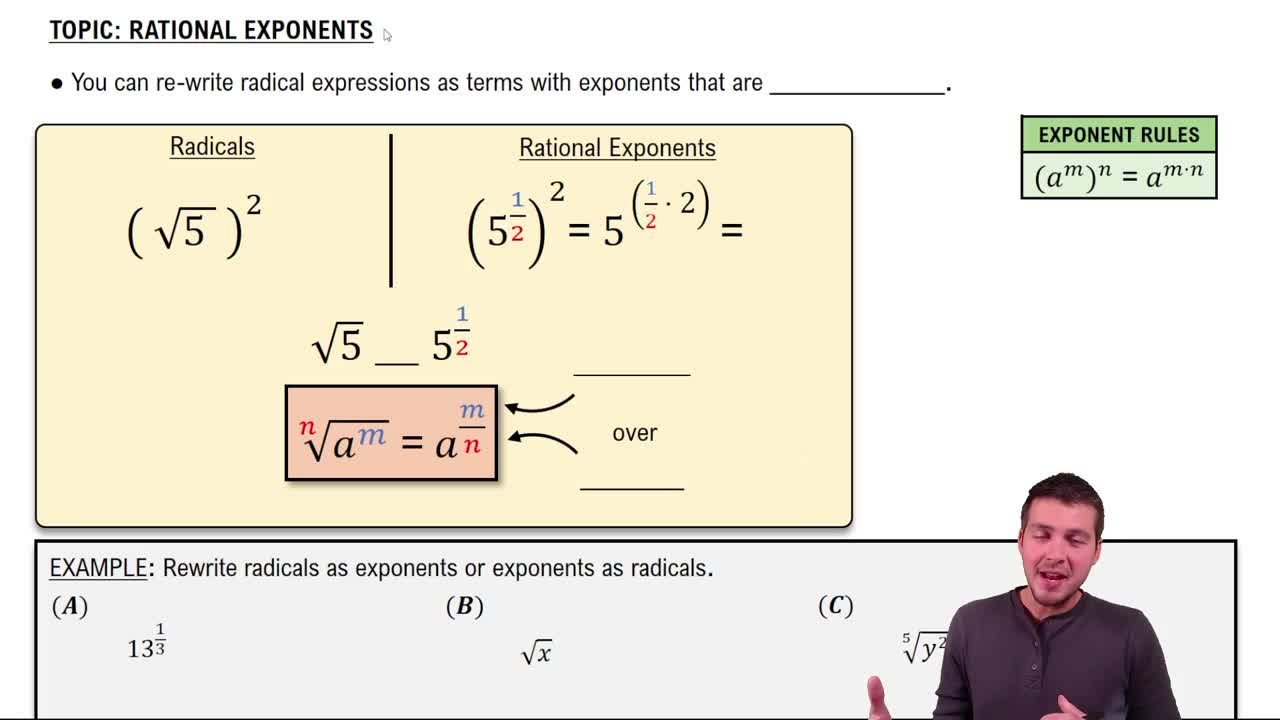
The laws of exponents govern how to simplify expressions involving powers. Key rules include dividing powers with the same base by subtracting exponents, multiplying powers by adding exponents, and handling negative exponents by rewriting them as reciprocals. These rules allow simplification of expressions like the given one.
Recommended video:
Guided course
04:06
Rational Exponents

Simplifying Algebraic Fractions

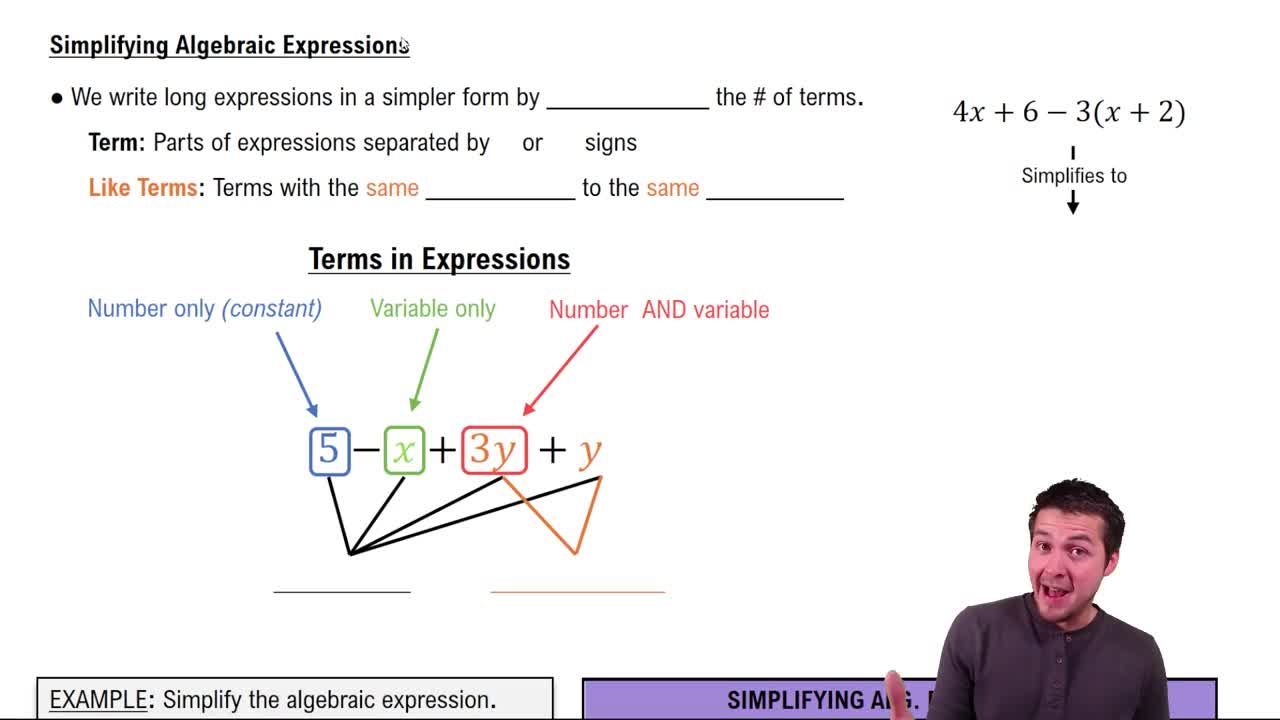
Simplifying algebraic fractions involves reducing coefficients and variables separately. Coefficients are simplified by dividing their numerical values, while variables with exponents are simplified using exponent rules. This process helps to rewrite the expression in its simplest form.
Recommended video:
Guided course
05:07
Simplifying Algebraic Expressions

Negative Exponents

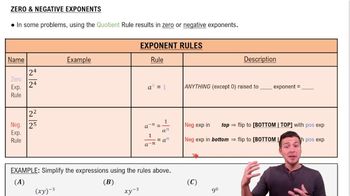
A negative exponent indicates the reciprocal of the base raised to the positive exponent. For example, x^(-n) equals 1/x^n. Understanding this concept is essential to simplify terms like y^(-3) in the denominator by moving them to the numerator with a positive exponent.
Recommended video:
Guided course
6:37
Zero and Negative Rules