In Exercises 17–24, a) List all possible rational roots. b) List all possible rational roots. c) Use the quotient from part (b) to find the remaining roots and solve the equation. 6x3+25x2−24x+5=0
Ch. 3 - Polynomial and Rational Functions

Chapter 4, Problem 21
Solve each polynomial inequality in Exercises 1–42 and graph the solution set on a real number line. Express each solution set in interval notation.
Verified step by step guidance1
Start by rewriting the inequality: \$2x^{2} + 3x > 0$.
Factor the left-hand side expression: \(x(2x + 3) > 0\).
Identify the critical points by setting each factor equal to zero: \(x = 0\) and \(2x + 3 = 0 \Rightarrow x = -\frac{3}{2}\).
Use the critical points to divide the real number line into intervals: \((-\infty, -\frac{3}{2})\), \((-\frac{3}{2}, 0)\), and \((0, \infty)\).
Test a value from each interval in the factored inequality \(x(2x + 3) > 0\) to determine where the product is positive, then express the solution set in interval notation.

Verified video answer for a similar problem:
This video solution was recommended by our tutors as helpful for the problem above.
Video duration:
1mWas this helpful?
Key Concepts
Here are the essential concepts you must grasp in order to answer the question correctly.
Polynomial Inequalities
Polynomial inequalities involve expressions where a polynomial is compared to zero or another value using inequality symbols like >, <, ≥, or ≤. Solving them requires finding the values of the variable that make the inequality true, often by analyzing the sign of the polynomial over different intervals.
Recommended video:
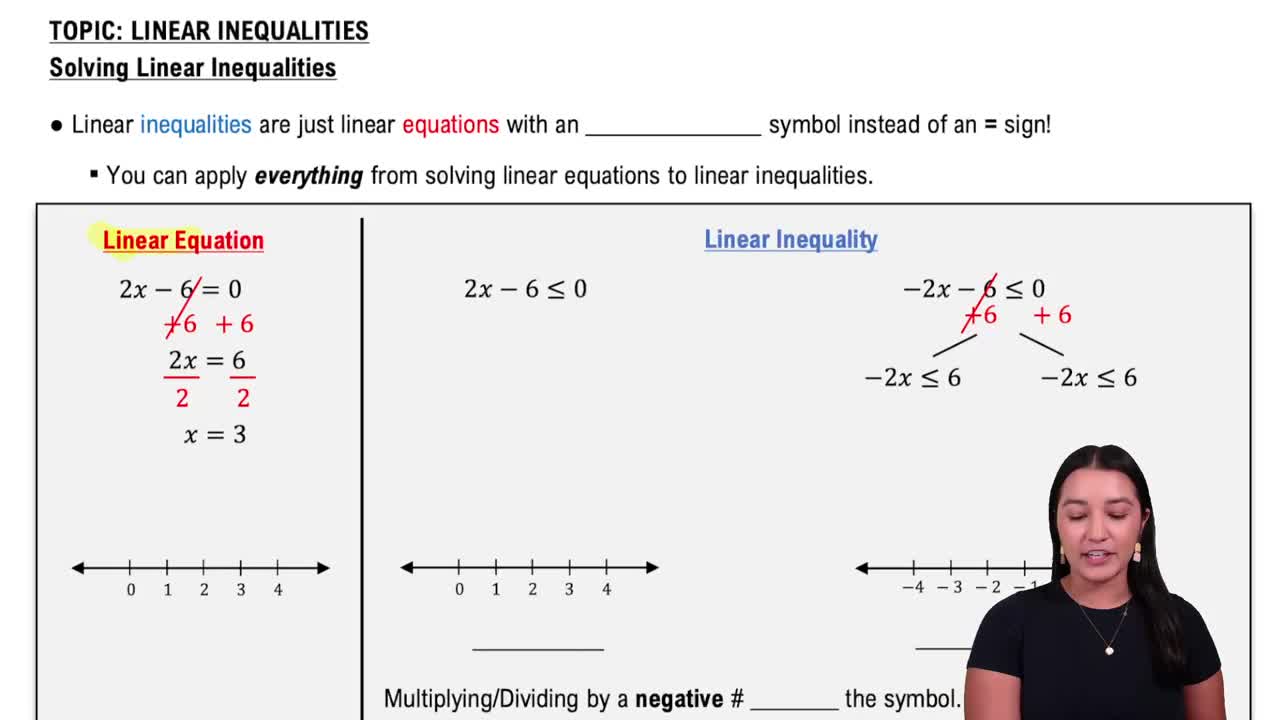
Linear Inequalities
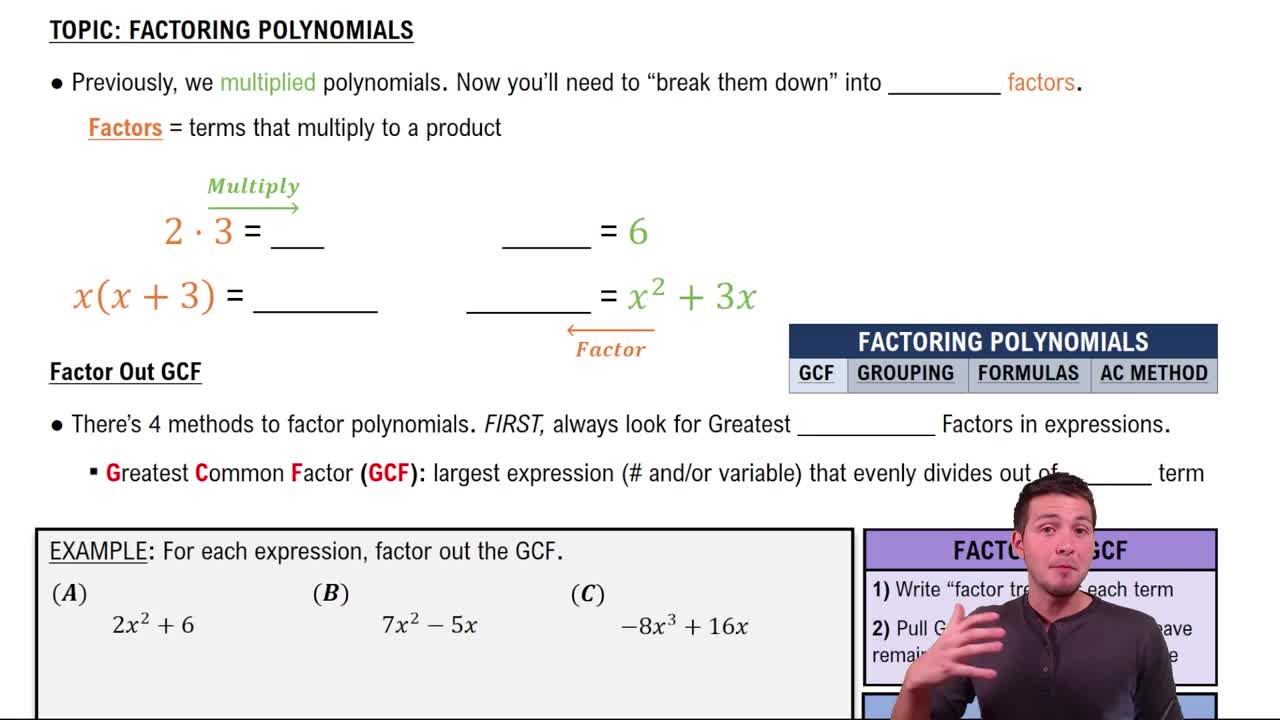
Factoring Quadratic Polynomials
Factoring quadratic polynomials means rewriting the expression as a product of two binomials or simpler polynomials. This step is crucial for solving inequalities because it helps identify the roots or zeros, which divide the number line into intervals to test for the inequality.
Recommended video:
Guided course
Introduction to Factoring Polynomials
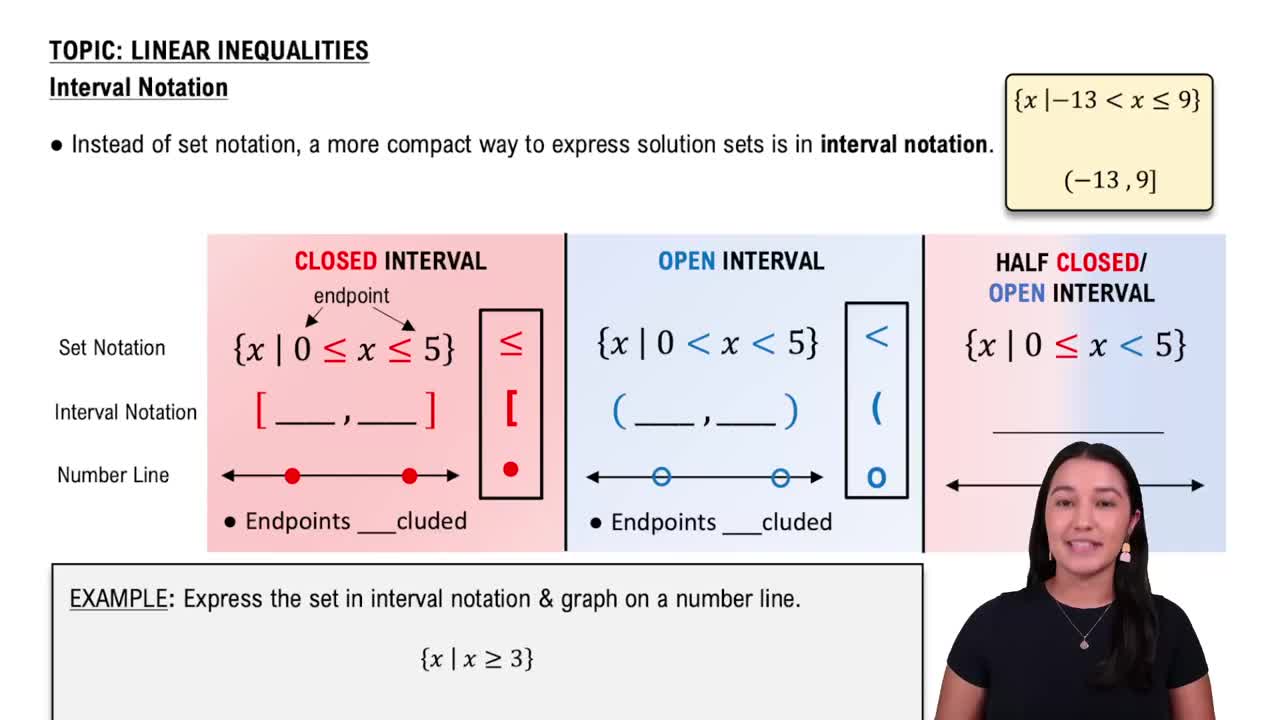
Interval Notation and Graphing on the Number Line
Interval notation is a concise way to represent sets of real numbers that satisfy inequalities, using parentheses and brackets to indicate open or closed intervals. Graphing the solution on a number line visually shows where the polynomial inequality holds true, aiding in understanding and verification.
Recommended video:
Interval Notation
Related Practice
Textbook Question
111
views
Textbook Question
Divide using synthetic division. (4x3−3x2+3x−1)÷(x−1)
554
views
Textbook Question
In Exercises 19–24, (a) Use the Leading Coefficient Test to determine the graph's end behavior. (b) Determine whether the graph has y-axis symmetry, origin symmetry, or neither. (c) Graph the function.
1426
views
Textbook Question
Find the vertical asymptotes, if any, and the values of x corresponding to holes, if any, of the graph of each rational function. f(x)=x/(x+4)
900
views
Textbook Question
Use the Leading Coefficient Test to determine the end behavior of the graph of the polynomial function.
549
views
Textbook Question
Use the vertex and intercepts to sketch the graph of each quadratic function. Give the equation of the parabola's axis of symmetry. Use the graph to determine the function's domain and range. y−1=(x−3)2
621
views