In Exercises 1 - 24, use Gaussian Elimination to find the complete solution to each system of equations, or show that none exists.
Ch. 6 - Matrices and Determinants

Chapter 7, Problem 18
In Exercises 14–27, perform the indicated matrix operations given that and D are defined as follows. If an operation is not defined, state the reason. 3A+2D
Verified step by step guidance1
Step 1: Understand the problem. The problem asks us to perform the matrix operation 3A + 2D, where A and D are matrices. This involves scalar multiplication and matrix addition. Ensure that the matrices A and D are provided and have the same dimensions, as matrix addition is only defined for matrices of the same size.
Step 2: Perform scalar multiplication. Multiply each element of matrix A by the scalar 3 to compute 3A. Similarly, multiply each element of matrix D by the scalar 2 to compute 2D. Scalar multiplication is performed element-wise.
Step 3: Verify dimensions. Before adding the resulting matrices (3A and 2D), confirm that they have the same dimensions. If they do not, the operation is not defined, and you should state this as the reason.
Step 4: Add the matrices. If the dimensions match, add the corresponding elements of 3A and 2D to compute the resulting matrix. Matrix addition is performed element-wise.
Step 5: Write the resulting matrix. After performing the addition, write the resulting matrix as the final answer. If the operation is not defined, clearly state the reason (e.g., mismatched dimensions).

Verified video answer for a similar problem:
This video solution was recommended by our tutors as helpful for the problem above.
Video duration:
4mWas this helpful?
Key Concepts
Here are the essential concepts you must grasp in order to answer the question correctly.
Matrix Operations
Matrix operations include addition, subtraction, and scalar multiplication. For two matrices to be added or subtracted, they must have the same dimensions. Scalar multiplication involves multiplying each element of a matrix by a scalar (a single number), which can change the size of the matrix but not its structure.
Recommended video:
Guided course
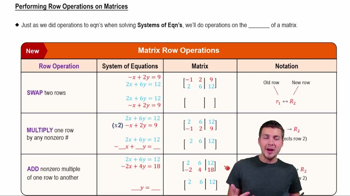
Performing Row Operations on Matrices
Matrix Dimensions
The dimensions of a matrix are defined by the number of rows and columns it contains, expressed as 'm x n' where 'm' is the number of rows and 'n' is the number of columns. Understanding dimensions is crucial for determining whether certain operations, like addition or multiplication, can be performed between matrices.
Recommended video:
Guided course
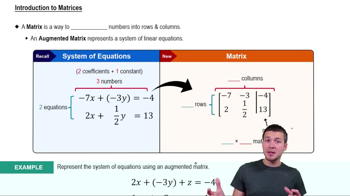
Introduction to Matrices
Scalar Multiplication
Scalar multiplication is the process of multiplying each entry of a matrix by a scalar value. This operation affects the magnitude of the matrix but not its shape. In the expression '3A + 2D', the matrices A and D are first multiplied by their respective scalars before any addition is performed, assuming both matrices are compatible in dimensions.
Recommended video:
Finding Zeros & Their Multiplicity
Related Practice
Textbook Question
670
views
Textbook Question
Let and Solve each matrix equation for X. X - A = B
74
views
Textbook Question
In Exercises 1 - 24, use Gaussian Elimination to find the complete solution to each system of equations, or show that none exists.
599
views
Textbook Question
In Exercises 19–20, a few steps in the process of simplifying the given matrix to row-echelon form, with 1s down the diagonal from upper left to lower right, and 0s below the 1s, are shown. Fill in the missing numbers in the steps that are shown.
1213
views
Textbook Question
Perform each matrix row operation and write the new matrix.
937
views
Textbook Question
For Exercises 11–22, use Cramer's Rule to solve each system.
798
views