Ch. 3 - Polynomial and Rational Functions
Blitzer - College Algebra 8th Edition
Blitzer8th EditionCollege AlgebraISBN: 9780136970514Not the one you use?Change textbook
Chapter 4, Problem 28

Find the zeros for each polynomial function and give the multiplicity for each zero. State whether the graph crosses the x-axis, or touches the x-axis and turns around, at each zero. f(x)=−3(x+1/2)(x−4)3

Verified step by step guidance
1
Identify the zeros of the polynomial function by setting each factor equal to zero. For the function \(f(x) = -3\left(x + \frac{1}{2}\right)\left(x - 4\right)^3\), the zeros come from solving \(x + \frac{1}{2} = 0\) and \(x - 4 = 0\).
Solve each equation to find the zeros: \(x + \frac{1}{2} = 0\) gives \(x = -\frac{1}{2}\), and \(x - 4 = 0\) gives \(x = 4\).
Determine the multiplicity of each zero by looking at the exponent on each factor. The factor \(\left(x + \frac{1}{2}\right)\) has an implied exponent of 1, so its multiplicity is 1. The factor \(\left(x - 4\right)^3\) has an exponent of 3, so its multiplicity is 3.
Use the multiplicity to describe the behavior of the graph at each zero: if the multiplicity is odd (like 1 or 3), the graph crosses the x-axis at that zero. If the multiplicity were even, the graph would touch the x-axis and turn around at that zero.
Summarize the results: at \(x = -\frac{1}{2}\) (multiplicity 1), the graph crosses the x-axis; at \(x = 4\) (multiplicity 3), the graph also crosses the x-axis but with a flatter, cubic behavior near the zero.

Verified video answer for a similar problem:

This video solution was recommended by our tutors as helpful for the problem above.
Video duration:
3m
Was this helpful?

Key Concepts

Here are the essential concepts you must grasp in order to answer the question correctly.

Zeros of a Polynomial Function

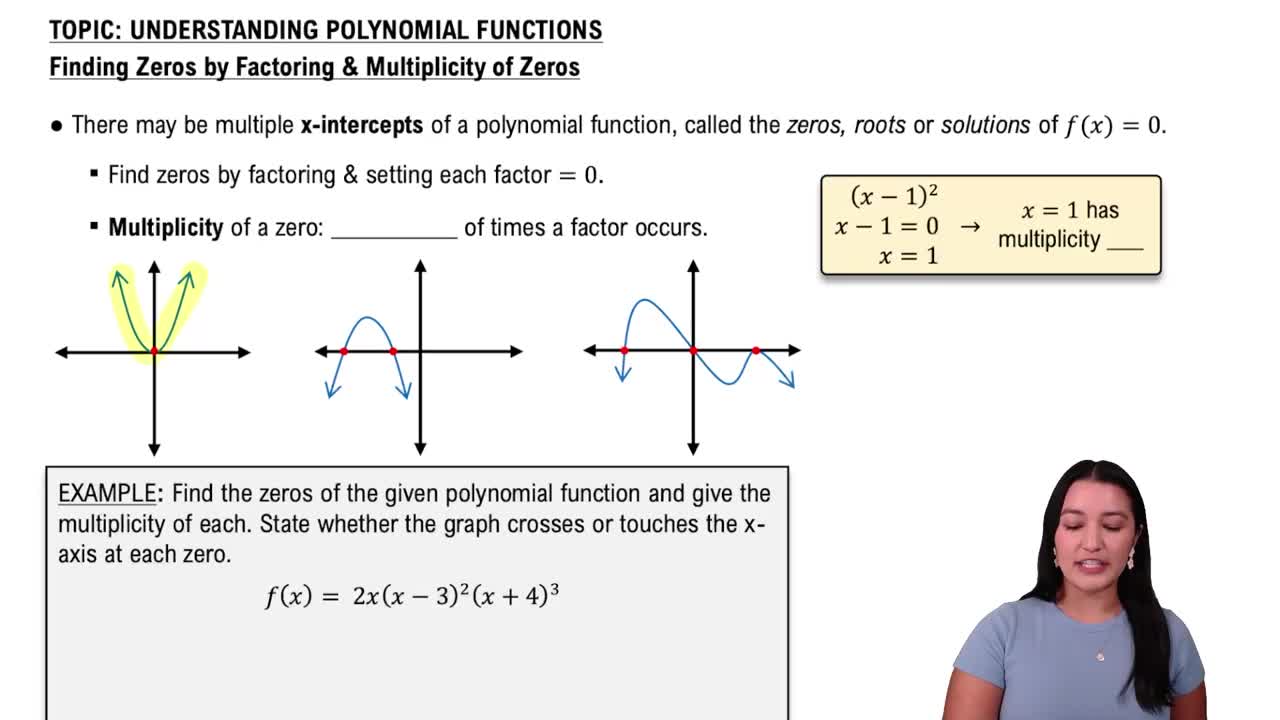
Zeros of a polynomial are the values of x that make the function equal to zero. They correspond to the x-intercepts of the graph. Finding zeros involves setting the polynomial equal to zero and solving for x, often by factoring or using the zero-product property.
Recommended video:
03:42
Finding Zeros & Their Multiplicity

Multiplicity of Zeros

Multiplicity refers to the number of times a particular zero appears as a factor in the polynomial. If a zero has an odd multiplicity, the graph crosses the x-axis at that zero; if even, the graph touches and turns around without crossing.
Recommended video:
03:42
Finding Zeros & Their Multiplicity

Behavior of the Graph at Zeros

The graph's behavior at each zero depends on the zero's multiplicity. For odd multiplicities, the graph crosses the x-axis, while for even multiplicities, it only touches and reverses direction. This helps in sketching the polynomial's graph accurately.
Recommended video:
05:01
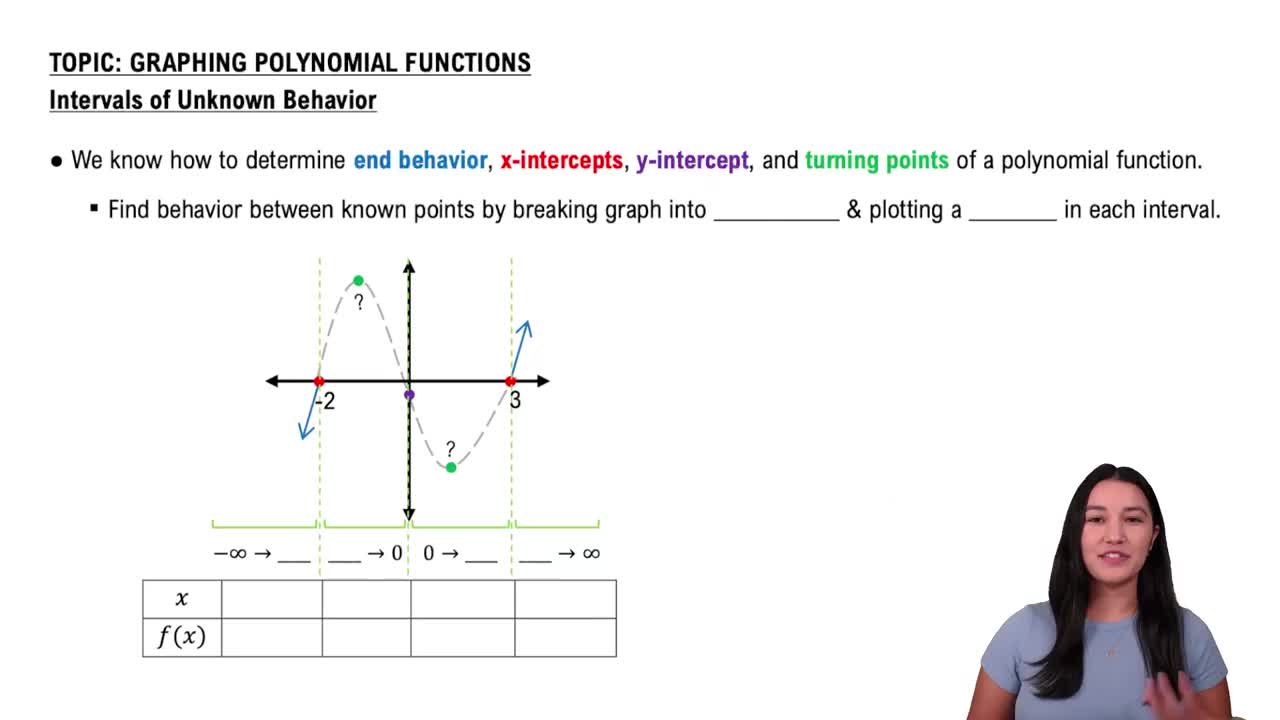
Identifying Intervals of Unknown Behavior