In Exercises 33–40, use the Intermediate Value Theorem to show that each polynomial has a real zero between the given integers. f(x)=x5−x3−1; between 1 and 2
Ch. 3 - Polynomial and Rational Functions

Chapter 4, Problem 39
Solve each polynomial inequality in Exercises 1–42 and graph the solution set on a real number line. Express each solution set in interval notation.
Verified step by step guidance1
First, rewrite the inequality clearly: \(x^3 + x^2 + 4x + 4 > 0\).
Next, factor the cubic polynomial if possible. Try to factor by grouping: group terms as \((x^3 + x^2) + (4x + 4)\).
Factor out common factors from each group: \(x^2(x + 1) + 4(x + 1)\).
Since both groups contain the factor \((x + 1)\), factor it out: \((x + 1)(x^2 + 4) > 0\).
Analyze the factors separately: \(x + 1\) and \(x^2 + 4\). Note that \(x^2 + 4\) is always positive for all real \(x\) because \(x^2 \geq 0\) and adding 4 keeps it positive. So the inequality depends on the sign of \(x + 1\).

Verified video answer for a similar problem:
This video solution was recommended by our tutors as helpful for the problem above.
Video duration:
6mWas this helpful?
Key Concepts
Here are the essential concepts you must grasp in order to answer the question correctly.
Polynomial Inequalities
Polynomial inequalities involve expressions where a polynomial is compared to zero or another value using inequality signs (>, <, ≥, ≤). Solving them requires finding the values of the variable that make the inequality true, often by analyzing the sign of the polynomial over different intervals.
Recommended video:
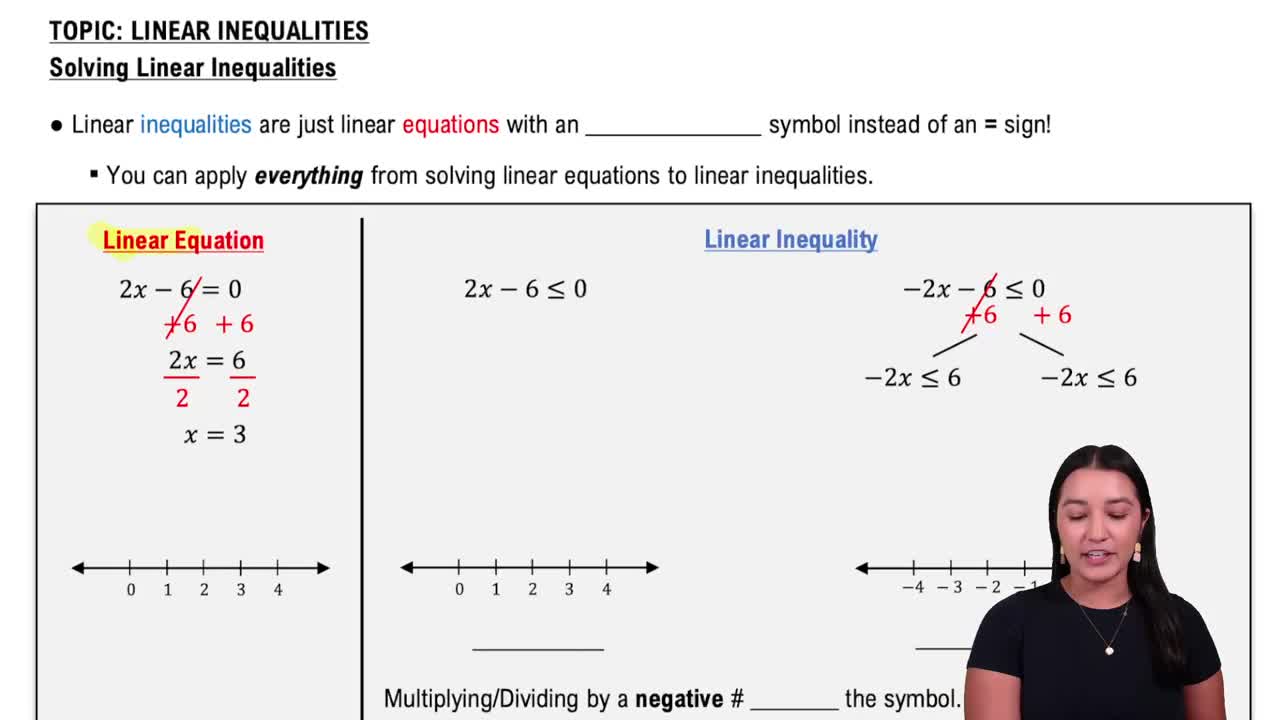
Linear Inequalities
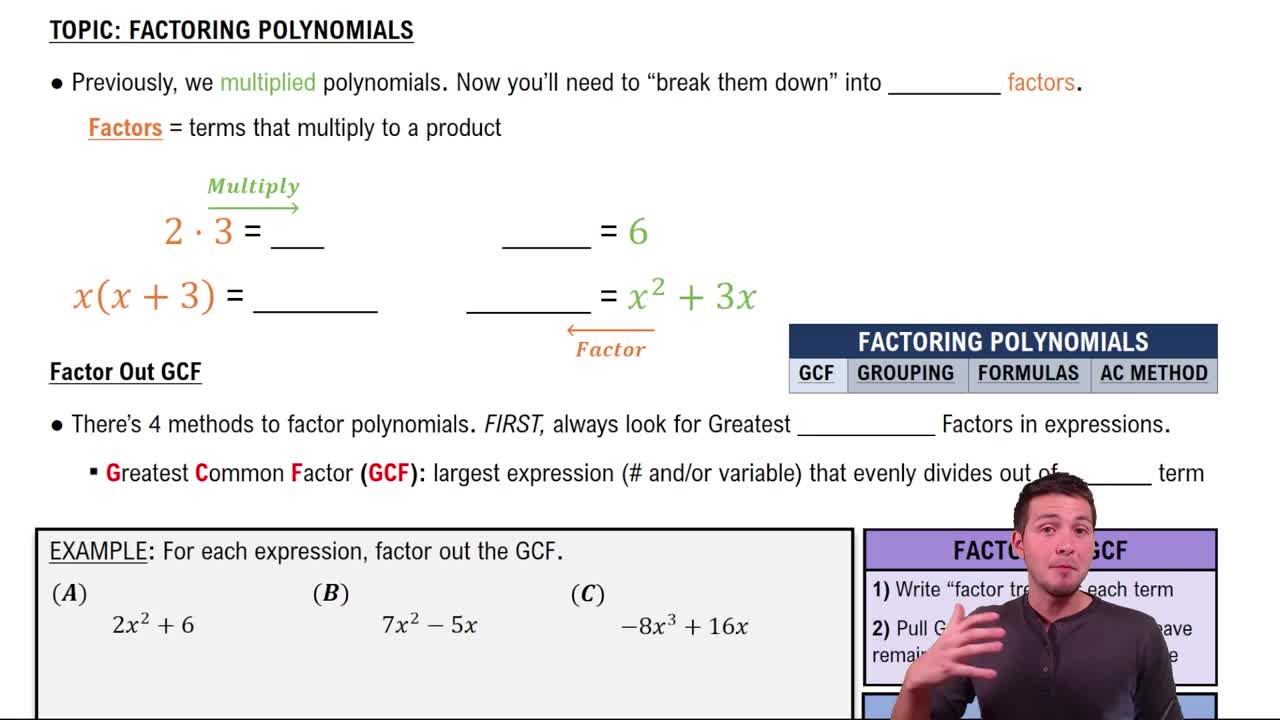
Factoring Polynomials
Factoring is the process of breaking down a polynomial into simpler polynomials (factors) whose product equals the original polynomial. This helps identify the roots or zeros of the polynomial, which are critical points for determining where the polynomial changes sign.
Recommended video:
Guided course
Introduction to Factoring Polynomials
Interval Notation and Number Line Graphing
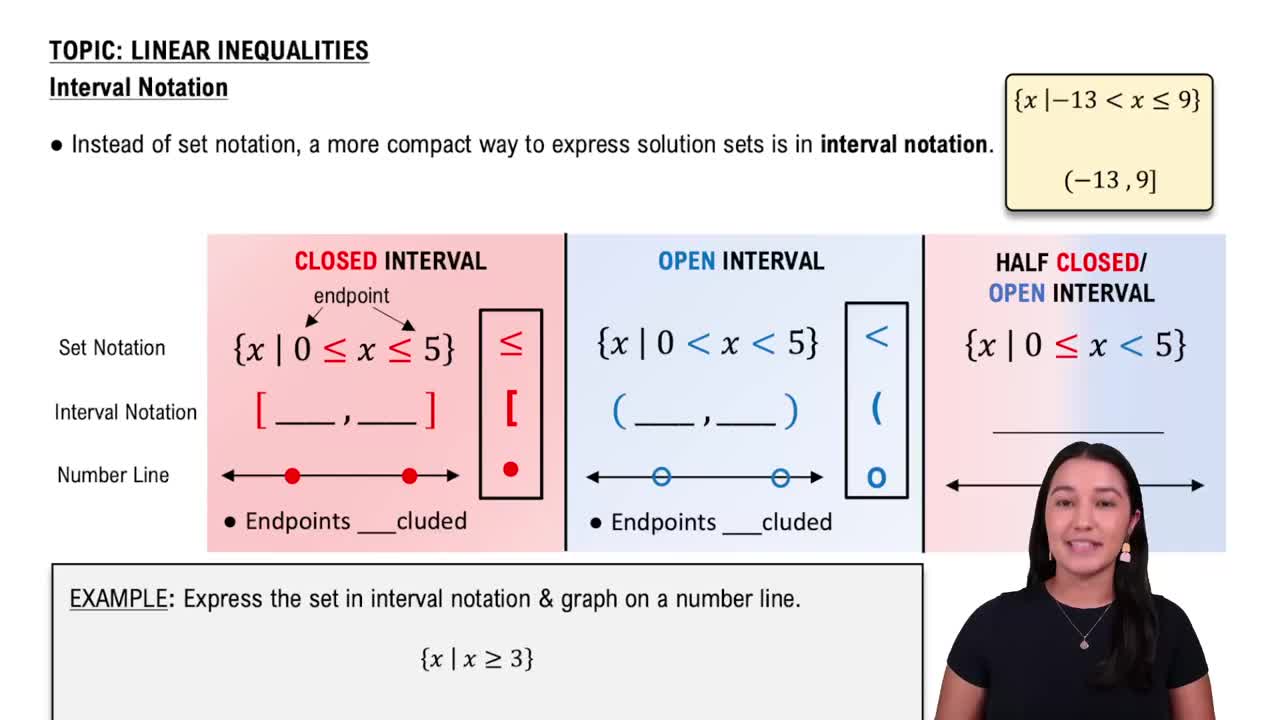
Interval notation is a concise way to represent sets of real numbers, especially solution sets of inequalities. Graphing on a number line visually shows where the polynomial is positive or negative, helping to interpret and communicate the solution clearly.
Recommended video:
Interval Notation
Related Practice
Textbook Question
519
views
Textbook Question
Use Descartes' Rule of Signs to explain why has no real roots.
950
views
Textbook Question
In Exercises 17–38, use the vertex and intercepts to sketch the graph of each quadratic function. Give the equation of the parabola's axis of symmetry. Use the graph to determine the function's domain and range. f(x)=2x−x2−2
1007
views
Textbook Question
Solve each polynomial inequality in Exercises 1–42 and graph the solution set on a real number line. Express each solution set in interval notation.
618
views
Textbook Question
Find the horizontal asymptote, if there is one, of the graph of each rational function. g(x)=12x2/(3x2+1)
909
views
Textbook Question
Use the Intermediate Value Theorem to show that each polynomial has a real zero between the given integers. f(x)=3x3−10x+9; between -3 and -2
577
views