Factor each polynomial. See Examples 5 and 6. x4-16
Verified step by step guidance
1
Recognize that the polynomial \(x^4 - 16\) is a difference of squares because it can be written as \((x^2)^2 - 4^2\).
Apply the difference of squares formula: \(a^2 - b^2 = (a - b)(a + b)\), where \(a = x^2\) and \(b = 4\). This gives us \((x^2 - 4)(x^2 + 4)\).
Notice that \(x^2 - 4\) is itself a difference of squares and can be factored further as \((x - 2)(x + 2)\).
The term \(x^2 + 4\) is a sum of squares, which does not factor over the real numbers, so it remains as is.
Combine all factors to express the fully factored form: \((x - 2)(x + 2)(x^2 + 4)\).
Verified video answer for a similar problem:
This video solution was recommended by our tutors as helpful for the problem above
Video duration:
1m
Play a video:
0 Comments
Key Concepts
Here are the essential concepts you must grasp in order to answer the question correctly.
Difference of Squares
The difference of squares is a factoring technique used when an expression is in the form a^2 - b^2. It factors into (a - b)(a + b). Recognizing this pattern helps simplify polynomials like x^4 - 16 by expressing terms as squares.
Solving Quadratic Equations by Completing the Square
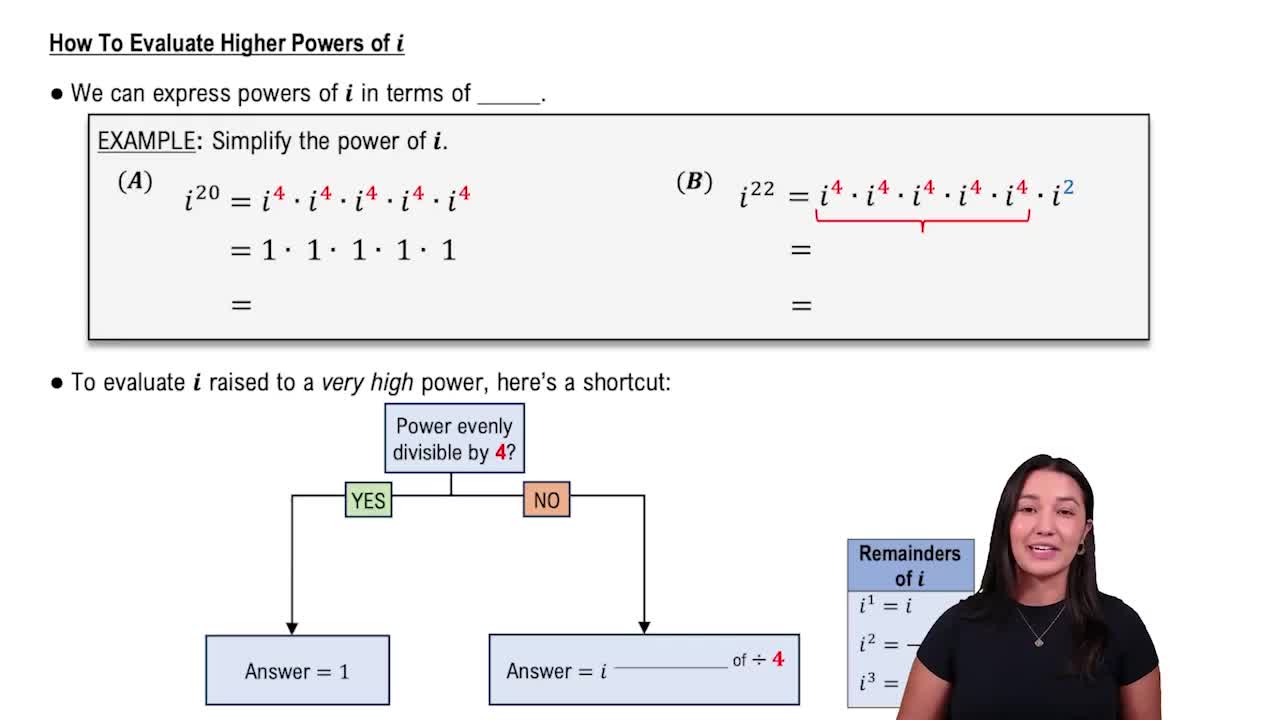
Factoring Higher Powers
Polynomials with higher powers, such as x^4, can often be rewritten as powers of squares (e.g., (x^2)^2). This allows the use of difference of squares repeatedly to factor completely, breaking down complex expressions step-by-step.
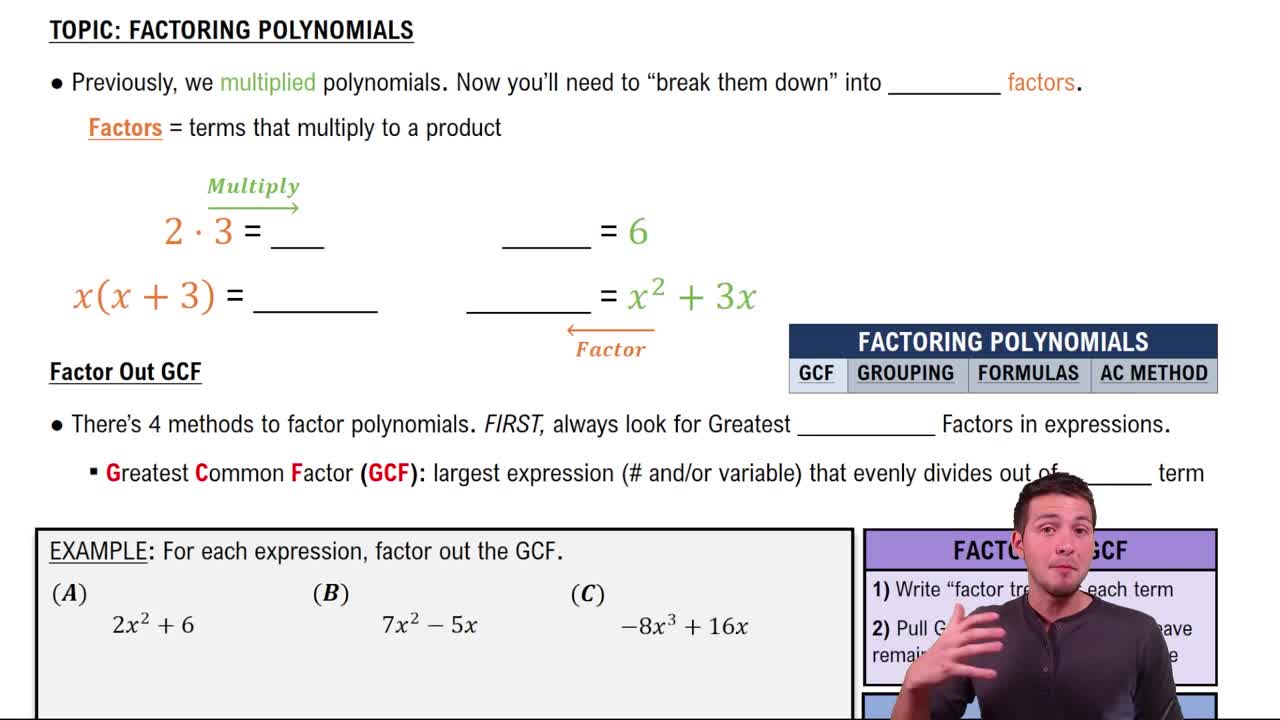
Factoring polynomials involves identifying patterns and applying appropriate methods like difference of squares, grouping, or special formulas. A systematic approach ensures complete factorization, which is essential for solving or simplifying polynomial expressions.

 1:58 minutes
 Verified step by step guidance
 06:24
06:24