Ch. 2 - Functions and Graphs
Blitzer - College Algebra 8th Edition
Blitzer8th EditionCollege AlgebraISBN: 9780136970514Not the one you use?Change textbook
Chapter 3, Problem 29

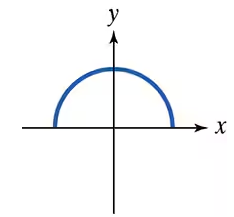
Which graphs in Exercises 29–34 represent functions that have inverse functions?
Graph of a semicircle above the x-axis centered at the origin on a coordinate plane.

Verified step by step guidance
1
Step 1: Understand the problem. We need to determine if the graph shown represents a function that has an inverse function.
Step 2: Recall the definition of a function having an inverse. A function has an inverse if and only if it is one-to-one, meaning it passes the Horizontal Line Test (no horizontal line intersects the graph more than once).
Step 3: Analyze the graph. The graph is a semicircle above the x-axis centered at the origin. This means for some x-values, there is exactly one y-value, but for others, the horizontal line will intersect the graph more than once.
Step 4: Apply the Horizontal Line Test. Since the semicircle is curved and symmetric, horizontal lines near the top of the semicircle will intersect the graph twice, failing the test.
Step 5: Conclusion: Because the graph fails the Horizontal Line Test, it does not represent a function that has an inverse function.

Verified video answer for a similar problem:

This video solution was recommended by our tutors as helpful for the problem above.
Video duration:
3m
Was this helpful?

Key Concepts

Here are the essential concepts you must grasp in order to answer the question correctly.

Definition of a Function

A function assigns exactly one output value for each input value. This means that for every x-value in the domain, there is only one corresponding y-value. Understanding this is essential to determine if a graph represents a function.
Recommended video:
5:57
Graphs of Common Functions

Horizontal Line Test

The horizontal line test is used to determine if a function has an inverse that is also a function. If any horizontal line intersects the graph more than once, the function fails the test and does not have an inverse function.
Recommended video:
Guided course
06:49
The Slope of a Line

Inverse Functions

An inverse function reverses the roles of inputs and outputs of the original function. For a function to have an inverse function, it must be one-to-one, meaning each output corresponds to exactly one input.
Recommended video:
4:30
Graphing Logarithmic Functions