Solve each exponential equation in Exercises 1–22 by expressing each side as a power of the same base and then equating exponents. 42x−1=64
Ch. 4 - Exponential and Logarithmic Functions

Chapter 5, Problem 9
In Exercises 5–9, graph f and g in the same rectangular coordinate system. Use transformations of the graph of f to obtain the graph of g. Graph and give equations of all asymptotes. Use the graphs to determine each function's domain and range. f(x) = ex and g(x) = 2ex/2
Verified step by step guidance1
Identify the base function and the transformed function. Here, the base function is \(f(x) = e^{x}\), and the transformed function is \(g(x) = 2e^{\frac{x}{2}}\).
Analyze the transformation from \(f(x)\) to \(g(x)\). The exponent changes from \(x\) to \(\frac{x}{2}\), which represents a horizontal stretch by a factor of 2, and the coefficient 2 in front of the exponential represents a vertical stretch by a factor of 2.
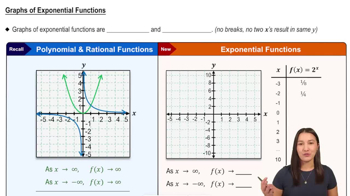
Graph \(f(x) = e^{x}\) first. This graph passes through the point \((0,1)\), increases exponentially, and has a horizontal asymptote at \(y=0\).
Apply the transformations to graph \(g(x)\). Stretch the graph of \(f(x)\) horizontally by a factor of 2 (so points like \((x, e^{x})\) become \((2x, e^{x})\)), then stretch vertically by a factor of 2 (multiply the \(y\)-values by 2).
Determine the asymptotes, domain, and range for both functions. Both have a horizontal asymptote at \(y=0\). The domain of both functions is all real numbers \((-\infty, \infty)\). The range of \(f(x)\) is \((0, \infty)\), and since \(g(x)\) is a vertical stretch of \(f(x)\), its range is also \((0, \infty)\).

Verified video answer for a similar problem:
This video solution was recommended by our tutors as helpful for the problem above.
Video duration:
10mWas this helpful?
Key Concepts
Here are the essential concepts you must grasp in order to answer the question correctly.
Exponential Functions and Their Graphs
Exponential functions have the form f(x) = a^x, where the variable is in the exponent. The graph of f(x) = e^x is a smooth curve increasing rapidly for positive x and approaching zero for negative x. Understanding this base graph is essential for applying transformations and analyzing behavior.
Recommended video:
Graphs of Exponential Functions
Transformations of Functions
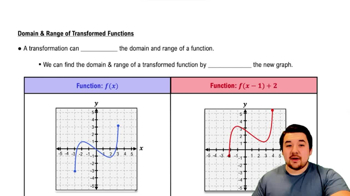
Transformations include shifts, stretches, compressions, and reflections applied to a base graph. For g(x) = 2e^(x/2), the factor 2 vertically stretches the graph, and the exponent x/2 horizontally stretches it. Recognizing these changes helps in sketching g from f and understanding how the graph changes.
Recommended video:
Domain & Range of Transformed Functions
Asymptotes, Domain, and Range of Exponential Functions
Exponential functions like f(x) = e^x have a horizontal asymptote, typically y = 0, which the graph approaches but never touches. The domain is all real numbers, while the range is positive real numbers. Identifying asymptotes and determining domain and range are key to fully describing the function's behavior.
Recommended video:
Domain & Range of Transformed Functions
Related Practice
Textbook Question
747
views
Textbook Question
In Exercises 1–10, approximate each number using a calculator. Round your answer to three decimal places. e2.3
1050
views
Textbook Question
Use properties of logarithms to expand each logarithmic expression as much as possible. Where possible, evaluate logarithmic expressions without using a calculator. log(x/100)
1085
views
Textbook Question
Solve each exponential equation in Exercises 1–22 by expressing each side as a power of the same base and then equating exponents. 32x=8
697
views
Textbook Question
Use properties of logarithms to expand each logarithmic expression as much as possible. Where possible, evaluate logarithmic expressions without using a calculator. log7 (7/x)
985
views
Textbook Question
In Exercises 1–10, approximate each number using a calculator. Round your answer to three decimal places. e-0.95
882
views