Use the graphs of the arithmetic sequences {a} and {b} to solve Exercises 51-58. If {an} is a finite sequence whose last term is -83, how many terms does {an} contain?
Ch. 8 - Sequences, Induction, and Probability

Chapter 9, Problem 51
Express each sum using summation notation. Use as the lower limit of summation and for the index of summation.
Verified step by step guidance1
Identify the pattern in the given sum: the first term is \(4\), the second term is \(\frac{4^2}{2}\), the third term is \(\frac{4^3}{3}\), and so on, up to \(\frac{4^n}{n}\).
Notice that each term can be written as \(\frac{4^i}{i}\), where \(i\) is the index of summation starting from 1 and going up to \(n\).
Since the problem asks to express the sum using summation notation with lower limit 1 and index \(i\), write the sum as \(\sum_{i=1}^n \frac{4^i}{i} \).
This notation compactly represents the entire sum from the first term to the \(n\)-th term, capturing the pattern of powers of 4 divided by their respective indices.
Thus, the summation notation for the given sum is \(\sum_{i=1}^n \frac{4^i}{i} \).

Verified video answer for a similar problem:
This video solution was recommended by our tutors as helpful for the problem above.
Video duration:
3mWas this helpful?
Key Concepts
Here are the essential concepts you must grasp in order to answer the question correctly.
Summation Notation
Summation notation is a concise way to represent the sum of a sequence of terms using the sigma symbol (∑). It includes an index of summation, lower and upper limits, and a general term formula. This notation simplifies writing long sums and helps in analyzing series.
Recommended video:
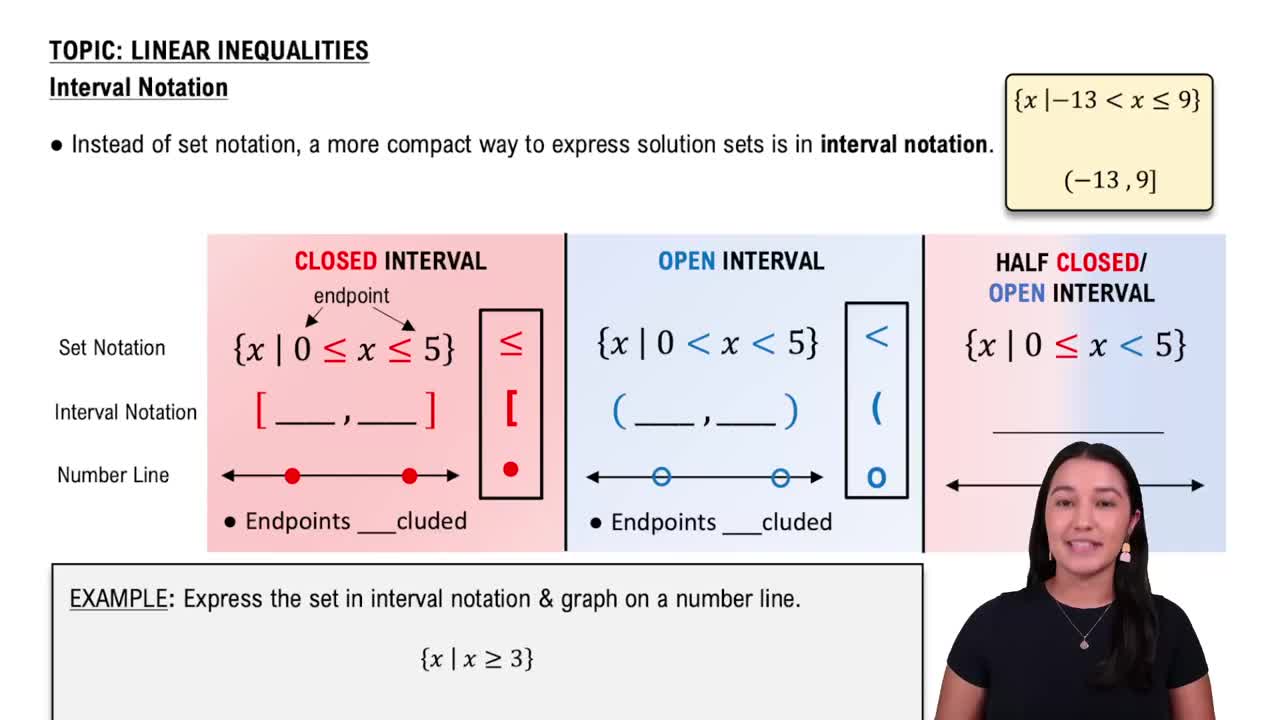
Interval Notation
Index of Summation and Limits
The index of summation (commonly i) represents the variable that changes in each term of the sum. The lower limit indicates where the summation starts (here, 1), and the upper limit (n) shows where it ends. Properly setting these limits is essential for accurately expressing the sum.
Recommended video:
Guided course
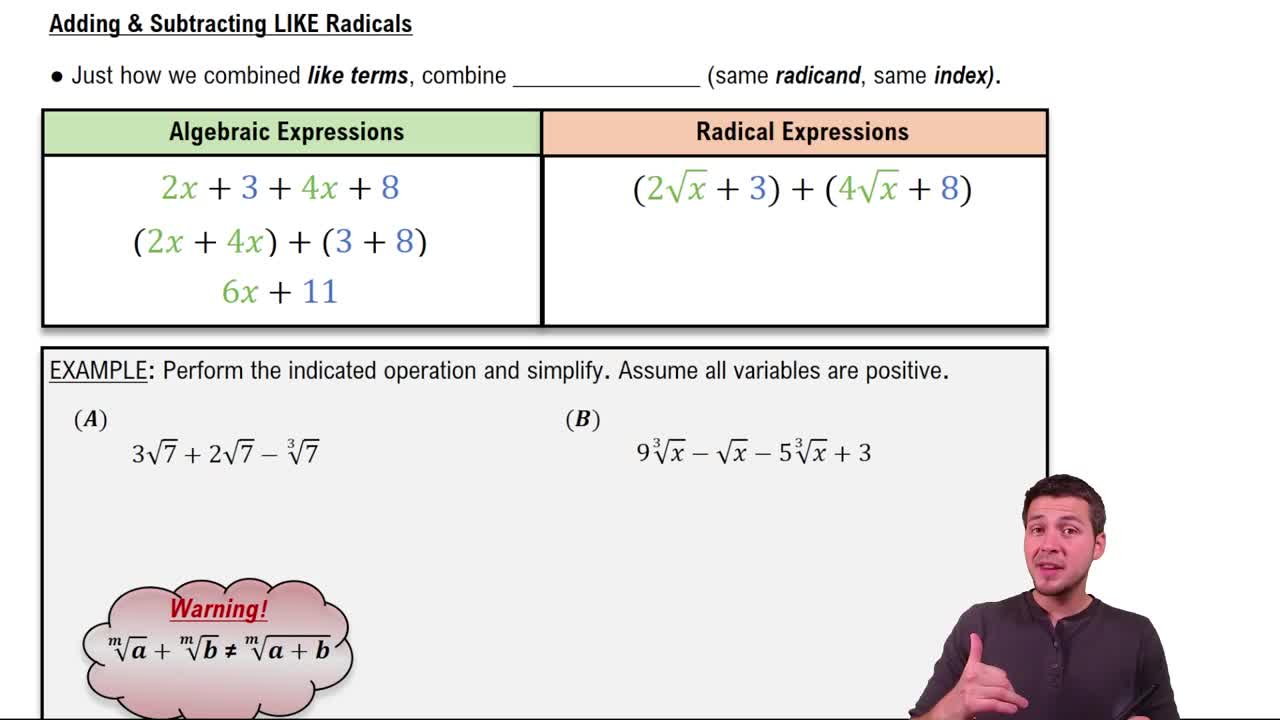
Adding & Subtracting Like Radicals
General Term of a Series
The general term defines the formula for each term in the sum based on the index. In this problem, each term is of the form 4^i divided by i. Identifying this pattern allows you to write the entire sum compactly using summation notation.
Recommended video:
Guided course
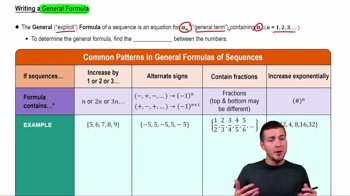
Writing a General Formula
Related Practice
Textbook Question
939
views
Textbook Question
In Exercises 49–52, a single die is rolled twice. Find the probability of rolling an even number the first time and a number greater than 2 the second time.
673
views
Textbook Question
The general term of a sequence is given. Determine whether the sequence is arithmetic, geometric, or neither. If the sequence is arithmetic, find the common difference; if it is geometric, find the common ratio. an = n + 5
964
views
Textbook Question
Use the Binomial Theorem to expand each expression and write the result in simplified form. (x1/3 +x-1/3)3
635
views
Textbook Question
Use the graphs of the arithmetic sequences {a} and {b} to solve Exercises 51-58.
Find a14+b12.
1232
views
Textbook Question
Use the formula for nCr to solve Exercises 49–56. Of 12 possible books, you plan to take 4 with you on vacation. How many different collections of 4 books can you take?
893
views