
Textbook Question
Solve each inequality. Give the solution set in interval notation. 4/(x+6)>2/(x-1)
515
views

 Verified step by step guidance
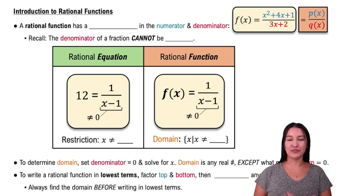
 6:04
6:04
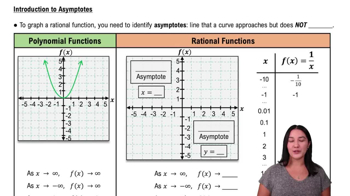 6:24
6:24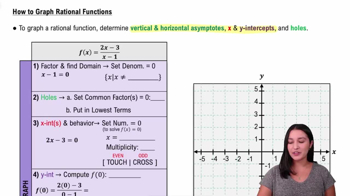 8:19
8:19Solve each inequality. Give the solution set in interval notation. 4/(x+6)>2/(x-1)
Determine the different possibilities for the numbers of positive, negative, and nonreal complex zeros of each function.
Use a graphing calculator to find the coordinates of the turning points of the graph of each polynomial function in the given domain interval. Give answers to the nearest hundredth. ƒ(x)=x4-7x3+13x2+6x-28; [-1, 0]
Determine the different possibilities for the numbers of positive, negative, and nonreal complex zeros of each function.
A quadratic equation ƒ(x) = 0 has a solution x = 2. Its graph has vertex (5, 3). What is the other solution of the equation?
Use a graphing calculator to find the coordinates of the turning points of the graph of each polynomial function in the given domain interval. Give answers to the nearest hundredth. ƒ(x)=x3+4x2-8x-8; [-3.8, -3]