Ch. 4 - Exponential and Logarithmic Functions
Blitzer - College Algebra 8th Edition
Blitzer8th EditionCollege AlgebraISBN: 9780136970514Not the one you use?Change textbook
Chapter 5, Problem 4

Write each equation in its equivalent exponential form. 2 = log9 x

Verified step by step guidance
1
Recall the definition of logarithm: if \(y = \log_b x\), then the equivalent exponential form is \(b^y = x\).
Identify the base \(b\), the exponent \(y\), and the result \(x\) from the given equation \(2 = \log_9 x\).
Here, the base \(b\) is 9, the exponent \(y\) is 2, and the result \(x\) is the unknown.
Rewrite the logarithmic equation \(2 = \log_9 x\) in exponential form using the formula: \$9^2 = x$.
This gives the equivalent exponential equation, which expresses \(x\) in terms of the base and exponent.

Verified video answer for a similar problem:

This video solution was recommended by our tutors as helpful for the problem above.
Video duration:
1m
Was this helpful?

Key Concepts

Here are the essential concepts you must grasp in order to answer the question correctly.

Definition of Logarithms

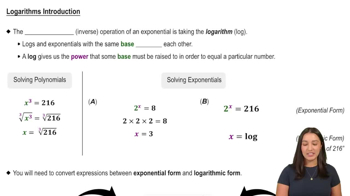
A logarithm answers the question: to what exponent must the base be raised to produce a given number? For example, log base 9 of x equals 2 means 9 raised to the power 2 equals x. Understanding this definition is essential to convert between logarithmic and exponential forms.
Recommended video:
7:30
Logarithms Introduction

Conversion Between Logarithmic and Exponential Forms

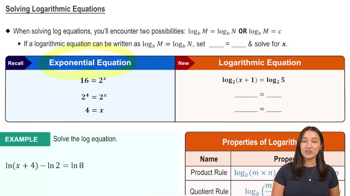
Every logarithmic equation can be rewritten as an equivalent exponential equation. The general form log_b(a) = c is equivalent to b^c = a. This conversion is key to solving or rewriting logarithmic expressions in exponential terms.
Recommended video:
5:02
Solving Logarithmic Equations

Properties of Exponents

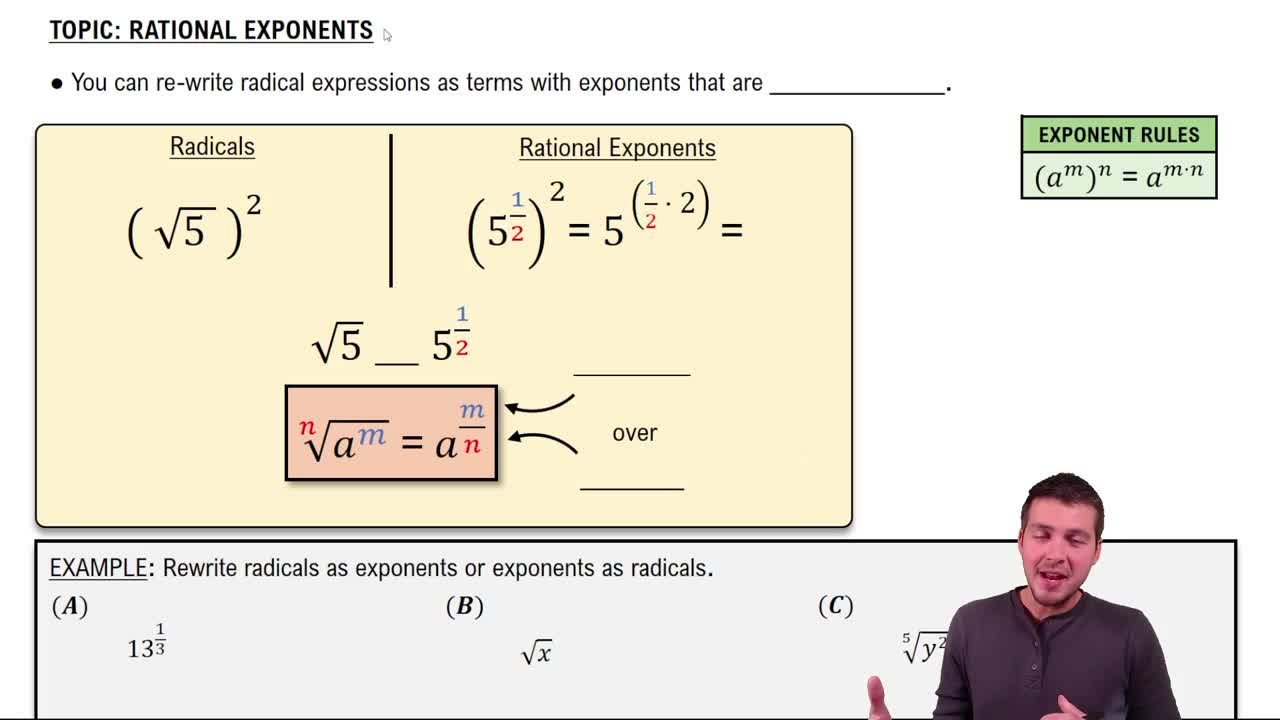
Exponents represent repeated multiplication of a base number. Knowing how to interpret and manipulate exponents, such as understanding that b^c means multiplying b by itself c times, helps in correctly expressing and simplifying exponential forms derived from logarithmic equations.
Recommended video:
Guided course
04:06
Rational Exponents