Let U = {0, 1, 2, 3, 4, 5, 6, 7, 8, 9, 10, 11, 12, 13}, M = {0, 2, 4, 6, 8}, N = {1, 3, 5, 7, 9, 11, 13}, Q = {0, 2, 4, 6, 8, 10, 12}, and R = {0, 1, 2, 3, 4}.Use these sets to find each of the following. Identify any disjoint sets. M′ ∩ Q
Table of contents
- 0. Review of Algebra4h 18m
- 1. Equations & Inequalities3h 18m
- 2. Graphs of Equations1h 43m
- 3. Functions2h 17m
- 4. Polynomial Functions1h 44m
- 5. Rational Functions1h 23m
- 6. Exponential & Logarithmic Functions2h 28m
- 7. Systems of Equations & Matrices4h 5m
- 8. Conic Sections2h 23m
- 9. Sequences, Series, & Induction1h 22m
- 10. Combinatorics & Probability1h 45m
0. Review of Algebra
Exponents
Problem 93
Textbook Question
Evaluate each expression. (4-2³)(-2+√25)
Verified step by step guidance1
First, evaluate the exponent in the expression: calculate \$2^3\( which means \)2\( raised to the power of \)3$.
Next, perform the subtraction inside the first parentheses: compute \$4 - 2^3$ using the value found in the previous step.
Then, evaluate the square root in the second parentheses: calculate \(\sqrt{25}\), which is the number that when squared gives \$25$.
After that, perform the addition inside the second parentheses: compute \(-2 + \sqrt{25}\) using the value from the previous step.
Finally, multiply the results from the two parentheses together to find the value of the entire expression \((4 - 2^3)(-2 + \sqrt{25})\).
Verified video answer for a similar problem:This video solution was recommended by our tutors as helpful for the problem above
Video duration:
2mPlay a video:
Was this helpful?
Key Concepts
Here are the essential concepts you must grasp in order to answer the question correctly.
Order of Operations
The order of operations dictates the sequence in which mathematical operations are performed to ensure consistent results. It follows the PEMDAS/BODMAS rules: Parentheses, Exponents, Multiplication and Division (left to right), Addition and Subtraction (left to right). Applying this correctly is essential to evaluate expressions accurately.
Recommended video:
Guided course
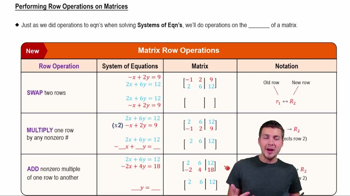
Performing Row Operations on Matrices
Exponents
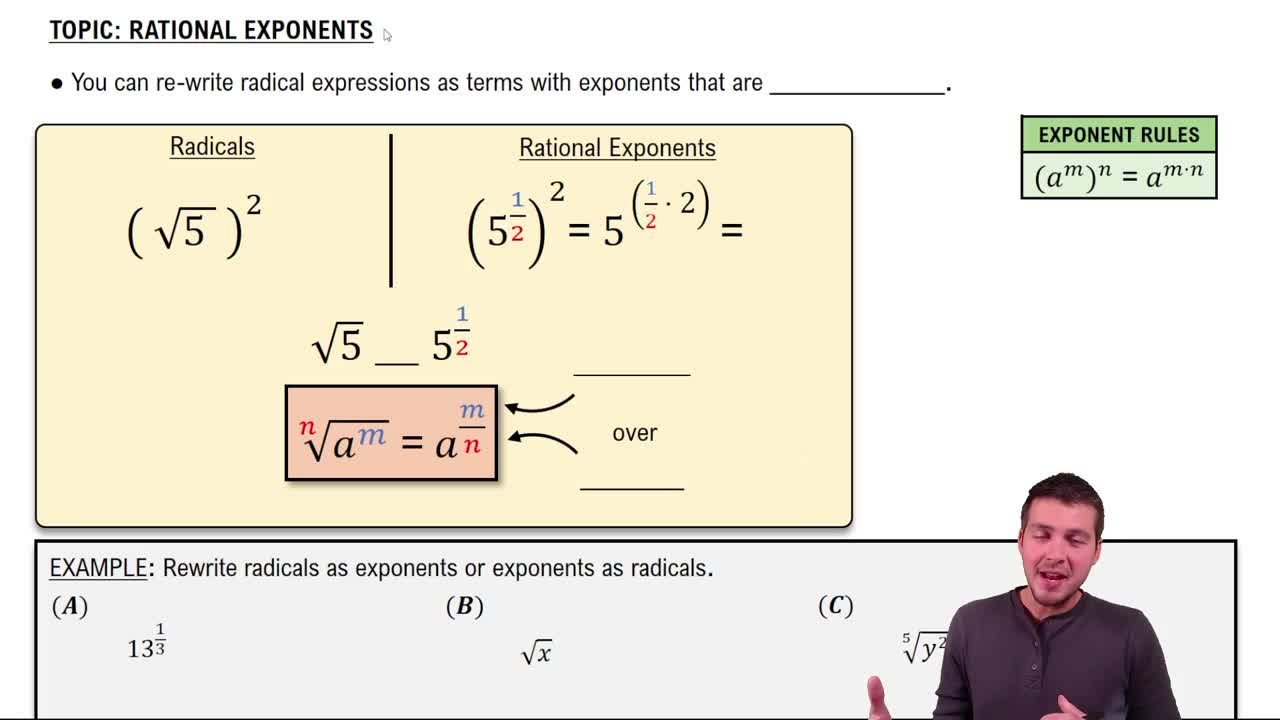
Exponents represent repeated multiplication of a base number. For example, 2³ means 2 multiplied by itself three times (2 × 2 × 2 = 8). Understanding how to calculate powers is crucial when evaluating expressions involving exponents.
Recommended video:
Guided course
Rational Exponents
Square Roots
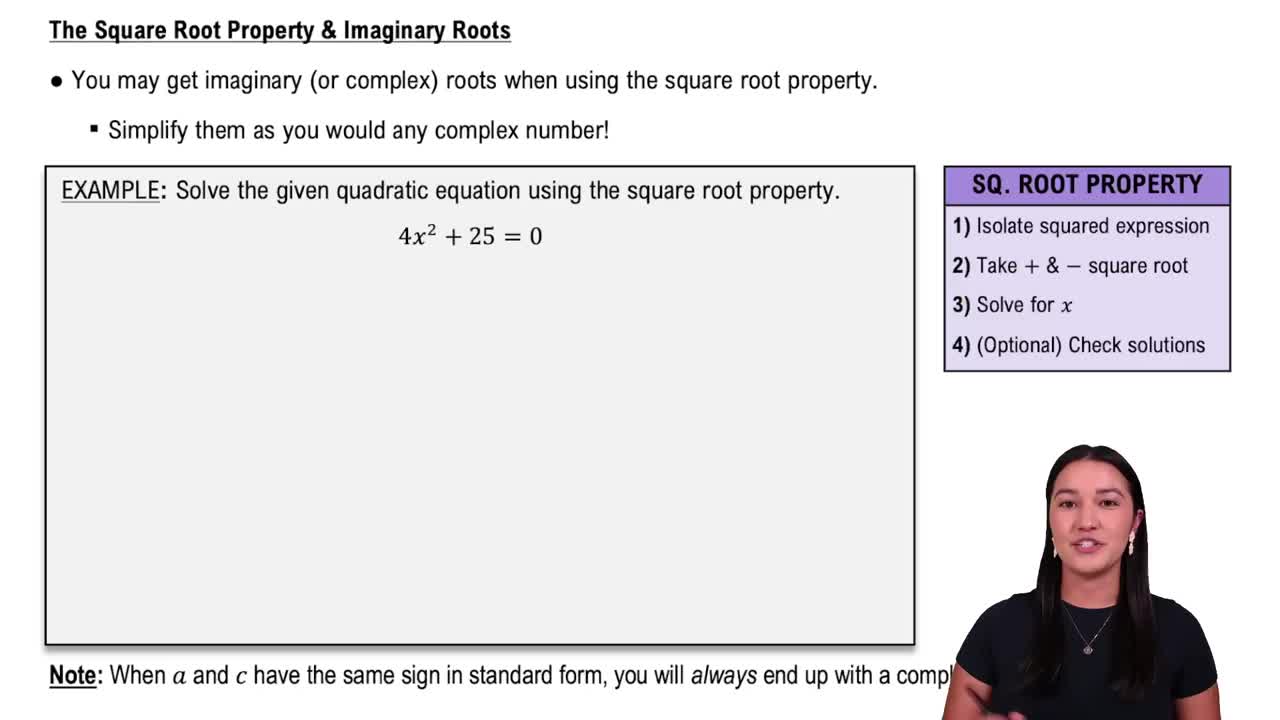
The square root of a number is a value that, when multiplied by itself, gives the original number. For instance, √25 equals 5 because 5 × 5 = 25. Recognizing and simplifying square roots helps in evaluating expressions involving radicals.
Recommended video:
Imaginary Roots with the Square Root Property
Watch next
Master Introduction to Exponent Rules with a bite sized video explanation from Patrick
Start learningRelated Videos
Related Practice
Textbook Question
691
views