Ch. 4 - Exponential and Logarithmic Functions
Blitzer - College Algebra 8th Edition
Blitzer8th EditionCollege AlgebraISBN: 9780136970514Not the one you use?Change textbook
Chapter 5, Problem 76

In Exercises 74–79, solve each logarithmic equation. log2 (x+3) + log2 (x-3) =4

Verified step by step guidance
1
Step 1: Use the logarithmic property for addition, \( \log_b(A) + \log_b(B) = \log_b(A \cdot B) \), to combine the two logarithmic terms. The equation becomes \( \log_2((x+3)(x-3)) = 4 \).
Step 2: Simplify the expression \((x+3)(x-3)\) using the difference of squares formula, \( (a+b)(a-b) = a^2 - b^2 \). This gives \( \log_2(x^2 - 9) = 4 \).
Step 3: Rewrite the logarithmic equation in its exponential form. Recall that \( \log_b(A) = C \) implies \( b^C = A \). Here, \( 2^4 = x^2 - 9 \).
Step 4: Solve for \( x^2 \) by calculating \( 2^4 \), which equals 16, and then adding 9 to both sides of the equation. This gives \( x^2 = 16 + 9 \).
Step 5: Solve for \( x \) by taking the square root of both sides. Remember to include both the positive and negative roots, as \( x \) can be either \( \sqrt{25} \) or \( -\sqrt{25} \). Finally, check the solutions to ensure they do not make the original logarithmic expressions undefined.

Verified video answer for a similar problem:

This video solution was recommended by our tutors as helpful for the problem above.
Video duration:
3m
Was this helpful?

Key Concepts

Here are the essential concepts you must grasp in order to answer the question correctly.

Logarithmic Properties

Understanding the properties of logarithms is essential for solving logarithmic equations. Key properties include the product rule, which states that log_b(m) + log_b(n) = log_b(m*n), and the power rule, which states that k*log_b(m) = log_b(m^k). These properties allow us to combine or simplify logarithmic expressions, making it easier to isolate the variable.
Recommended video:
5:36
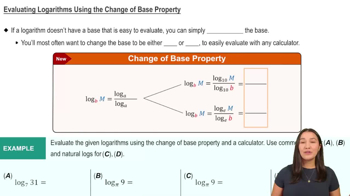
Change of Base Property

Exponential Form

Logarithmic equations can often be solved by converting them into exponential form. For example, if log_b(a) = c, then a = b^c. This transformation is crucial for isolating the variable in the equation, as it allows us to express the logarithmic relationship in a more straightforward algebraic form.
Recommended video:
6:13
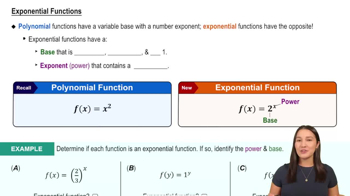
Exponential Functions

Domain of Logarithmic Functions

The domain of a logarithmic function is restricted to positive real numbers. In the equation log2(x+3) + log2(x-3) = 4, both x+3 and x-3 must be greater than zero. This means that x must be greater than 3 for the logarithmic expressions to be defined, which is an important consideration when solving the equation.
Recommended video:
5:26
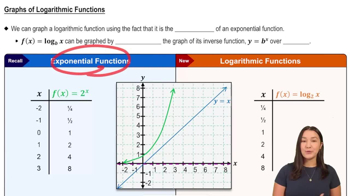
Graphs of Logarithmic Functions